


Screening for gene-environment (G×E) interaction using omics data from exposed individuals: an application to gene-arsenic interaction
- PMID: 29453499
- PMCID: PMC5908479
- DOI: 10.1007/s00335-018-9737-8
Screening for gene-environment (G×E) interaction using omics data from exposed individuals: an application to gene-arsenic interaction
Abstract
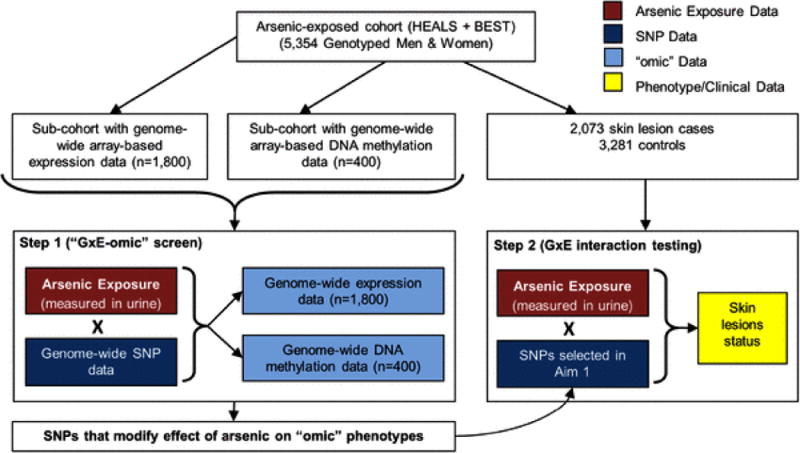
Identifying gene-environment interactions is a central challenge in the quest to understand susceptibility to complex, multi-factorial diseases. Developing an understanding of how inter-individual variability in inherited genetic variation alters the effects of environmental exposures will enhance our knowledge of disease mechanisms and improve our ability to predict disease and target interventions to high-risk sub-populations. Limited progress has been made identifying gene-environment interactions in the epidemiological setting using existing statistical approaches for genome-wide searches for interaction. In this paper, we describe a novel two-step approach using omics data to conduct genome-wide searches for gene-environment interactions. Using existing genome-wide SNP data from a large Bangladeshi cohort study specifically designed to assess the effect of arsenic exposure on health, we evaluated gene-arsenic interactions by first conducting genome-wide searches for SNPs that modify the effect of arsenic on molecular phenotypes (gene expression and DNA methylation features). Using this set of SNPs showing evidence of interaction with arsenic in relation to molecular phenotypes, we then tested SNP-arsenic interactions in relation to skin lesions, a hallmark characteristic of arsenic toxicity. With the emergence of additional omics data in the epidemiologic setting, our approach may have the potential to boost power for genome-wide interaction research, enabling the identification of interactions that will enhance our understanding of disease etiology and our ability to develop interventions targeted at susceptible sub-populations.
Conflict of interest statement
The authors have no conflicts of interest, financial or otherwise.
Figures
References
-
-
IARC. http://www.inchem.org/documents/iarc/vol84/84-01-arsenic.html. 2004;84(39).
-
Publication types
MeSH terms
Substances
Grants and funding
LinkOut - more resources
Full Text Sources
Other Literature Sources
Medical
