


Fluoridation advocacy in referenda where media coverage is balanced yet biased
- PMID: 29454461
- PMCID: PMC5878108
- DOI: 10.1016/j.adaj.2017.10.016
Fluoridation advocacy in referenda where media coverage is balanced yet biased
Abstract
Background: Despite supporting scientific evidence, community water fluoridation (CWF) often fails in public referenda. To understand why, the authors quantitatively analyzed text from news media coverage of CWF referenda.
Methods: The authors analyzed text from 234 articles covering 11 CWF referenda conducted in 3 US cities from 1956 through 2013. The authors used cluster analysis to identify each article's core rhetoric and classified it according to sentiment and tone. The authors used multilevel count regression models to measure the use of positive and negative words regarding CWF.
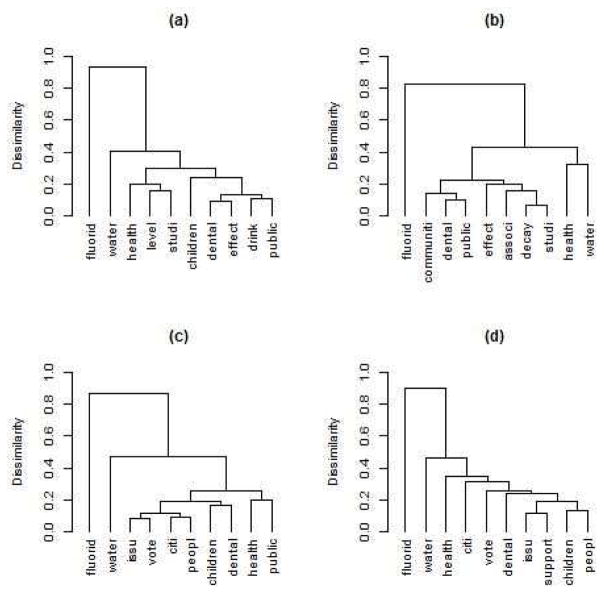
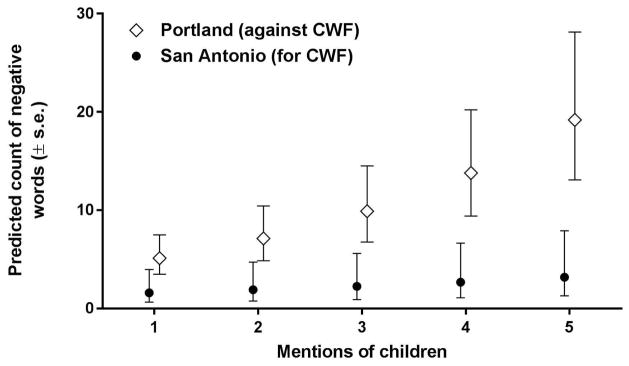
Results: Media coverage more closely resembled core rhetoric used by fluoridation opponents than the rhetoric used by fluoridation proponents. Despite the scientific evidence, the media reports were balanced in tone and sentiment for and against CWF. However, in articles emphasizing children, greater negative sentiment was associated with CWF rejection.
Conclusions: Media coverage depicted an artificial balance of evidence and tone in favor of and against CWF. The focus on children was associated with more negative tone in cities where voters rejected CWF.
Practical implications: When speaking to the media, advocates for CWF should emphasize benefits for children and use positive terms about dental health rather than negative terms about dental disease.
Keywords: Fluoridation; drinking water; health promotion; public health and community dentistry; public opinion.
Copyright © 2018 American Dental Association. Published by Elsevier Inc. All rights reserved.
Figures
References
-
- Centers for Disease Control and Prevention (CDC) Ten great public health achievements--United States, 1900–1999. Morb Mortal Wkly Rep. 1999;48(12):241–243. - PubMed
-
- Hochschild JL, Einstein KL. Do facts matter? Information and misinformation in American politics. Polit Sci Q. 2015;130(4):585–624.
-
- Metz AS. An analysis of some determinants of attitude toward fluoridation. Soc Forces. 1966;44(4):477–484.
-
- Martin B. The sociology of the fluoridation controversy: A reexamination. Sociol Q. 1989;30(1):59–76.
-
- Bennett WL. Toward a theory of press-state relations in the United States. J Commun. 1990;40(2):103–127.
Bibliography
-
- Long S. Regression Models for Categorical and Limited Dependent Variables. Thousand Oaks, CA: SAGE Publications; 1997. pp. 217–250.
-
- Bolker BM, Brooks ME, Clark CJ, Geange SW, Poulsen JR, Stevens MHH, White JSS. Generalized linear mixed models: a practical guide for ecology and evolution. Trends in Ecology and Evolution. 2009;24:127–135. - PubMed
-
- Harrison XA. Using observation level random effects to model overdispersion in count data in ecology and evolution. [Accessed July 29, 2017];PeerJ. 2014 2 Available at http://doi.org/10.7717/peerj.616. - DOI - PMC - PubMed
MeSH terms
Grants and funding
LinkOut - more resources
Full Text Sources
Other Literature Sources
Medical
