


A CREB-mediated increase in miRNA let-7f during prolonged β-agonist exposure: a novel mechanism of β2-adrenergic receptor down-regulation in airway smooth muscle
- PMID: 29455573
- PMCID: PMC5998966
- DOI: 10.1096/fj.201701278R
A CREB-mediated increase in miRNA let-7f during prolonged β-agonist exposure: a novel mechanism of β2-adrenergic receptor down-regulation in airway smooth muscle
Abstract
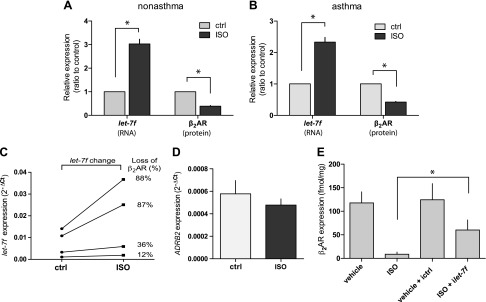
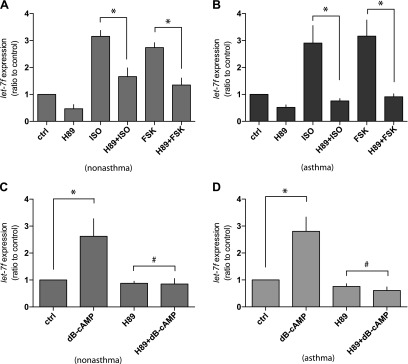
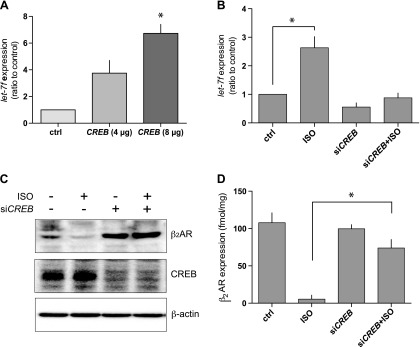
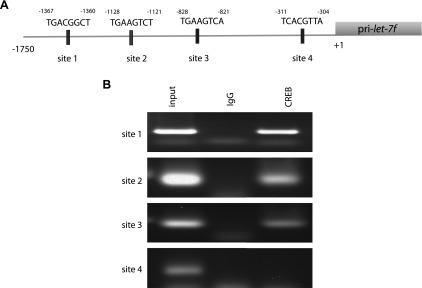
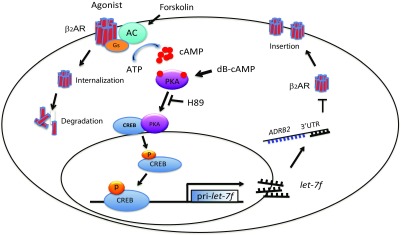
β2-Adrenergic receptors (β2ARs) desensitize during continuous agonist activation, which manifests clinically as tachyphylaxis. β-Agonist desensitization of β2ARs in human airway smooth muscle (HASM) cells is recognized in the treatment of asthma and may be related to poor outcomes. Rapid events in desensitization include receptor phosphorylation and internalization, but mechanisms responsible for the decrease in receptor protein after prolonged agonist exposure (down-regulation) are ill defined. The microRNA (miRNA) let-7f regulates β2AR expression by translational repression. In cultured HASM cells from nonasthmatic and asthmatic lungs, 18 h of β-agonist exposure increased let-7f by 2-3-fold, concomitant with a ∼90% decrease in β2ARs. Inhibition of let-7f attenuated this down-regulation response by ∼50%. The let-7f increase was found to be cAMP/PKA-dependent. The mechanism of the let-7f increase was found by chromatin immunoprecipitation to be from activated cAMP response element-binding protein (CREB) binding to the let-7f promoter, thereby increasing let-7f expression. Knockdown of CREB attenuated agonist-promoted β2AR down-regulation by ∼50%. Thus, β2AR down-regulation occurs as a result of not only internalized receptor degradation but also a novel cAMP/PKA/CREB-mediated increase in let-7f, which causes enhanced repression of the β2AR gene, adrenoreceptor β2 ( ADRB2) translation and represents ∼50% of the net loss of receptors observed after prolonged agonist exposure. This mechanism is apparent in asthmatic HASM cells, indicating relevance in a disease model.-Kim, D., Cho, S., Woo, J. A., Liggett, S. B. A CREB-mediated increase in miRNA let-7f during prolonged β-agonist exposure: a novel mechanism of β2-adrenergic receptor down-regulation in airway smooth muscle.
Keywords: G protein; asthma; microRNA; tachyphylaxis.
Conflict of interest statement
The authors thank Ashley Goss, Maria Castano, and Tara Rosin for technical assistance, and Lisa Steward for manuscript preparation and editing (all from the University of South Florida). This work was funded by U.S. National Institutes of Health, National Heart, Lung, and Blood Institute Grants HL045967 and HL114471. The authors declare no conflicts of interest.
Figures
References
-
- Liggett S. B. (1991) Desensitization of the β-adrenergic receptor: distinct molecular determinants of phosphorylation by specific kinases. Pharmacol. Res. 24(Suppl 1), 29–41 - PubMed
-
- Kohout T. A., Lefkowitz R. J. (2003) Regulation of G protein–coupled receptor kinases and arrestins during receptor desensitization. Mol. Pharmacol. 63, 9–18 - PubMed
-
- Lohse M. J., Engelhardt S., Eschenhagen T. (2003) What is the role of β-adrenergic signaling in heart failure? Circ. Res. 93, 896–906 - PubMed
-
- Liggett S. B. (2011) Phosphorylation barcoding as a mechanism of directing GPCR signaling. Sci. Signal. 4, pe36 - PubMed
-
- Hanyaloglu A. C., von Zastrow M. (2008) Regulation of GPCRs by endocytic membrane trafficking and its potential implications. Annu. Rev. Pharmacol. Toxicol. 48, 537–568 - PubMed
Publication types
MeSH terms
Substances
Grants and funding
LinkOut - more resources
Full Text Sources
Other Literature Sources
Medical
Research Materials
