. 2018 Feb 19;17(1):24.
doi: 10.1186/s12943-018-0784-2.

The E3 ubiquitin ligase NEDD4 mediates cell migration signaling of EGFR in lung cancer cells

Affiliations

The E3 ubiquitin ligase NEDD4 mediates cell migration signaling of EGFR in lung cancer cells

Genbao Shao et al. Mol Cancer. .

Abstract

Background: EGFR-dependent cell migration plays an important role in lung cancer progression. Our previous study observed that the HECT E3 ubiquitin ligase NEDD4 is significantly correlated with tumor metastasis and required for migration and invasion signaling of EGFR in gastric cancer cells. However, how NEDD4 promotes the EGFR-dependent lung cancer cell migration is unknown. This study is to elucidate the mechanism by which NEDD4 mediates the EGFR lung cancer migration signaling.

Methods: Lentiviral vector-loaded NEDD4 shRNA was used to deplete endogenous NEDD4 in lung cancer cell lines. Effects of the NEDD4 knockdown on the EGFR-dependent or independent lung cancer cell migration were determined using the wound-healing and transwell assays. Association of NEDD4 with activated EGFR was assayed by co-immunoprecipitation. Co-expression of NEDD4 with EGFR or PTEN was determined by immunohistochemical (IHC) staining in 63 lung adenocarcinoma tissue samples. Effects of NEDD4 ectopic expression or knockdown on PTEN ubiquitination and down-regulation, AKT activation and lysosomal secretion were examined using the GST-Uba pulldown assay, immunoblotting, immunofluorescent staining and a human cathepsin B ELISA assay respectively. The specific cathepsin B inhibitor CA-074Me was used for assessing the role of cathepsin B in lung cancer cell migration.

Results: Knockdown of NEDD4 significantly reduced EGF-stimulated cell migration in non-small cell lung carcinoma (NSCLC) cells. Co-immunoprecipitation assay found that NEDD4 is associated with EGFR complex upon EGF stimulation, and IHC staining indicates that NEDD4 is co-expressed with EGFR in lung adenocarcinoma tumor tissues, suggesting that NEDD4 might mediate lung cancer cell migration by interaction with the EGFR signaling complex. Interestingly, NEDD4 promotes the EGF-induced cathepsin B secretion, possibly through lysosomal exocytosis, as overexpression of the ligase-dead mutant of NEDD4 impedes lysosomal secretion, and knockdown of NEDD4 significantly reduced extracellular amount of cathepsin B induced by EGF. Consistent with the role of NEDD4, cathepsin B is pivotal for both basal and the EGF-stimulated lung cancer cell migration. Our studies propose a novel mechanism underlying the EGFR-promoted lung cancer cell migration that is mediated by NEDD4 through regulation of cathepsin B secretion.

Conclusion: NEDD4 mediates the EGFR lung cancer cell migration signaling through promoting lysosomal secretion of cathepsin B.

Keywords: Cathepsin B; EGFR; Lung cancer cell migration; Lysosomal secretion; NEDD4.


Conflict of interest statement

Springer Nature remains neutral with regard to jurisdictional claims in published maps and institutional affiliations.

Figures

Fig. 1
Fig. 1
NEDD4 mediates EGFR-dependent lung cancer cell migration. a, Wound healing assay of A549 cell migration. Left top panel, the knockdown of NEDD4 by shNEDD4 (lane 2) and recovery of NEDD4 upon re-introducing NEDD4 cDNA in the knockdown cells (lane 3); NEDD4-HM, high molecular weight NEDD4; NEDD4-LM, low molecular weight NEDD4. Left bottom panel, the protein level of EGFR in the lung cancer cell lines A549 and H1650 shown by immunoblotting with the cell lysates. Middle panel, photo images of the cell migration. Right panel, quantification of the EGF-stimulated cell migration area occupied after 24 h from the data of three independent experiments using the imaging software Image J (NIH). The non-EGF-treated cell migration area was subtracted by the EGF-treated cell migration area to obtain the EGF-stimulated cell migration area. b, Transwell assay of A549 cell migration. Note that the small lightly-stained round dots are pores of the transwell plates (shNEDD4 panels). c, Wound healing assay of H1650 cells
Fig. 2
Fig. 2
NEDD4 is associated with activated EGFR. a, Co-immunoprecipitation of NEDD4 with activated EGFR in lung cancer cells. Lung cancer A549 or H358 cells were serum-starved for 12 h followed by stimulation with EGF (50 ng/ml) for indicated times. EGFR was immunoprecipitated with anti-EGFR (Mab528) and detected by immunoblotting with anti-EGFR (1005) (top panels). Co-immunoprecipitated NEDD4 was detected by immunoblotting with an anti-NEDD4 (second top panels). The level of EGFR and NEDD4 in the cell lysates was also detected by immunoblotting (middle and second bottom panels). Notice that EGFR in A549 and H358 cells has an EGF-induced degradation. b, Internalized EGFR is co-localized with NEDD4. A549 cells were serum-starved for 12 h followed by stimulation with EGF (50 ng/ml) for 0 or 60 min. The cells were immuno-stained with anti-EGFR (1005) (red) and anti-NEDD4 (green). Bar, 20 μM. c, Co-expression of NEDD4 with EGFR in lung adenocarcinoma tissue. The tissue microarray containing 63 lung adenocarcinoma section samples was immunohistochemically stained with anti-EGFR or anti-NEDD4
Fig. 3
Fig. 3
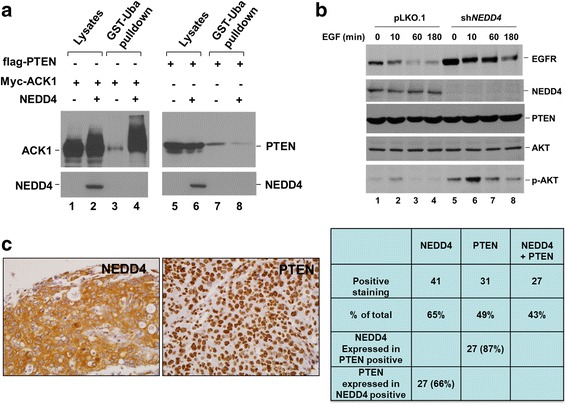
NEDD4 does not ubiquitinate and downregulate PTEN. a, NEDD4 was co-expressed with flag-PTEN or Myc-ACK1 by transfection in HEK293 cells. Ubiquitinated ACK1 or PTEN was precipitated with bead-bound GST-Uba from the cell lysates followed by immunoblotting with anti-Myc or anti-flag antibodies. b, Lung cancer A549 cells were infected with lenti-viral vector pLKO.1 or the vector-loaded shNEDD4. NEDD4 in the cell lysates was detected by immunoblotting with anti-NEDD4 (second top panel). The effect of knockdown NEDD4 on expression of PTEN and activation of AKT was assessed by immunoblotting PTEN AKT or phospho-AKT in the cell lysates with their antibodies respectively. c, Immunohistochemical (IHC) staining of 63 human lung adenocarcinoma tumors with anti-NEDD4 and anti-PTEN antibodies. The positive tumor samples were assessed and counted under microscope and listed in the table
Fig. 4
Fig. 4
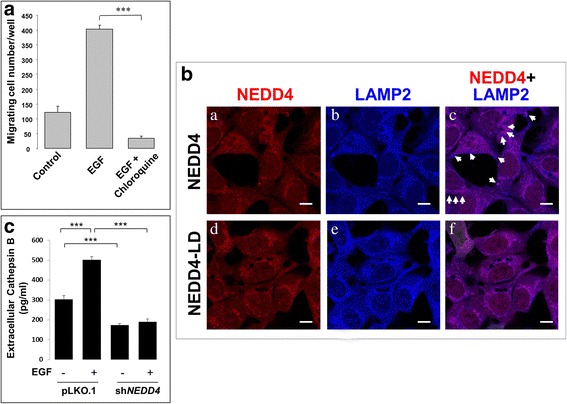
NEDD4 is required for EGF-stimulated lysosomal secretion of cathepsin B. a, Lysosomes function in lung cancer cell migration. A549 cells were resuspended in serum-free medium and used for transwell cell migration assay. The migration attractant was 10% fetal bovine serum plus or minus EGF (50 ng/ml). The lysosome inhibitors chloroquine (10 μM) was added in the medium with EGF. The cells migrated from the top well to the bottom well within 6 h. The migrated cells were stained and quantified as described in the section of Methods. b, Overexpression of the NEDD4 ligase-dead mutant NEDD4[C867A] eliminated the LAMP2-positive vesicles at cell edges. NEDD4 or the ligase-dead mutant was stably expressed in A549 cells. The cells were stimulated with EGF (50 ng/ml) for 30 min, followed by immunofluorescent staining. NEDD4 and LAMP2 were stained with anti-NEDD4 and anti-LAMP2. The white arrows indicate the putative lysosomal secretion vesicles. NEDD4-LD stands for the ligase-dead mutant of NEDD4, NEDD4[C867A]. Bar, 20 μM. c, The culture medium collected from the vector control or shNEDD4 cells treated with or without EGF for 12 h was used for detection of cathepsin B with a human cathepsin B ELISA assay kit. The assay was repeated three times. ***, p < 0.001
Fig. 5
Fig. 5
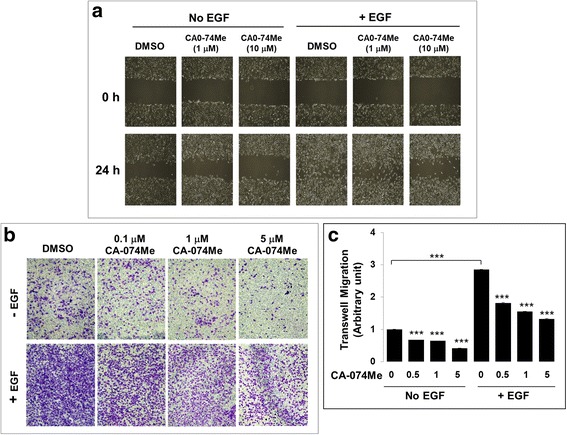
Cathepsin B plays an important role in lung cancer cell migration. a, The effect of the cathepsin B inhibitor CA-074Me on the EGF-stimulated lung cancer A549 cell migration determined by the wound healing assay. b, The effect of the cathepsin B inhibitor CA-074Me on the EGF-stimulated lung cancer A549 cell migration determined by the transwell assay. c, Quantification of the data from three independent transwell migration experiments. The statistics was performed with the treatment sample vs its control. ***, p < 0.001
Fig. 6
Fig. 6
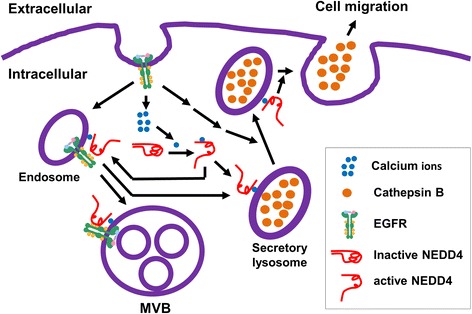
A proposed pathway of the NEDD4-mediated EGFR-dependent cell migration. Activated EGFR signaling elevates cytoplasmic calcium level and subsequently activates NEDD4. The activated NEDD4 is recruited to the EGFR endosomal complex and the secretary lysosomal vesicles, where NEDD4 interacts with and ubiquitinates the ESCRT complex to facilitate the engulfment of EGFR into MVB and the secretion of lysosmal cathepsin B to extracellular matrix. The secreted lysosomal cathepsin B hydrolyzes cell matrix/junction proteins and promotes cell migration

References

    1. Staub O, Gautschi I, Ishikawa T, Breitschopf K, Ciechanover A, Schild L, Rotin D. Regulation of stability and function of the epithelial Na+ channel (ENaC) by ubiquitination. EMBO J. 1997;16(21):6325–6336. doi: 10.1093/emboj/16.21.6325. - DOI - PMC - PubMed
    1. Staub O, Dho S, Henry P, Correa J, Ishikawa T, McGlade J, Rotin DWW. Domains of Nedd4 bind to the proline-rich PY motifs in the epithelial Na+ channel deleted in Liddle's syndrome. EMBO J. 1996;15(10):2371–2380. - PMC - PubMed
    1. Persaud A, Alberts P, Amsen EM, Xiong X, Wasmuth J, Saadon Z, Fladd C, Parkinson J, Rotin D. Comparison of substrate specificity of the ubiquitin ligases Nedd4 and Nedd4-2 using proteome arrays. Mol Syst Biol. 2009;5:333. doi: 10.1038/msb.2009.85. - DOI - PMC - PubMed
    1. Boase NA, Kumar S. NEDD4: the founding member of a family of ubiquitin-protein ligases. Gene. 2015;557(2):113–122. doi: 10.1016/j.gene.2014.12.020. - DOI - PMC - PubMed
    1. Ren J, Kee Y, Huibregtse JM, Piper RC. Hse1, a component of the yeast Hrs-STAM ubiquitin-sorting complex, associates with ubiquitin peptidases and a ligase to control sorting efficiency into multivesicular bodies. Mol Biol Cell. 2007;18(1):324–335. doi: 10.1091/mbc.E06-06-0557. - DOI - PMC - PubMed

Publication types

MeSH terms