. 2018 Feb 27;22(9):2254-2264.
doi: 10.1016/j.celrep.2018.02.009. Epub 2018 Feb 15.

The Coding Regions of Germline mRNAs Confer Sensitivity to Argonaute Regulation in C. elegans

Affiliations

The Coding Regions of Germline mRNAs Confer Sensitivity to Argonaute Regulation in C. elegans

Meetu Seth et al. Cell Rep. .

Abstract

Protein-coding genes undergo a wide array of regulatory interactions with factors that engage non-coding regions. Open reading frames (ORFs), in contrast, are thought to be constrained by coding function, precluding a major role in gene regulation. Here, we explore Piwi-interacting (pi)RNA-mediated transgene silencing in C. elegans and show that marked differences in the sensitivity to piRNA silencing map to the endogenous sequences within transgene ORFs. Artificially increasing piRNA targeting within the ORF of a resistant transgene can lead to a partial yet stable reduction in expression, revealing that piRNAs not only silence but can also "tune" gene expression. Our findings support a model that involves a temporal element to mRNA regulation by germline Argonautes, likely prior to translation, and suggest that piRNAs afford incremental control of germline mRNA expression by targeting the body of the mRNA, including the coding region.

Keywords: Argonautes; C. elegans; P granules; gene expression; nonsense-mediated decay; perinuclear germline nuage; piRNAs.


Conflict of interest statement

DECLARATION OF INTERESTS

The authors declare no competing interests.

Figures
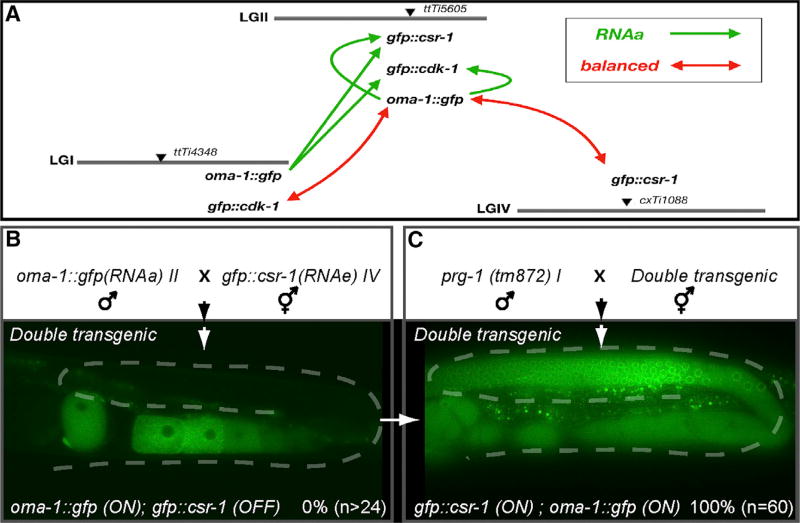
Figure 1
Figure 1. Balanced Silencing and Activation Signals
(A) Transgene insertion at different chromosomal locations by MOSCI (see Supplemental Experimental Procedures) and summarizing the interactions between transgenes inserted at these locations. (B and C) Epifluorescence image of representative germlines (outlined with dashes) within transgenic strains (as indicated). The cytoplasmic fluorescence signal is OMA-1::GFP; the P granule signal is GFP::CSR-1. The percentages indicate the number of animals that exhibited the expression of GFP::CSR-1 in the wild-type and prg-1 (tm872) mutant after at least two generations of maintenance of the double transgenic strains. See also Figure S1.
Figure 2
Figure 2. Transgenes Differ in Their Responses to piRNA Targeting
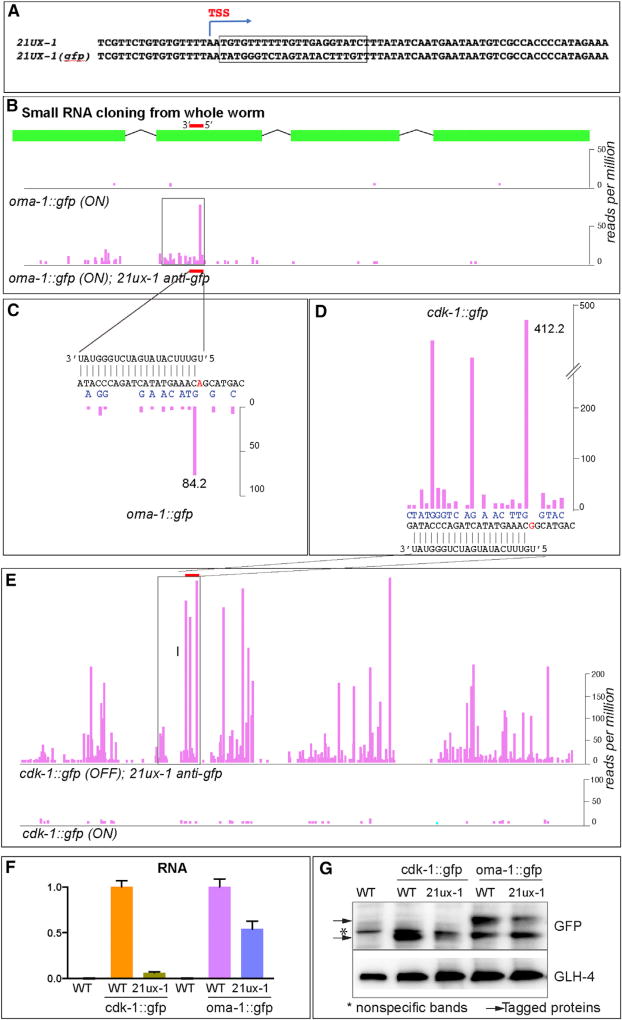
(A) Schematic representing the replacement of 21ux-1 with an anti-gfp sequence. (B–E) Schematics showing plots of small RNA species induced along gfp in oma-1::gfp (B) and in cdk-1::gfp (E) transgenic animals. Each bar indicates the 5′ end of a small RNA species, and the height indicates abundance in reads per million. In (B), the upper plot shows the very low density of 22G-RNAs detected in oma-1::gfp wild-type transgenic animals, while the lower plot shows locally induced 22G-RNAs in 21ux-1(anti-gfp) animals. In (C) and (D), 21ux-1(anti-gfp) is shown base-paired to the gfp sequence, and induced small RNAs are plotted above each nucleotide in oma-1::gfp (C) and in cdk-1::gfp (D) 21ux-1(anti-gfp) transgenic animals. In (E), 22G-RNA levels are shown in cdk-1::gfp transgenic animals that express 21ux-1(anti-gfp) (upper plot) and in wild-type transgenic animals (lower plot). (F) qRT-PCR analysis of cdk-1::gfp-RNA and oma-1::gfp-RNA from total RNA prepared from different transgenic strains (as indicated). Error bars represent the standard deviation for three replicates in one experiment. (G) Western blot analysis of GFP protein expression in wild-type and transgenic strains (as indicated). As a loading control, the blot was stripped and re-probed for the germline specific GLH-4 protein. See also Figures S1 and S2.
Figure 3
Figure 3. Increasing piRNA Targeting Induces oma-1::gfp to Silence
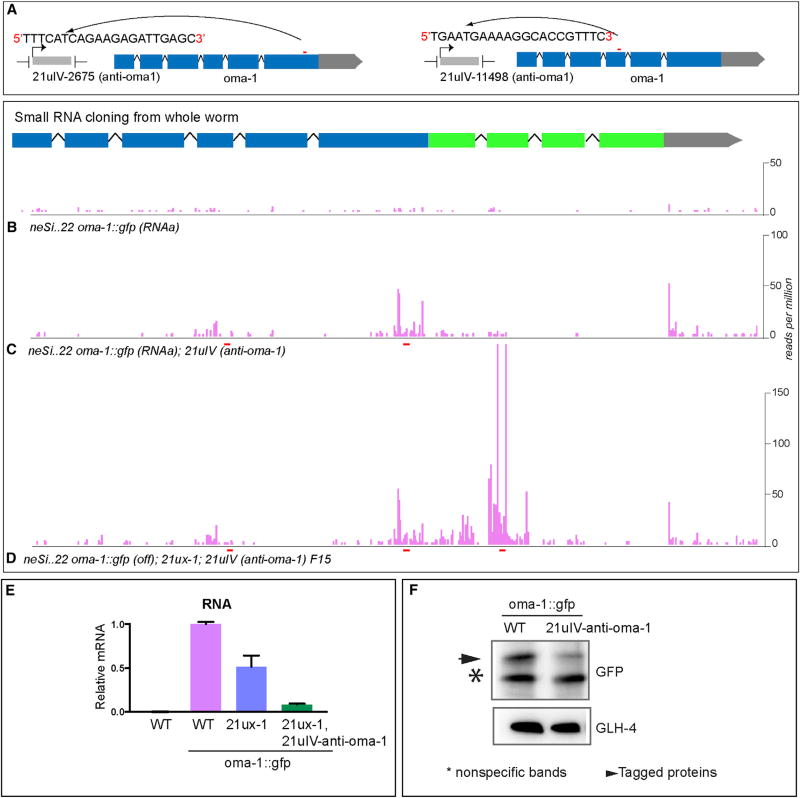
(A) Schematic representing the replacement of 21U-2675 IV and 21U-11498 IV with anti-oma-1 sequence. (B–D) Schematics showing plots of small RNA species induced along the entire oma-1::gfp transgene in (B) wildtype, (C) 21uIV-11498(anti-oma1) and 21uIV-2675(anti-oma1) animals, and (D) 21uIV-11498(anti-oma1), 21uIV-2675(anti-oma1), and 21ux-1(anti-gfp) animals. In the browser schematic, oma-1 sequences are blue, fused to green gfp sequences. The positions of each artificial piRNA are indicated by red dash marks beneath the small RNA graphs. The 5′ ends of small RNA reads are plotted, and the height indicates abundance in reads per million. (E) qRT-PCR analysis of wild-type (WT) and oma-1::gfp-RNA from total RNA prepared from different transgenic strains (as indicated). Error bars represent the standard deviation for three replicates in one experiment. (F) Western blot analysis of GFP protein expression in wild-type and transgenic strains (as indicated). As a loading control, the blot was stripped and re-probed for the germline-specific GLH-4 protein. See also Figure S3.
Figure 4
Figure 4. Properties Intrinsic to the oma-1 Coding Sequences Confer Resistance to Silencing
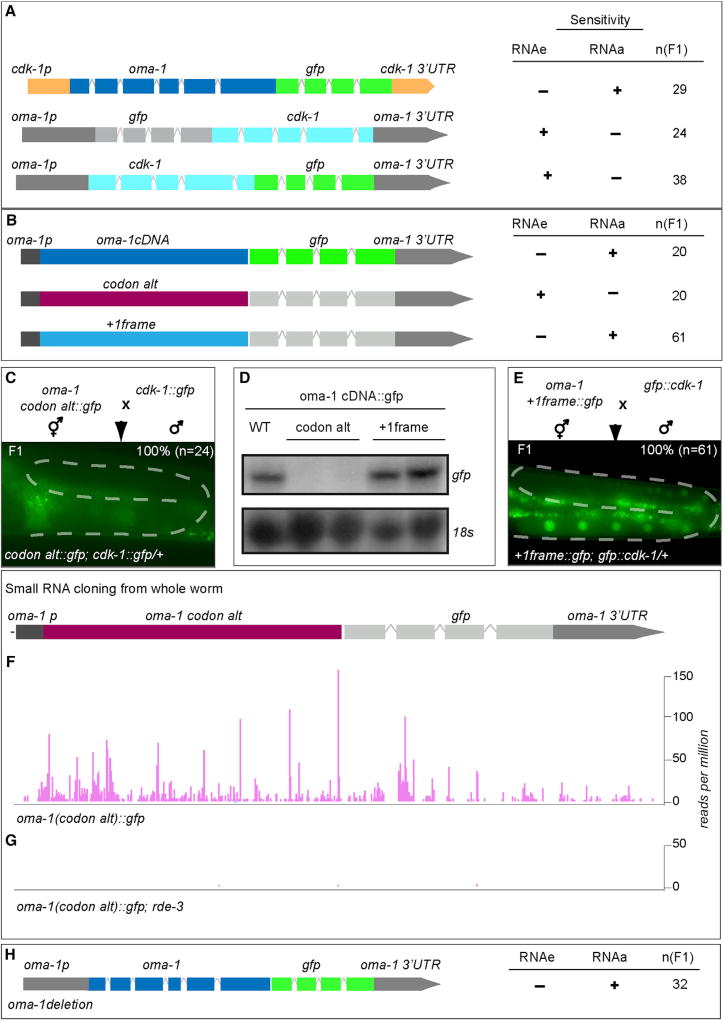
(A and B) Promoters, UTRs, and introns do not determine transgene sensitivity/resistance to silencing. Schematics indicating the exon-intron structure of fusion genes analyzed are displayed alongside tabulations of their respective RNAe and RNAa activities. Transgenes were scored as (+) if they could act in trans to silence (RNAe) or activate (RNAa) another transgene. In (A), the (s) indicates that the cdk-1::gfp transgene was expressed but was sensitive to RNAe. For each transgene type, 100% of the (n) F1 cross progeny analyzed exhibited the same sensitivity. (C–G) The body of the mRNA, but not its coding potential, determines sensitivity/resistance to silencing. In (C) and (E), schematics of genetic crosses are shown above representative epifluorescence images of F1 progeny (percentages indicate the number of F1 animals that exhibited the expression pattern shown). In (C), codon-altered oma-1::gfp is silent and induces the silencing of cdk-1::gfp (absence of nuclear GFP signal). (D) Northern blot analysis of gfp mRNA expression in animals transgenic for gfp fused to oma-1 cDNA sequences with un-altered codons (WT), with maximally altered codons (codon alt), and with a frameshifted and stop-codon-corrected (+1frame) oma-1 sequence. (E) Frameshifted oma-1::gfp induces the transactivation of a silent gfp::cdk-1 (nuclear GFP signal). (F and G) oma-1(codon alt)::gfp is silenced by RNAe. Plots show 22G-RNA levels in wild-type and rde-3 mutants (as described in Figure 2). (H) Endogenous oma-1-associated CSR-1/22G is not required for RNAa. Schematics and tabulations of RNAe and RNAa sensitivity are shown as described in Figures 3A and 3B.
Figure 5
Figure 5. Premature Nonsense Mutations Do Not Prevent RNAa and RNAe
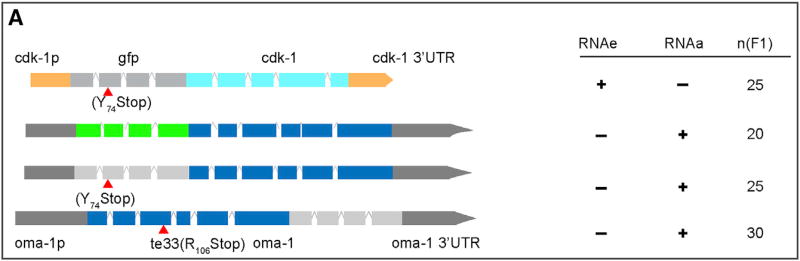
(A) Premature stop codons do not interfere with RNAa and RNAe activities. Schematics and tabulations of RNAe and RNAa sensitivity are shown as described in Figures 3A and 3B. See also Figure S4.
Figure 6
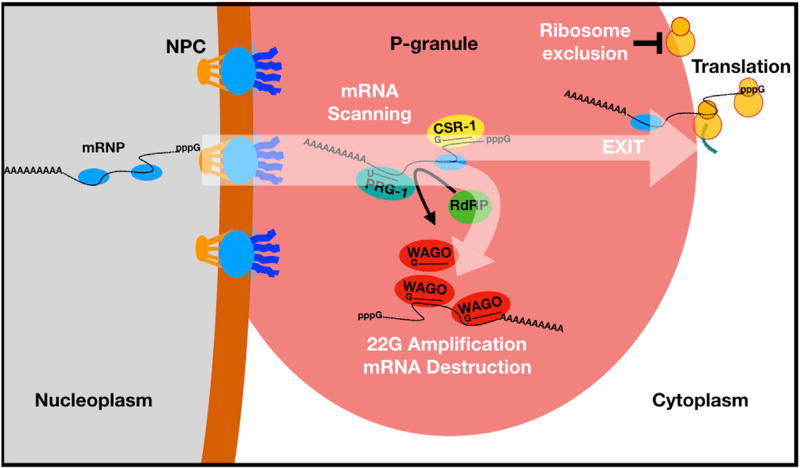
Figure 6. Model. piRNAs Scan mRNAs within Perinuclear Nuage prior to Translation Initiation
Schematic showing mRNPs exiting the nucleus through P granules. Binding factors and possibly covalent modification put in place during mRNA transcription and processing influence sensitivity to piRNA scanning. Three Argonaute systems within P granules are shown engaging the entire transcript including the ORF. The balance of positive and negative signals along an mRNA determines the fraction of molecules that escape destruction and gain access to the translation machinery.

References

    1. Aravin A, Gaidatzis D, Pfeffer S, Lagos-Quintana M, Landgraf P, Iovino N, Morris P, Brownstein MJ, Kuramochi-Miyagawa S, Nakano T, et al. A novel class of small RNAs bind to MILI protein in mouse testes. Nature. 2006;442:203–207. - PubMed
    1. Ashe A, Sapetschnig A, Weick EM, Mitchell J, Bagijn MP, Cording AC, Doebley AL, Goldstein LD, Lehrbach NJ, Le Pen J, et al. piRNAs can trigger a multigenerational epigenetic memory in the germline of C. elegans. Cell. 2012;150:88–99. - PMC - PubMed
    1. Bagijn MP, Goldstein LD, Sapetschnig A, Weick EM, Bouasker S, Lehrbach NJ, Simard MJ, Miska EA. Function, targets, and evolution of Caenorhabditis elegans piRNAs. Science. 2012;337:574–578. - PMC - PubMed
    1. Baker KE, Parker R. Nonsense-mediated mRNA decay: terminating erroneous gene expression. Curr. Opin. Cell Biol. 2004;16:293–299. - PubMed
    1. Batista PJ, Ruby JG, Claycomb JM, Chiang R, Fahlgren N, Kasschau KD, Chaves DA, Gu W, Vasale JJ, Duan S, et al. PRG-1 and 21U–RNAs interact to form the piRNA complex required for fertility in C. elegans. Mol. Cell. 2008;31:67–78. - PMC - PubMed

Publication types