


Fetal adrenal gland biometry and cervical elastography as predictors of preterm birth: A comparative study
- PMID: 29456583
- PMCID: PMC5810859
- DOI: 10.1177/1742271X17748515
Fetal adrenal gland biometry and cervical elastography as predictors of preterm birth: A comparative study
Abstract
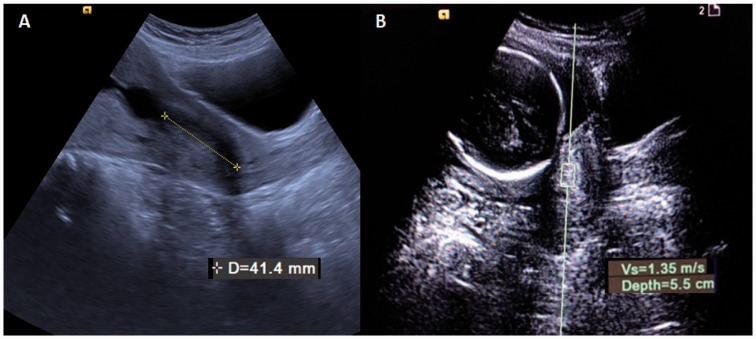
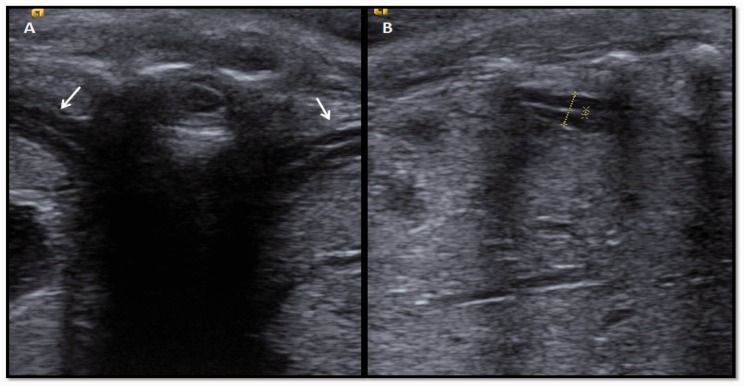
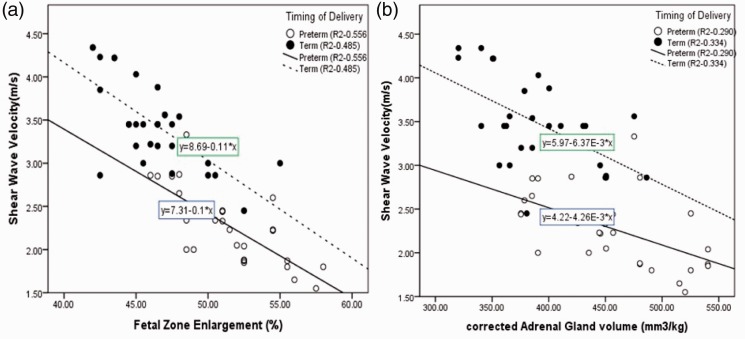
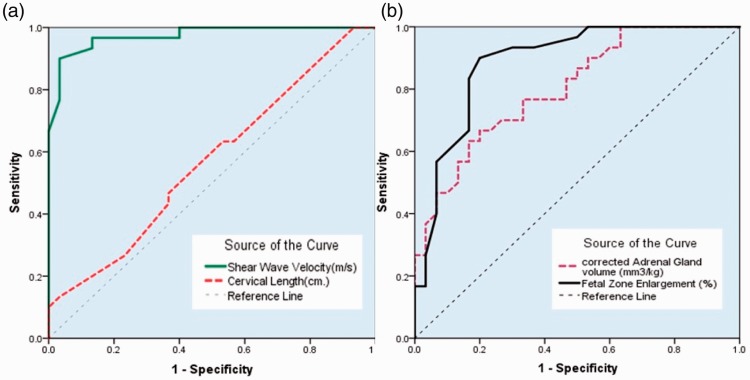
Background: Preterm birth is a major health problem in developing and developed countries leading to rising health care costs and long-term neurodevelopmental disability. The study aims to evaluate the role of new quantitative markers, like the elastography of cervix (shear wave speed estimation), fetal adrenal zone enlargement, and corrected fetal adrenal gland volume; in preterm birth prediction and analyze their relative importance. Thus, these markers may be beneficial in early preterm birth detection and prevent the related morbidities.
Methods: Thirty pregnant females (from 28 to 37 weeks of gestational age), showing clinical signs and delivery outcome of preterm birth were included in the study with an equal number of not-in-labor antenatal females at ≥37 weeks as controls. These patients were categorized as preterm and term groups. Both the groups were subjected to trans-abdominal ultrasonography where cervical length, cervical shear wave speed (dynamic elastography) and fetal adrenal gland parameters were measured.
Results: Shear wave speed estimation of the antenatal cervix showed the highest sensitivity and specificity (96.7% and 87% respectively) in the prediction of preterm birth and also showed a strong correlation with fetal adrenal gland enlargement. Fetal adrenal zone enlargement was also shown to be a reliable marker of preterm birth, however, with reduced sensitivity and specificity than shear wave speed.
Conclusion: The elastographic advancement and fetal adrenal biometry derived quantitative markers can be used as an objective and standard criterion for accurate prediction of preterm birth.
Keywords: Preterm birth; adrenal gland; cervix; elastography; tissue elasticity imaging.
Figures
References
-
- Svigos JM, Dodd JM and Robinson JS. Threatened and actual preterm labor including mode of delivery. In: High risk pregnancy management options. 4th ed. New York: Elsevier Inc., 2012, pp. 1075–1090.
-
- The Lancet. The unfinished agenda of preterm births . Lancet 2016; 388: 2323–2323. - PubMed
-
- National Institute for Health and Care Excellence. Preterm labour and birth. NICE guideline (NG25), 2005. - PubMed
-
- Guler AE, Pehlivan H, Cakmak B, et al. Assessment of fetal adrenal gland enlargement in term and preterm labor cases. Int J Res Med Sci 2015; 3: 1035–1040.
LinkOut - more resources
Full Text Sources
Other Literature Sources