. 2018 Mar;15(3):3490-3495.
doi: 10.3892/ol.2018.7773. Epub 2018 Jan 11.

Long noncoding RNA BLACAT1 promotes cell proliferation and invasion in human cervical cancer

Affiliations

Long noncoding RNA BLACAT1 promotes cell proliferation and invasion in human cervical cancer

Dan Shan et al. Oncol Lett. 2018 Mar.

Abstract

Cervical cancer is one of the leading causes of mortality in females worldwide. Predisposition to distant metastasis has reduced the prognosis of this malignancy, thus the identification of a novel agent for metastatic cervical cancer is required. Long noncoding RNAs (LncRNAs) have been reported to serve significant roles in human tumorigenesis. The present study aimed to investigate the effects of a newly discovered LncRNA bladder cancer associated transcript 1 (non-protein coding) (BLACAT1) on cell proliferation and metastasis in cervical cancer. A total of 100 patients with cervical cancer were included, and tumor tissues as well as the adjacent non-cancerous counterparts were collected for reverse transcription-quantitative polymerase chain reaction analysis. It was demonstrated that BLACAT1 was highly expressed in human cervical cancer tissues and cell lines. The knockdown of BLACAT1 with specific short hairpin RNA reduced colony formation rates in ME180 and C33A cells. Cell cycle and cell proliferation assays revealed that depletion of BLACAT1 in ME180, and C33A cells arrested the cell cycle at the G0/G1 phase and inhibited cell proliferation. Transwell assays demonstrated that the knockdown of BLACAT1 inhibited cell migration and invasion in ME180, and C33A cells. Moreover, wound-healing assays supported the aformentioned observations. Western blot analysis showed that the knockdown of BLACAT1 in ME180 and C33A cells decreased the protein levels of cyclin B1, cell division cycle 25C, and N-cadherin, while increasing the protein level of E-cadherin. These findings indicated the oncogenic potential of BLACAT1 in cervical cancer, which may provide novel insights for the clinical diagnosis and treatment of cervical cancer.

Keywords: BLACAT1; cervical cancer; long noncoding RNA; metastasis; proliferation.


Figures
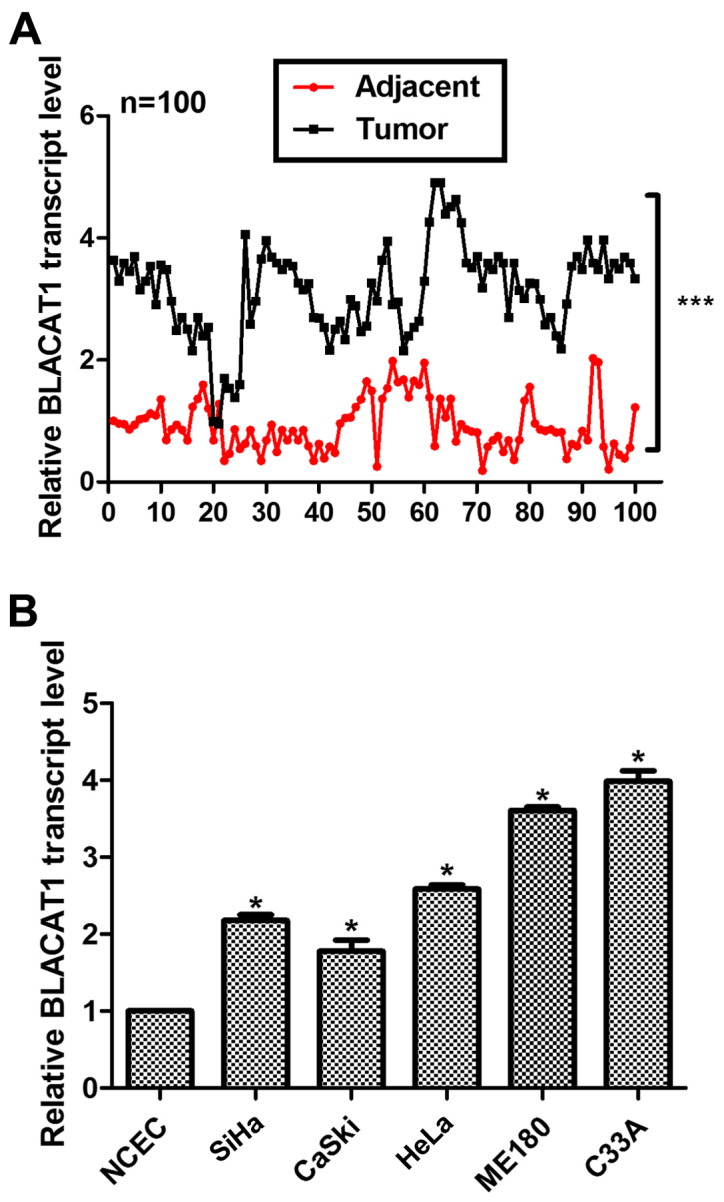
Figure 1.
Figure 1.
Long noncoding RNA BLACAT1 was upregulated in human cervical cancer in vivo and in vitro. (A) A total of 100 cervical cancer patients were included and RT-PCR analysis was used to assess the transcript level of BLACAT1. ***P<0.0001, vs. Adjacent. (B) RT-PCR analysis was performed to calculate the transcript level of BLACAT1 in NCEC control cells and five cervical cancer cell lines. *P<0.05, vs. NCEC.
Figure 2.
Figure 2.
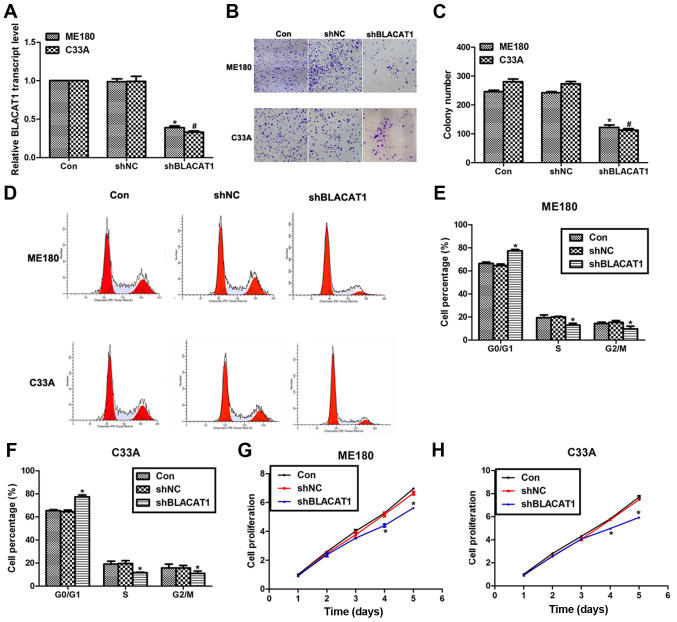
Knockdown of BLACAT1 inhibited cell proliferation in human cervical cancer in vitro. (A) RT-PCR analysis was performed to assess the expression of BLACAT1 in ME180 and C33A cells upon transfection of shBLACAT1. (B) Representative images of colony formation assays for ME180 and C33A cells. (C) Colony formation assay was performed to assess the formed colonies of ME180 and C33A cells upon transfection of shBLACAT1. *P<0.05, vs. Con in ME180 cells. #P<0.05, vs. Con in C33A cells. (D) Representative images of cell cycle assays for ME180 and C33A cells. (E) Cell cycle analysis showed the cell percentage in each phase upon shBLACAT1 transfection in ME180 cells. (F) Cell cycle analysis showed the cell percentage in each phase upon shBLACAT1 transfection in C33A cells. (G) Cell proliferation assay was performed to reveal the cell proliferative rate of ME180 cells upon shBLACAT1 transfection in a continuous five days. (H) Cell proliferation assay was performed to reveal the cell proliferative rate of C33A cells upon shBLACAT1 transfection in a continuous five days. *P<0.05, vs. Con.
Figure 3.
Figure 3.
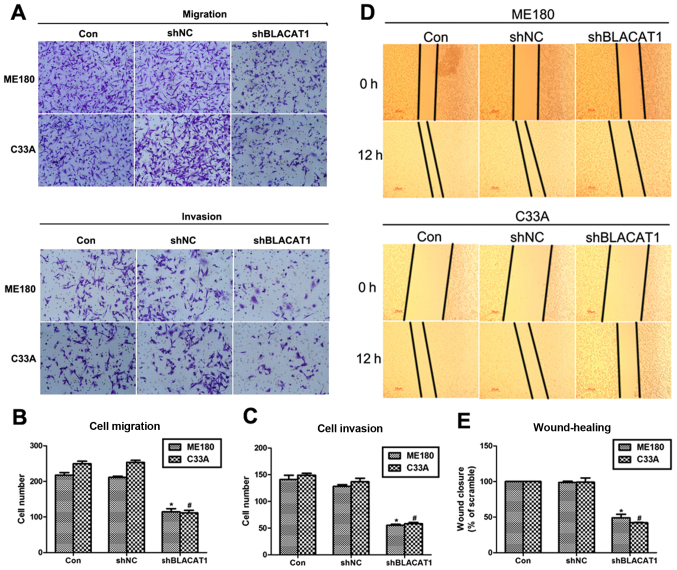
Depletion of BLACAT1 suppressed cell metastasis in ME180 and C33A cells. (A) Representative images of Transwell assays were presented after treatment of shBLACAT1 on ME180 and C33A cells. (B) Quantification of cell migration assays showed the cell number on the lower surface of membrane upon shBLACAT1 transfection in ME180 and C33A cells. (C) Quantification of cell invasion assays showed the cell number on the lower surface of membrane upon shBLACAT1 transfection in ME180 and C33A cells. *P<0.05, vs. Con in ME180 cells. #P<0.05, vs. Con in C33A cells. (D) Representative images of wound-healing assays were presented after 0 or 12 h treatment of shBLACAT1 on ME180 and C33A cells. (E) Quantification of wound-healing assays showed the cell capacity to migrate and invade upon shBLACAT1 transfection in ME180 and C33A cells. *P<0.05, vs. Con in ME180 cells. #P<0.05, vs. Con in C33A cells.
Figure 4.
Figure 4.
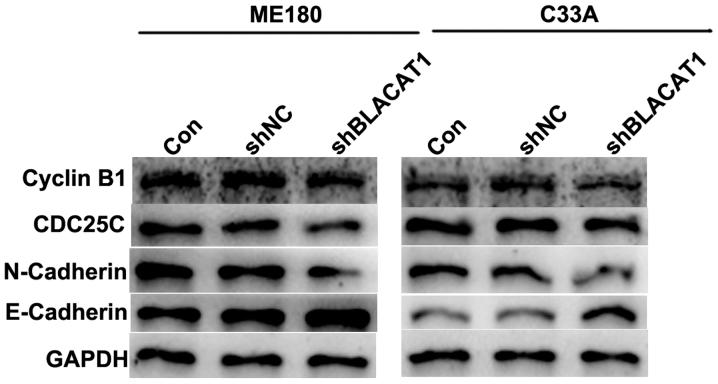
Depletion of BLACAT1 in ME180 and C33A cells decreased cell cycle markers and suppressed EMT process. Western blot analysis revealed that the protein levels of Cyclin B1, CDC25C, N-Cadherin, E-Cadherin and GAPDH altered upon transfection of shBLACAT1 in ME180 and C33A cells.

References

    1. Arbyn M, Castellsagué X, de Sanjosé S, Bruni L, Saraiya M, Bray F, Ferlay J. Worldwide burden of cervical cancer in 2008. Ann. Oncol. 2011;22:2675–2686. - PubMed
    1. Yeung TL, Leung CS, Yip KP, Yeung Au CL, Wong ST, Mok SC. Cellular and molecular processes in ovarian cancer metastasis. A Review in the Theme: Cell and molecular processes in cancer metastasis. Am J Physiol Cell Physiol. 2015;309:C444–C456. doi: 10.1152/ajpcell.00188.2015. - DOI - PMC - PubMed
    1. Zhang Y, Gao H, Gao X, Huang S, Wu K, Yu X, Yuan K, Zeng T. Elevated expression of Kin17 in cervical cancer and its association with cancer cell proliferation and invasion. Int J Gynecol Cancer. 2017;27:628–633. doi: 10.1097/IGC.0000000000000928. - DOI - PubMed
    1. Zhou N, Fei D, Zong S, Zhang M, Yue Y. MicroRNA-138 inhibits proliferation, migration and invasion through targeting hTERT in cervical cancer. Oncol Lett. 2016;12:3633–3639. doi: 10.3892/ol.2016.5038. - DOI - PMC - PubMed
    1. de Hoon M, Shin JW, Carninci P. Paradigm shifts in genomics through the FANTOM projects. Mamm Genome. 2015;26:391–402. doi: 10.1007/s00335-015-9593-8. - DOI - PMC - PubMed