Effects of Streptokinase and Normal Saline on the Incidence of Intra-abdominal Adhesion 1 Week and 1 Month after Laparotomy in Rats
- PMID: 29456987
- PMCID: PMC5812088
- DOI: 10.4103/abr.abr_225_16
Effects of Streptokinase and Normal Saline on the Incidence of Intra-abdominal Adhesion 1 Week and 1 Month after Laparotomy in Rats
Abstract
Background: Intra-abdominal adhesions after surgery are usually in the form of bands and can annoy the patient throughout life causing repeated surgical procedures. Therefore, any action to prevent adhesions after surgery can increase longevity and quality of life. For this aim, this study investigates the effect of streptokinase and normal saline on the 7th day and 1 month after laparotomy.
Materials and methods: Experimental study was conducted on thirty healthy male Wistar rats weighing 200-250 g with age of 3 months divided into three groups of 10. Group I: No treatment, Group II: Received normal saline, and Group III: Received normal saline and streptokinase at the same time. One week and 1 month after laparotomy, the frequency of the presence or absence of adhesion bands was performed by a person who was unaware of the sample grouping. The collected information was analyzed with the SPSS software (version 16; SPSS Inc., Chicago, IL, USA).
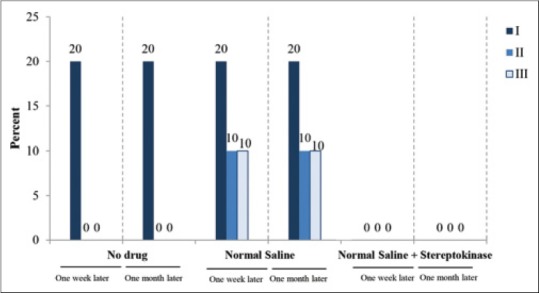
Results: Adhesion frequency was found to be 20% on the 7th day (early) and 1 month after laparotomy (late) for Group 1, and it was 40% on early and late for Group II, while 0% on the early and late for Group III. Hence, in the group receiving streptokinase, no early or late adhesion was observed; therefore, it had a significant role in the prevention of intra-abdominal adhesions (P < 0.05). However, adhesions in the group receiving normal saline had no remarkable difference with the group receiving no drug (P > 0.05).
Conclusion: According to the results of our study, we believe that streptokinase could be a good antiadhesive agent considering its effectiveness.
Keywords: Intra-abdominal adhesion; normal saline; streptokinase.
Conflict of interest statement
There are no conflicts of interest.
Figures

References
-
- Trimbos-Kemper TC, Trimbos JB, van Hall EV. Adhesion formation after tubal surgery: Results of the eighth-day laparoscopy in 188 patients. Fertility and sterility. 1985;43(3):395–400. - PubMed
-
- Kaǧızman SH, Belviranlı M, Şahin M, Vatansev C, Karahan Ö, Alptekin H. Mekanik intestinal obstrüksiyona baǧlı opera edilmiş hastaların klinik analizi. T Klin. 1997;17:203–9.
-
- Leach RE, Burns JW, Dawe EJ, SmithBarbour MD, Diamond MP. Reduction of postsurgical adhesion formation in the rabbit uterine horn model with use of hyaluronate/carboxymethylcellulose gel. Fertil Steril. 1998;69:415–8. - PubMed
-
- Schnüriger B, Barmparas G, Branco BC, Lustenberger T, Inaba K, Demetriades D. Prevention of postoperative peritoneal adhesions: A review of the literature. Am J Surg. 2011;201:111–21. - PubMed
-
- Monk BJ, Berman ML, Montz FJ. Adhesions after extensive gynecologic surgery: Clinical significance, etiology, and prevention. Am J Obstet Gynecol. 1994;170(5 Pt 1):1396–403. - PubMed
LinkOut - more resources
Full Text Sources
Other Literature Sources