


Nail Changes in Early Mycosis Fungoides
- PMID: 29457018
- PMCID: PMC5806182
- DOI: 10.1159/000478946
Nail Changes in Early Mycosis Fungoides
Abstract
Background: Mycosis fungoides (MF) has a wide range of clinical presentations and it has been reported rarely to involve the nail apparatus.
Objective: We intended to evaluate the frequency and characteristics of nail changes in patients with biopsy-proven MF.
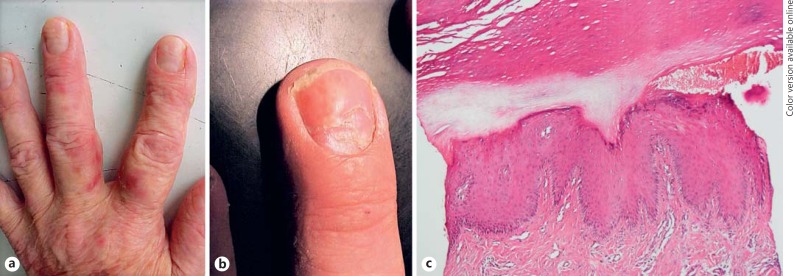
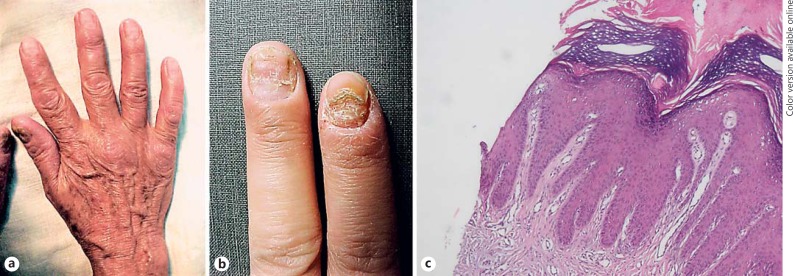
Methods: A retrospective analysis of 60 patients with MF who were evaluated at our cancer center from 2013 to 2014 was performed to identify patients with nail changes. Histological examinations of the skin around the nail apparatus were obtained from 10 patients with periungual skin erythema and scaling.
Results: In 45 patients out of 60 cases, the skin around the nail apparatus was normal, and only in 5 patients of these 45 cases, nail changes were detected. These changes included leukonychia, longitudinal ridging, nail thickening, and opacity. In the remaining 15 patients, erythema and scaling was observed in periungual skin, and 13 of them demonstrated nail changes including longitudinal ridging, nail thickening, fragility of the nail plate, subungual hyperkeratosis, pigmented nail band, Beau's lines, onychomadesis, koilonychia, nail thinning, distal notching, subungual debris, leukonychia, and pitting. In biopsies of periungual skin, none of 10 cases revealed histological findings consistent with MF.
Conclusions: Evidence of nail changes was observed in 18 cases (30%). The most common nail changes detected in MF patients included longitudinal ridging, nail thickening, nail fragility, and leukonychia.
Keywords: Histology; Mycosis fungoides; Nail changes.
Figures
References
-
- Desai M, Liu S, Parker S. Clinical characteristics, prognostic factors, and survival of 393 patients with mycosis fungoides and Sézary syndrome in the southeastern United States: a single-institution cohort. J Am Acad Dermatol. 2015;72:276–285. - PubMed
-
- Willemze R, Jaffe ES, Burg G, Cerroni L, Berti E, Swerdlow SH, et al. WHO-EORTC classification for cutaneous lymphomas. Blood. 2005;105:3768–3785. - PubMed
-
- Tomsick RS. Hyperkeratosis in mycosis fungoides. Cutis. 1982;29:621–623. - PubMed
-
- Harland E, Dalle S, Balme B, Dumontet C, Thomas L. Ungueotropic T-cell lymphoma. Arch Dermatol. 2006;142:1071–1073. - PubMed
-
- Fleming CJ, Hunt MJ, Barnetson RS. Mycosis fungoides with onychomadesis. Br J Dermatol. 1996;135:1012–1013. - PubMed
LinkOut - more resources
Full Text Sources
Other Literature Sources
