


Effects of real-time gait biofeedback on paretic propulsion and gait biomechanics in individuals post-stroke
- PMID: 29457532
- PMCID: PMC5901660
- DOI: 10.1080/10749357.2018.1436384
Effects of real-time gait biofeedback on paretic propulsion and gait biomechanics in individuals post-stroke
Abstract
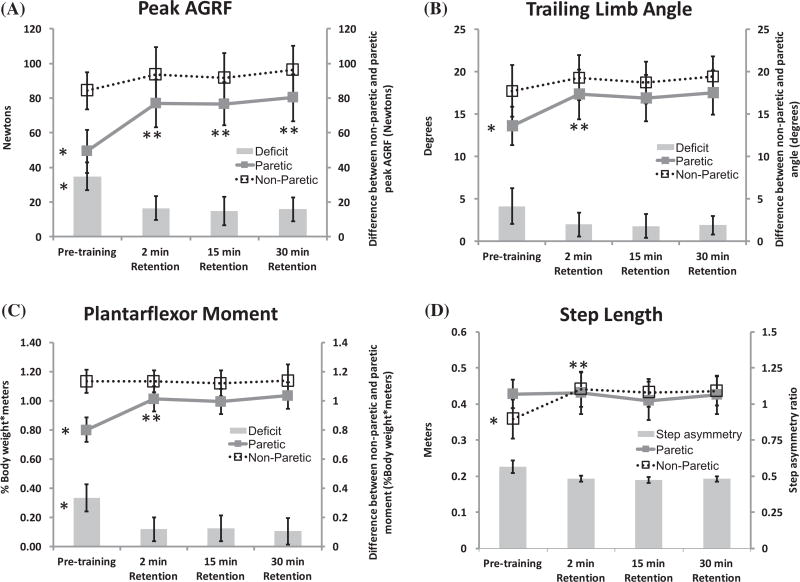
Objectives Gait training interventions that target paretic propulsion induce improvements in walking speed and function in individuals post-stroke. Previously, we demonstrated that able-bodied individuals increase propulsion unilaterally when provided real-time biofeedback targeting anterior ground reaction forces (AGRF). The purpose of this study was to, for the first time, investigate short-term effects of real-time AGRF gait biofeedback training on post-stroke gait. Methods Nine individuals with post-stroke hemiparesis (6 females, age = 54 ± 12.4 years 39.2 ± 24.4 months post-stroke) completed three 6-minute training bouts on an instrumented treadmill. During training, visual and auditory biofeedback were provided to increase paretic AGRF during terminal stance. Gait biomechanics were evaluated before training, and during retention tests conducted 2, 15, and 30 minutes post-training. Primary dependent variables were paretic and non-paretic peak AGRF; secondary variables included paretic and non-paretic peak trailing limb angle, plantarflexor moment, and step length. In addition to evaluating the effects of biofeedback training on these dependent variables, we compared effects of a 6-minute biofeedback training bout to a non-biofeedback control condition. Results Compared to pre-training, significantly greater paretic peak AGRFs were generated during the 2, 15, and 30-minute retention tests conducted after the 18-minute biofeedback training session. Biofeedback training induced no significant effects on the non-paretic leg. Comparison of a 6-minute biofeedback training bout with a speed-matched control bout without biofeedback demonstrated a main effect for training type, with greater peak AGRF generation during biofeedback. Discussion Our results suggest that AGRF biofeedback may be a feasible and promising gait training strategy to target propulsive deficits in individuals post-stroke.
Keywords: Feedback; gait biomechanics; hemiparesis; locomotor training; motor learning; push-off; walking.
Figures


References
-
- Bowden MG, Balasubramanian CK, Neptune RR, Kautz SA. Anterior-posterior ground reaction forces as a measure of paretic leg contribution in hemiparetic walking. Stroke. 2006;37(3):872–876. - PubMed
-
- Balasubramanian CK, Bowden MG, Neptune RR, Kautz SA. Relationship between step length asymmetry and walking performance in subjects with chronic hemiparesis. Arch Phys Med Rehabil. 2007;88(1):43–49. - PubMed
-
- Neptune RR, Kautz SA, Zajac FE. Contributions of the individual ankle plantar flexors to support, forward progression and swing initiation during walking. J Biomech. 2001;34(11):1387–1398. - PubMed
-
- Chen G, Patten C, Kothari DH, Zajac FE. Gait differences between individuals with post-stroke hemiparesis and non-disabled controls at matched speeds. Gait Posture. 2005;22(1):51–56. - PubMed
Publication types
MeSH terms
Grants and funding
LinkOut - more resources
Full Text Sources
Other Literature Sources
Medical
