


Determining Risk of Colorectal Cancer and Starting Age of Screening Based on Lifestyle, Environmental, and Genetic Factors
- PMID: 29458155
- PMCID: PMC5985207
- DOI: 10.1053/j.gastro.2018.02.021
Determining Risk of Colorectal Cancer and Starting Age of Screening Based on Lifestyle, Environmental, and Genetic Factors
Abstract
Background & aims: Guidelines for initiating colorectal cancer (CRC) screening are based on family history but do not consider lifestyle, environmental, or genetic risk factors. We developed models to determine risk of CRC, based on lifestyle and environmental factors and genetic variants, and to identify an optimal age to begin screening.
Methods: We collected data from 9748 CRC cases and 10,590 controls in the Genetics and Epidemiology of Colorectal Cancer Consortium and the Colorectal Transdisciplinary study, from 1992 through 2005. Half of the participants were used to develop the risk determination model and the other half were used to evaluate the discriminatory accuracy (validation set). Models of CRC risk were created based on family history, 19 lifestyle and environmental factors (E-score), and 63 CRC-associated single-nucleotide polymorphisms identified in genome-wide association studies (G-score). We evaluated the discriminatory accuracy of the models by calculating area under the receiver operating characteristic curve values, adjusting for study, age, and endoscopy history for the validation set. We used the models to project the 10-year absolute risk of CRC for a given risk profile and recommend ages to begin screening in comparison to CRC risk for an average individual at 50 years of age, using external population incidence rates for non-Hispanic whites from the Surveillance, Epidemiology, and End Results program registry.
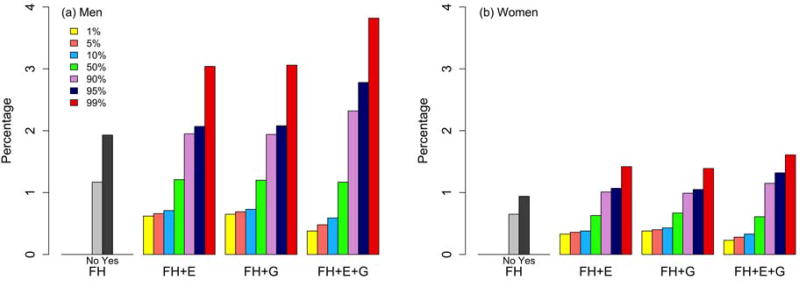
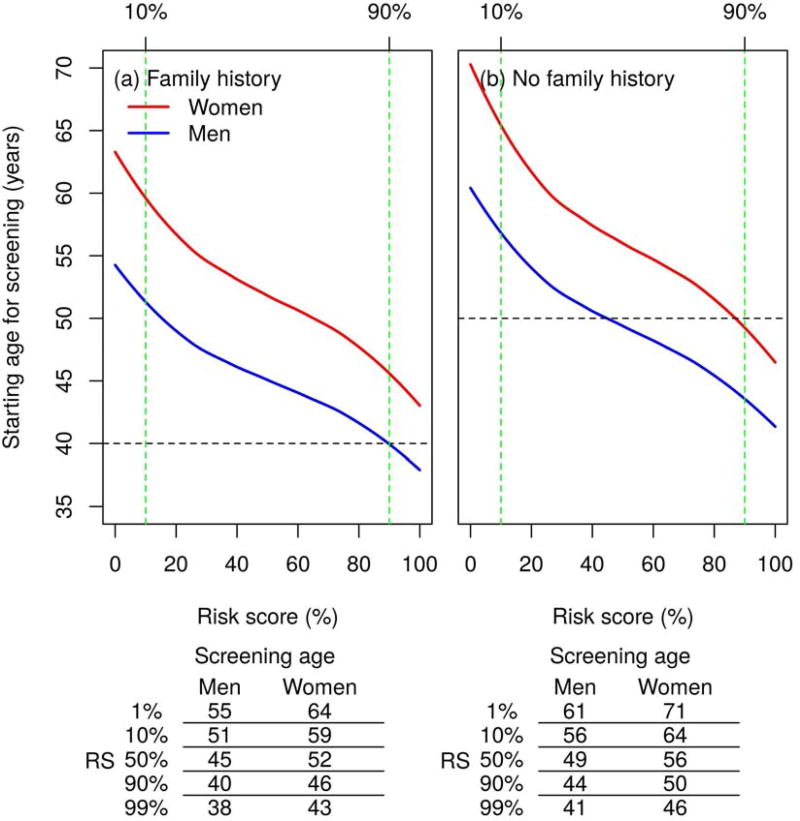
Results: In our models, E-score and G-score each determined risk of CRC with greater accuracy than family history. A model that combined both scores and family history estimated CRC risk with an area under the receiver operating characteristic curve value of 0.63 (95% confidence interval, 0.62-0.64) for men and 0.62 (95% confidence interval, 0.61-0.63) for women; area under the receiver operating characteristic curve values based on only family history ranged from 0.53 to 0.54 and those based only E-score or G-score ranged from 0.59 to 0.60. Although screening is recommended to begin at age 50 years for individuals with no family history of CRC, starting ages calculated based on combined E-score and G-score differed by 12 years for men and 14 for women, for individuals with the highest vs the lowest 10% of risk.
Conclusions: We used data from 2 large international consortia to develop CRC risk calculation models that included genetic and environmental factors along with family history. These determine risk of CRC and starting ages for screening with greater accuracy than the family history only model, which is based on the current screening guideline. These scoring systems might serve as a first step toward developing individualized CRC prevention strategies.
Keywords: CORECT; Colon Cancer; Colonoscopy; GECCO.
Copyright © 2018 AGA Institute. Published by Elsevier Inc. All rights reserved.
Conflict of interest statement
Figures
Comment in
-
Personalized screening for colorectal cancer.Nat Rev Gastroenterol Hepatol. 2018 Jul;15(7):391-392. doi: 10.1038/s41575-018-0015-8. Nat Rev Gastroenterol Hepatol. 2018. PMID: 29713023 No abstract available.
References
-
- American Cancer Society. Colorectal Cancer Facts & Figures 2014–2016. 2014
-
- US Preventive Services Task Force. Bibbins-Domingo K, Grossman DC, et al. Screening for Colorectal Cancer: US Preventive Services Task Force Recommendation Statement. JAMA. 2016;315:2564–2575. - PubMed
-
- US Preventive Services Task Force. [Accessed 10/5, 2016];Final Recommendation Statement: Colorectal Cancer: Screening. 2016 Available at: https://www.uspreventiveservicestaskforce.org/Page/Document/UpdateSummar....
-
- National Center for Health Statistics. [Accessed 10/5, 2016];Table 72 (page 1 of 2). Use of colorectal tests or procedures among adults aged 50–75, by selected characteristics: United States, selected years 2000–2013. 2016 Available at: http://www.cdc.gov/nchs/hus/contents2015.htm#072.
-
- Inadomi JM. Screening for Colorectal Neoplasia. N Engl J Med. 2017;376:149–156. - PubMed
Publication types
MeSH terms
Grants and funding
- U01 HG004438/HG/NHGRI NIH HHS/United States
- U01 HG004446/HG/NHGRI NIH HHS/United States
- P01 CA087969/CA/NCI NIH HHS/United States
- K05 CA154337/CA/NCI NIH HHS/United States
- HHSN268201100046C/HL/NHLBI NIH HHS/United States
- HHSN268201100003C/WH/WHI NIH HHS/United States
- U01 CA164930/CA/NCI NIH HHS/United States
- R01 CA137178/CA/NCI NIH HHS/United States
- P30 CA008748/CA/NCI NIH HHS/United States
- R01 CA081488/CA/NCI NIH HHS/United States
- HHSN271201100004C/AG/NIA NIH HHS/United States
- HHSN268201100002C/WH/WHI NIH HHS/United States
- R01 CA054281/CA/NCI NIH HHS/United States
- UM1 CA167552/CA/NCI NIH HHS/United States
- S10 OD020069/OD/NIH HHS/United States
- U01 CA074783/CA/NCI NIH HHS/United States
- P01 CA196569/CA/NCI NIH HHS/United States
- P50 CA127003/CA/NCI NIH HHS/United States
- HHSN268201100004C/WH/WHI NIH HHS/United States
- R01 CA059045/CA/NCI NIH HHS/United States
- R35 CA197735/CA/NCI NIH HHS/United States
- R01 CA195789/CA/NCI NIH HHS/United States
- Z01 CP010200/ImNIH/Intramural NIH HHS/United States
- R01 CA206279/CA/NCI NIH HHS/United States
- P01 CA055075/CA/NCI NIH HHS/United States
- R01 CA151993/CA/NCI NIH HHS/United States
- U01 CA167552/CA/NCI NIH HHS/United States
- R01 CA048998/CA/NCI NIH HHS/United States
- U01 CA137088/CA/NCI NIH HHS/United States
- R01 CA063464/CA/NCI NIH HHS/United States
- P01 CA033619/CA/NCI NIH HHS/United States
- UM1 CA186107/CA/NCI NIH HHS/United States
- R01 CA060987/CA/NCI NIH HHS/United States
- R01 CA136726/CA/NCI NIH HHS/United States
- K07 CA190673/CA/NCI NIH HHS/United States
- R37 CA054281/CA/NCI NIH HHS/United States
- HHSN268201100001C/WH/WHI NIH HHS/United States
LinkOut - more resources
Full Text Sources
Other Literature Sources
Medical
