


Prevalence, aetiologies and prognosis of the symptom dizziness in primary care - a systematic review
- PMID: 29458336
- PMCID: PMC5819275
- DOI: 10.1186/s12875-017-0695-0
Prevalence, aetiologies and prognosis of the symptom dizziness in primary care - a systematic review
Abstract
Background: Dizziness is a common reason for consulting a general practitioner and there is a broad range of possible underlying aetiologies. There are few evidence-based data about prevalence, aetiology and prognosis in primary care. We aimed to conduct a systematic review of symptom-evaluating studies on prevalence, aetiology or prognosis of dizziness in primary care.
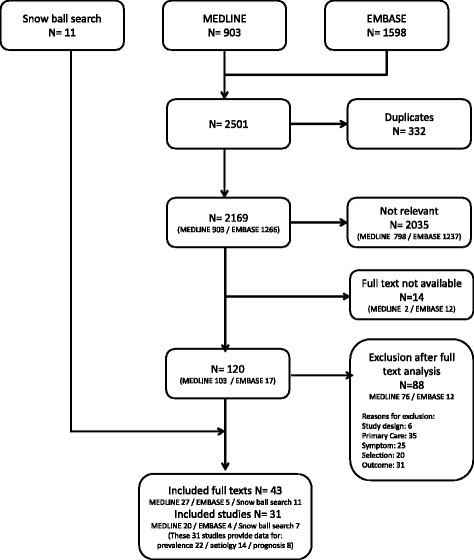
Methods: We systematically searched MEDLINE and EMBASE. Two independent researchers screened titles and abstracts according to predefined criteria. We included all studies evaluating the symptoms 'dizziness' or 'vertigo' as a reason for consultation in primary care. We extracted data about study population and methodology and prevalence, aetiology and prognosis. Two raters independently judged study quality and risk of bias. We investigated the variation across studies using forest plots, I2 and prediction intervals. Since we anticipated a great amount of clinical and unexplained statistical heterogeneity, we provided qualitative syntheses instead of pooled estimates.
Results: We identified 31 studies (22 on prevalence, 14 on aetiology and 8 on prognosis). Consultation prevalence differs between 1,0 and 15,5%. The most common aetiologies are vestibular/peripheral (5,4-42,1%), benign peripheral positional vertigo (4,3-39,5%), vestibular neuritis (0,6-24,0%), Menière's disease (1,4-2,7%), cardiovascular disease (3,8-56,8%), neurological disease (1,4-11,4%), psychogenic (1,8-21,6%), no clear diagnosis (0,0-80,2%). While studies based on subjective patient assessment reported improvement rates from 37 to 77%, these findings could not be confirmed when applying instruments that measure symptom severity or quality of life.
Conclusion: There is a broad variety of possible underlying diseases for the symptom dizziness. There exist only few methodologically sound studies concerning aetiology and prognosis of dizziness.
Keywords: Diagnosis; Dizziness; Family practice; Systematic review; Vertigo.
Conflict of interest statement
Ethics approval and consent to participate
Not applicable.
Consent for publication
Not applicable.
Competing interests
The authors declare that they have no competing interests
Publisher’s Note
Springer Nature remains neutral with regard to jurisdictional claims in published maps and institutional affiliations.
References
-
- Laux G, Rosemann T, Korner T, Heiderhoff M, Schneider A, Kuhlein T, Szecsenyi J. Detailed data collection regarding the utilization of medical services, morbidity, course of illness and outcomes by episode-based documentation in general practices within the CONTENT project. Gesundheitswesen. 2007;69:284–291. doi: 10.1055/s-2007-976517. - DOI - PubMed
Publication types
MeSH terms
LinkOut - more resources
Full Text Sources
Other Literature Sources
Medical
