


Is fasting safe? A chart review of adverse events during medically supervised, water-only fasting
- PMID: 29458369
- PMCID: PMC5819235
- DOI: 10.1186/s12906-018-2136-6
Is fasting safe? A chart review of adverse events during medically supervised, water-only fasting
Abstract
Background: Evidence suggests that fasting, during which only water is consumed, results in potentially health promoting physiological effects. However, peer-reviewed research assessing the safety of water-only fasting is lacking. To address this, we conducted a chart review to describe adverse events (AEs) that occurred during medically supervised, water-only fasting.
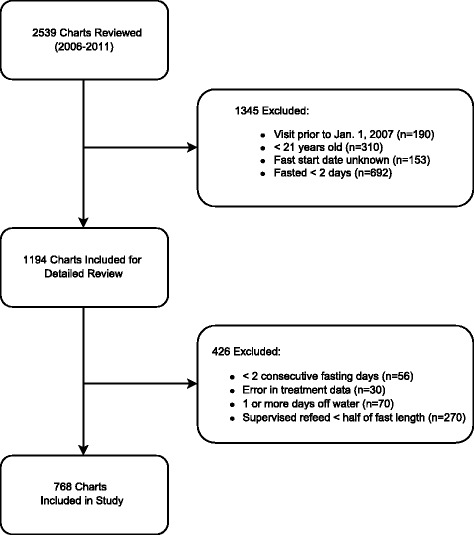
Methods: Electronic charts from patient visits to a residential medical facility from 2006 to 2011 were reviewed. Patients who were at least 21 years of age and water-only fasted for ≥2 consecutive days with a refeeding period equal to half of the fast length were included. Out of 2539 charts, 768 visits met our inclusion and exclusion criteria. AEs were abstracted from chart notes and classified according to CTCAE (v4.03) and MedDRA (v12.1) terminology. Descriptive analysis of AEs is reported.
Results: During the protocol period, the highest grade AE (HGAE) in 555 visits was a grade 2 event or lower, in 212 visits it was a grade 3 event, in 1 visit it was a grade 4 event, and there were no grade 5 events. There were 2 (0.002%) visits with a serious adverse event (SAE). The majority of AEs identified were mild (n = 4490, 75%) in nature and known reactions to fasting.
Conclusions: To our knowledge, this is the most comprehensive analysis of AEs experienced during medically supervised, water-only fasting conducted to date. Overall, our data indicate that the majority of AEs experienced were mild to moderate and known reactions to fasting. This suggests that the protocol used in this study can be safely implemented in a medical setting with minimal risk of a SAE.
Keywords: Adverse events; Fasting; Safety.
Conflict of interest statement
Ethics approval and consent for participation
This study was approved by the Institutional Review Board (IRB) at the AOMA Graduate School of Integrative Medicine (AOMA: 2015–002). The research was conducted in accordance with the approved protocol and complied with the standards of the Declaration of Helsinki. This study involved a retrospective review of existing data that was de-identified prior to analysis and was granted a waiver of informed consent by the AOMA IRB.
Consent for publication
Not applicable for this study.
Competing interests
ACG is the director of the TrueNorth Health Center, president of the board of the TrueNorth Health Foundation, and member of the board of the National Health Association. He does not receive financial compensation for these roles. BCS and TRM are paid consultants for the TrueNorth Health Foundation, which is funded in part by the TrueNorth Health Center. JSF received funds from the National Health Association grant.
Publisher’s Note
Springer Nature remains neutral with regard to jurisdictional claims in published maps and institutional affiliations.
Figures

References
-
- Fredericks R. Fasting: an exceptional human experience. San Jose: All Things Published Well; 2013.
-
- Goldhamer AC, Helms S, Salloum TK. Fasting. 4. St. Louis: Elsevier Churchill Livingstone; 2013.
-
- Furhman J. Fasting and eating for health: a medical doctor's program for conquering disease. New York: St. Martin's Griffin; 1995.
Publication types
MeSH terms
Substances
Grants and funding
LinkOut - more resources
Full Text Sources
Other Literature Sources
Medical
Miscellaneous
