


Efficacy and safety assessment of a water-soluble formulation of fluralaner for treatment of natural Ornithonyssus sylviarum infestations in laying hens
- PMID: 29458439
- PMCID: PMC5819287
- DOI: 10.1186/s13071-018-2678-y
Efficacy and safety assessment of a water-soluble formulation of fluralaner for treatment of natural Ornithonyssus sylviarum infestations in laying hens
Abstract
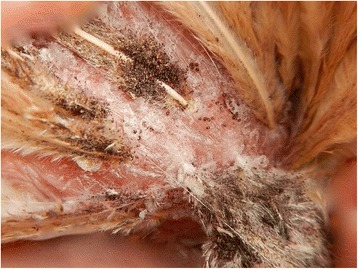
Background: Northern fowl mite, Ornithonyssus sylviarum (Canestrini & Fanzago, 1877), infestations can stress birds, impairing welfare and causing substantial economic losses. A study was undertaken to determine the efficacy of an ectoparasiticide solution (fluralaner) for oral administration in the treatment of mite-infested hens.
Methods: Clinically healthy, naturally mite-infested laying hens (n = 132), approximately 32 weeks of age, were ranked by Day -9 mite vent counts and randomized among 12 study pens, each to hold one of four treatment groups. Three groups received fluralaner-medicated water by oral gavage at dose rates of 0.25, 0.5 or 1.0 mg/kg on Days 0 and 7; one group was an untreated control (three pens for each group). Five naturally infested untreated birds were included in each pen to act as mite-infested source birds. Thus each pen, treated and control, had six non-source birds for assessment of efficacy, plus five source birds to provide ongoing challenge. Primary efficacy assessments were based on mean O. sylviarum vent counts from non-source birds in the control and treated group pens on Days 1, 2, 6, 8, 12, 15, 19, 22 and 26.
Results: Source-birds maintained infestations throughout the study, validating the challenge to study birds. On Days 1 through 22, mean control group mite counts were significantly greater than those of the treated groups (P ≤ 0.013). Relative to the control group, mean O. sylviarum counts were reduced by at least 90% from Day 6 through Days 19, 22 and 22 in the fluralaner 0.25, 0.5 and 1.0 mg/kg groups, respectively. On Day 19, mean mite counts were lower in the 0.5 and 1.0 mg/kg groups compared with the 0.25 mg/kg group (P ≤ 0.018), and in the 1.0 mg/kg compared with the 0.5 mg/kg group (P = 0.014). There were no adverse events in treated birds.
Conclusions: A fluralaner solution administered twice by gavage to laying hens with a one-week between-treatment interval was safe and effective in quickly controlling O. sylviarum infestations despite continuous challenge from infested birds. By eliminating mites, this fluralaner solution has the potential to improve bird health and productivity, and to eliminate the burden of topical pesticide application.
Keywords: Efficacy; Fluralaner; Northern fowl mite; Ornithonyssus sylviarum; Poultry.
Conflict of interest statement
Ethics approval
Animals were maintained in accordance with procedures of The University of Georgia Institutional Animal Care and Use Committee (IACUC), UGA Animal Welfare Assurance #A3437-01, AUP # A2013 06-018-A1.
Consent for publication
Not applicable.
Competing interests
NCH has conducted research funded by over a dozen pharmaceutical firms; FJ, ES, FS and AF-S are employees of Merck Animal Health.
Publisher’s Note
Springer Nature remains neutral with regard to jurisdictional claims in published maps and institutional affiliations.
Figures
References
-
- Vezzoli G, King AJ, Mench JA. The effect of northern fowl mite (Ornithonyssus sylviarum) infestation on hen physiology, physical condition, and egg quality. Poult Sci. 2016;95:1042–9. - PubMed
-
- Murillo AC, Chappell MA, Owen JP, Mullens BA. Northern fowl mite (Ornithonyssus sylviarum) effects on metabolism, body temperatures, skin condition, and egg production as a function of hen MHC haplotype. Poult Sci. 2016;95:2536–46. - PubMed
-
- Mullens BA, Owen JP, Kuney DR, Szijj CE, Klingler KA. Temporal changes in distribution, prevalence and intensity of northern fowl mite (Ornithonyssus sylviarum) parasitism in commercial caged laying hens, with a comprehensive economic analysis of parasite impact. Vet Parasitol. 2009;160:116–33. - PubMed
Publication types
MeSH terms
Substances
LinkOut - more resources
Full Text Sources
Other Literature Sources
