. 2018 Jun:81:157-166.
doi: 10.1016/j.addbeh.2018.02.017. Epub 2018 Feb 12.

Problematic internet use as an age-related multifaceted problem: Evidence from a two-site survey

Affiliations

Problematic internet use as an age-related multifaceted problem: Evidence from a two-site survey

Konstantinos Ioannidis et al. Addict Behav. 2018 Jun.

Abstract

Background and aims: Problematic internet use (PIU; otherwise known as Internet Addiction) is a growing problem in modern societies. There is scarce knowledge of the demographic variables and specific internet activities associated with PIU and a limited understanding of how PIU should be conceptualized. Our aim was to identify specific internet activities associated with PIU and explore the moderating role of age and gender in those associations.

Methods: We recruited 1749 participants aged 18 and above via media advertisements in an Internet-based survey at two sites, one in the US, and one in South Africa; we utilized Lasso regression for the analysis.

Results: Specific internet activities were associated with higher problematic internet use scores, including general surfing (lasso β: 2.1), internet gaming (β: 0.6), online shopping (β: 1.4), use of online auction websites (β: 0.027), social networking (β: 0.46) and use of online pornography (β: 1.0). Age moderated the relationship between PIU and role-playing-games (β: 0.33), online gambling (β: 0.15), use of auction websites (β: 0.35) and streaming media (β: 0.35), with older age associated with higher levels of PIU. There was inconclusive evidence for gender and gender × internet activities being associated with problematic internet use scores. Attention-deficit hyperactivity disorder (ADHD) and social anxiety disorder were associated with high PIU scores in young participants (age ≤ 25, β: 0.35 and 0.65 respectively), whereas generalized anxiety disorder (GAD) and obsessive-compulsive disorder (OCD) were associated with high PIU scores in the older participants (age > 55, β: 6.4 and 4.3 respectively).

Conclusions: Many types of online behavior (e.g. shopping, pornography, general surfing) bear a stronger relationship with maladaptive use of the internet than gaming supporting the diagnostic classification of problematic internet use as a multifaceted disorder. Furthermore, internet activities and psychiatric diagnoses associated with problematic internet use vary with age, with public health implications.

Keywords: Behavioral addiction; Internet addiction; Internet gaming disorder; Lasso; Machine learning; Problematic internet use.


Figures

Fig. 1
Fig. 1
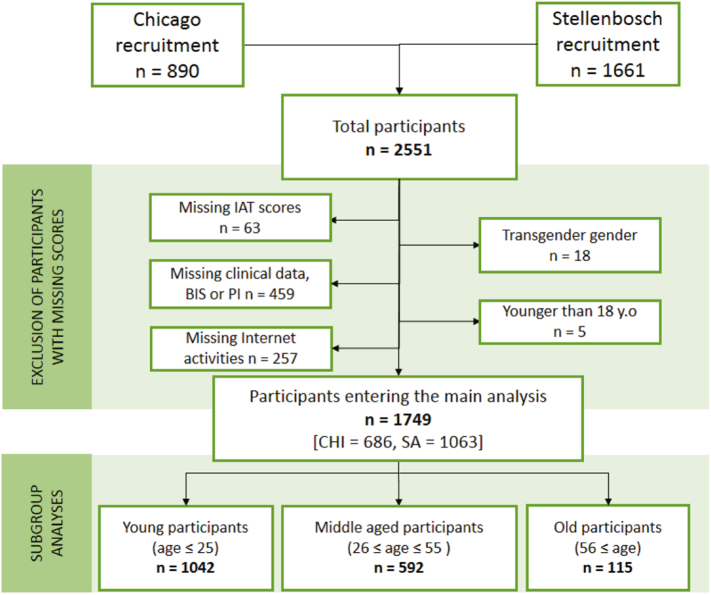
Recruitment flow diagram. Flow diagram describing recruitment and exclusion from main and subgroup analyses; IAT: Internet Addiction test; PI: Padua Inventory-Revised; BIS - Barratt Impulsiveness Scale 11; CHI – Chicago; SA – South Africa (Stellenbosch). (For interpretation of the references to colour in this figure legend, the reader is referred to the web version of this article.)
Fig. 2
Fig. 2
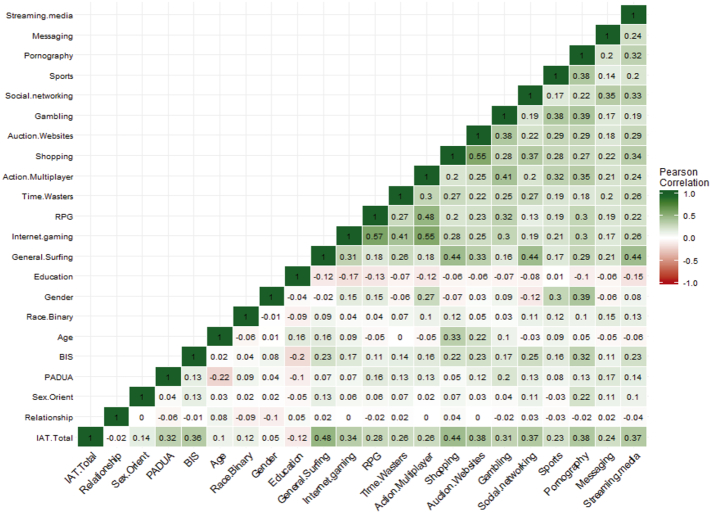
Exploratory correlation matrix of variables. Pearson correlations between all variables. Positive correlations are indicated in green gradient colour, negative correlations are in red gradient. IAT. Total - Internet Addiction Score; PADUA - PADUA Inventory score; BIS - Barratt Impulsiveness Scale score; RPG - Online Role Playing games. (For interpretation of the references to colour in this figure legend, the reader is referred to the web version of this article.)
Fig. 3
Fig. 3
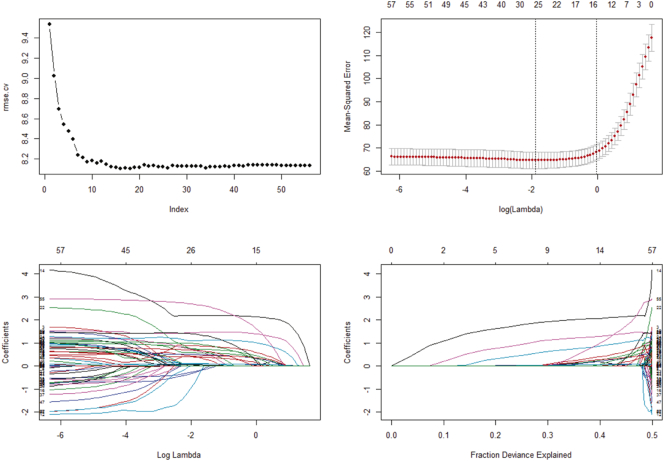
Explanatory plots for cross-validated errors and Lasso coefficients. Explanatory plots for cross-validated errors and Lasso coefficients (all participants n = 1749). The first plot (top left) demonstrates the cross-validated root mean squared error (rmse.cv) as a function of number of variables included in the linear regression model. The plot demonstrates that adding more than ~16 variables in the model does not necessarily improve the model in terms of RMSE reduction. The second plot (top right) demonstrates the 10-fold cross-validated mean squared error as a function of (log) lambda (λ) for the lasso regularized model using the full data with interaction terms. The top numbering of the plot indicates the number of predictors (variables) the model is using, going from all predictors (top left corner) to more sparse models (top right corner). This function helps the optimization of Lasso in terms of choosing the best λ. The third plot (bottom left) shows the predictors coefficients scores as a function of log(λ) indicating the shrinkage of coefficients for larger numbers of log(λ). The top numbering of the plot indicates the number of predictors (variables) the model is using, going from all predictors (top left corner) to more sparse models (top right corner). The last plot (bottom right) shows the fraction of deviance explained by the models in relation to the number of predictors used and their coefficients. Each coloured line described a single predictor and its coefficient score. The plot shows that close to the maximum fraction of deviance explained larger coefficients occur indicating likely over-fitting of the model. (For interpretation of the references to colour in this figure legend, the reader is referred to the web version of this article.)
Fig. 4
Fig. 4
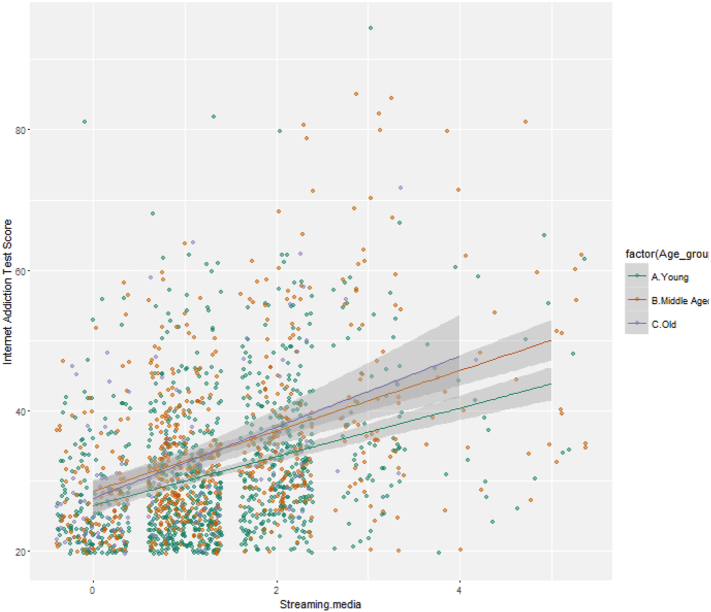
Example exploratory figure of the association between Problematic internet use and streaming media, by age group. This is an example figure showing the relationship between Problematic internet use (PIU) and streaming media grouped by age. The regression lines are linear models with confidence intervals (grey areas). Interestingly, streaming media appears to be less associated with PIU in the young age ≤ 25 as compared to older people >55 (also shown in Lasso analysis in the main paper; Lasso coef Streaming media β: 0.0 for young and β: 1.2 for old, Age × Streaming Media interaction Lasso coef β: 0.35). (For interpretation of the references to colour in this figure legend, the reader is referred to the web version of this article.)

References

    1. Achab S., Nicolier M., Mauny F., Monnin J., Trojak B., Vandel P.…Haffen E. Massively multiplayer online role-playing games: Comparing characteristics of addict vs non-addict online recruited gamers in a French adult population. BMC Psychiatry. 2011;11:144. - PMC - PubMed
    1. American Psychiatric Association . American Psychiatric Association; Washington, D.C: 2013. Diagnostic and statistical manual of mental disorders: DSM-5.
    1. Andreassen C.S., Torsheim T., Brunborg G.S., Pallesen S. Development of a Facebook addiction scale. Psychological Reports. 2012;110(2):501–517. - PubMed
    1. Bakken I.J., Wenzel H.G., Götestam K.G., Johansson A., Oren A. Internet addiction among Norwegian adults: A stratified probability sample study. Scandinavian Journal of Psychology. 2009;50(2):121–127. - PubMed
    1. Black D.W. A review of compulsive buying disorder. World Psychiatry: Official Journal of the World Psychiatric Association (WPA) 2007;6(1):14–18. http://www.ncbi.nlm.nih.gov/pubmed/17342214 Retrieved from. - PMC - PubMed

Publication types

MeSH terms