. 2019 Jun;25(3):771-789.
doi: 10.1007/s11948-018-0023-7. Epub 2018 Feb 19.

Testing Hypotheses on Risk Factors for Scientific Misconduct via Matched-Control Analysis of Papers Containing Problematic Image Duplications

Affiliations

Testing Hypotheses on Risk Factors for Scientific Misconduct via Matched-Control Analysis of Papers Containing Problematic Image Duplications

Daniele Fanelli et al. Sci Eng Ethics. 2019 Jun.

Abstract

It is commonly hypothesized that scientists are more likely to engage in data falsification and fabrication when they are subject to pressures to publish, when they are not restrained by forms of social control, when they work in countries lacking policies to tackle scientific misconduct, and when they are male. Evidence to test these hypotheses, however, is inconclusive due to the difficulties of obtaining unbiased data. Here we report a pre-registered test of these four hypotheses, conducted on papers that were identified in a previous study as containing problematic image duplications through a systematic screening of the journal PLoS ONE. Image duplications were classified into three categories based on their complexity, with category 1 being most likely to reflect unintentional error and category 3 being most likely to reflect intentional fabrication. We tested multiple parameters connected to the hypotheses above with a matched-control paradigm, by collecting two controls for each paper containing duplications. Category 1 duplications were mostly not associated with any of the parameters tested, as was predicted based on the assumption that these duplications were mostly not due to misconduct. Categories 2 and 3, however, exhibited numerous statistically significant associations. Results of univariable and multivariable analyses support the hypotheses that academic culture, peer control, cash-based publication incentives and national misconduct policies might affect scientific integrity. No clear support was found for the "pressures to publish" hypothesis. Female authors were found to be equally likely to publish duplicated images compared to males. Country-level parameters generally exhibited stronger effects than individual-level parameters, because developing countries were significantly more likely to produce problematic image duplications. This suggests that promoting good research practices in all countries should be a priority for the international research integrity agenda.

Keywords: Duplication; Fabrication; Falsification; Fraud; Gender; Pressures to publish; Research integrity; Scientific misconduct.


Figures
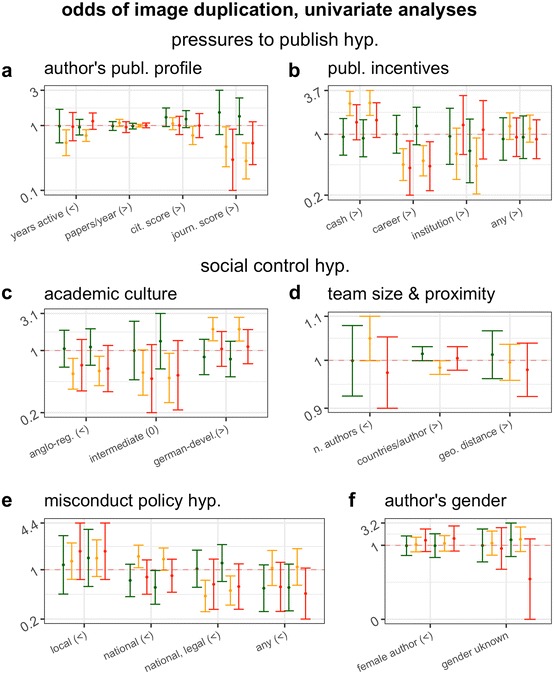
Fig. 1
Fig. 1
Effect (odds ratio and 95% CI) of characteristics of study and of first and last authors on the odds of publishing a paper containing a category 1 (green), category 2 (yellow) or category 3 (red) problematic image duplication. When six error bars are associated with one test, the first three error bars correspond to data from the first author and the last three are for data from the last author. Panels are subdivided according to overall hypothesis tested, and signs in parentheses indicate direction of expected effect (“>”: OR > 1; “<”: OR < 1; “0”: intermediate effect predicted). The more shifted the error bars are from the value of OR = 1 (dotted horizontal line), the larger the magnitude of effect measured. Bars that do not overlap with the OR = 1 line indicate an effect that is statistically significant at the 0.05 level or lower
Fig. 2
Fig. 2
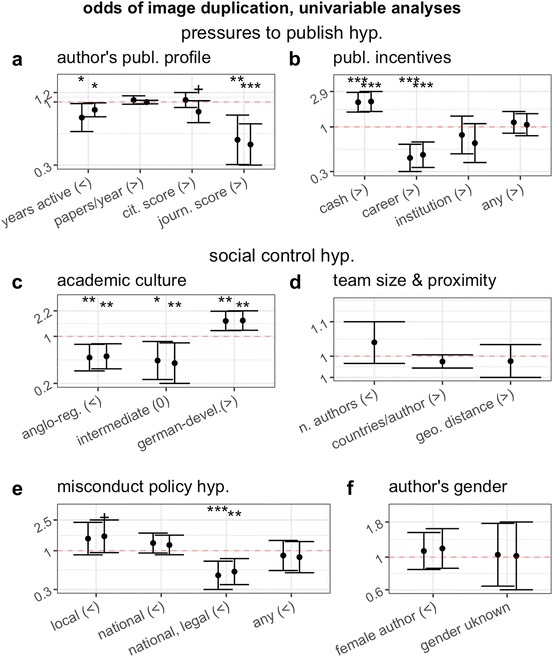
Effect (odds ratio and 95% CI) of characteristics of study and of first and last authors on the odds of publishing a paper containing a category 2 or 3 problematic image duplication. For each individual-level parameter, first and second error bars correspond to data from first and last authors, respectively. Panels are subdivided according to overall hypothesis tested, and signs in parentheses indicate the direction of expected effect (“>”: OR > 1; “<”: OR < 1; “0”: intermediate effect predicted). The more shifted the error bars are from the value of OR = 1 (dotted horizontal line), the larger the magnitude of the effect measured. Bars that do not overlap with the OR = 1 line indicate an effect that is statistically significant at the 0.05 level or lower. Conventional thresholds of statistical significance are flagged above each error bar to facilitate effect estimation (+P < 0.1; *P < 0.05; **P < 0.01; ***P < 0.001)
Fig. 3
Fig. 3
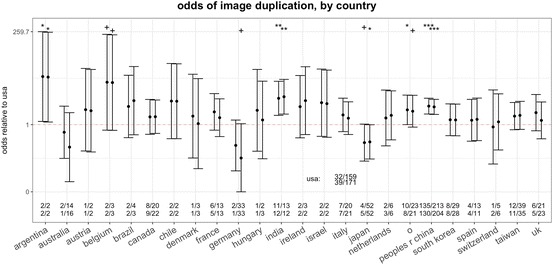
Effect (odds ratio and 95% CI) of country of activity of first and last authors on the odds of publishing a paper containing a category 2 or 3 problematic image duplication, compared to the United States. The data were produced with a multivariable model, in which dummy variables are attributed to countries that were associated with the first or last author of at least one treatment and one control paper. All other countries were included in the “other” category. Numeric data are raw numbers of treatment and control papers for first and last author (upper and lower row, respectively). The more shifted the error bars are from the value of OR = 1 (dotted horizontal line), the larger the magnitude of effect measured. Bars that do not overlap with the OR = 1 line indicate an effect that is statistically significant at the 0.05 level or lower. Conventional thresholds of statistical significance are flagged above each error bar to facilitate effect estimation (+P < 0.1; *P < 0.05; **P < 0.01; ***P < 0.001). The P values calculated for India and China (P = 0.002 and P < 0.001, respectively) remained significant at the 0.05 level if Bonferroni-corrected (i.e. divided by the total number of comparisons made, n = 24)
Fig. 4
Fig. 4
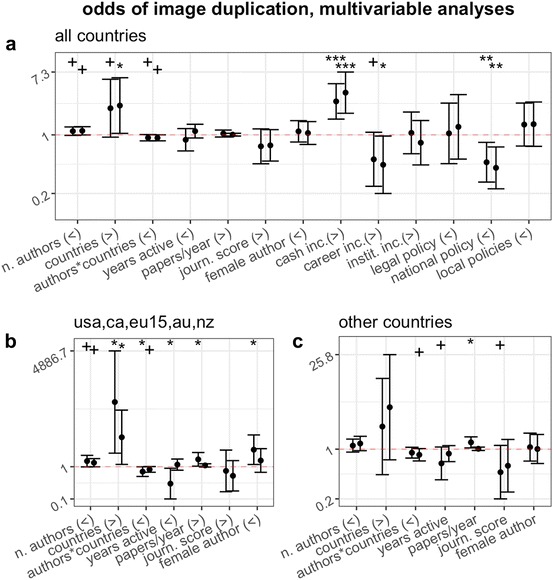
Effect (odds ratio and 95% CI) of characteristics of study and first and last author on the probability of publishing a paper containing a category 2 or 3 problematic image duplication. Each subpanel illustrates results of a multivariable model, partitioned by country subsets (see text for further details). First and second error bars correspond to data from first and last authors, respectively. Signs in parentheses indicate direction of expected effect (“>”: OR > 1; “<”: OR < 1). The more shifted the error bars are from the value of OR = 1 (dotted horizontal line), the larger the magnitude of effect measured. Bars that do not overlap with the OR = 1 line indicate an effect that is statistically significant at the 0.05 level or lower. Conventional thresholds of statistical significance are flagged above each error bar to facilitate effect estimation (+P < 0.1; *P < 0.05; **P < 0.01; ***P < 0.001)

References

    1. Anderson M, Ronning E, De Vries R, Martinson B. The perverse effects of competition on scientists’ work and relationships. Science and Engineering Ethics. 2007;13(4):437–461. doi: 10.1007/s11948-007-9042-5. - DOI - PubMed
    1. Bik EM, Casadevall A, Fang FC. The prevalence of inappropriate image duplication in biomedical research publications. Mbio. 2016;7(3):e00809–e00816. doi: 10.1128/mBio.00809-16. - DOI - PMC - PubMed
    1. Caron, E., & Van Eck, N. J. (2014). Large scale author name disambiguation using rule-based scoring and clustering.. In E. Noyons (Ed.), Proceedings of the 19th international conference on science and technology indicators, Leiden, The Netherlands (pp. 79–86). Universiteit Leiden—CWTS.
    1. Costas R, Bordons M. Do age and professional rank influence the order of authorship in scientific publications? Some evidence from a micro-level perspective. Scientometrics. 2011;88(1):145–161. doi: 10.1007/s11192-011-0368-z. - DOI - PMC - PubMed
    1. DFG. (2010). Quality not quantity—DFG adopts rules to counter the flood of publications in research. http://www.dfg.de/en/service/press/press_releases/2010/pressemitteilung_....

LinkOut - more resources