


The effect of digital rectal exam on the 4Kscore for aggressive prostate cancer
- PMID: 29460452
- PMCID: PMC6237549
- DOI: 10.1002/pros.23495
The effect of digital rectal exam on the 4Kscore for aggressive prostate cancer
Abstract
Background: The 4Kscore is a new commercially available blood-based diagnostic test which predicts risk for aggressive, clinically significant prostate cancer on prostate biopsy. The 4Kscore is currently restricted to patients who have not had a digital rectal exam (DRE) in the previous 96 h, owing to prior mixed data suggesting that prostate specific antigen (PSA) isoforms may increase by a statistically significant-if not necessarily clinically significant-amount shortly after DRE. Our primary objective was to determine if 4Kscore test results are affected by a preceding DRE.
Methods: Participants at a Prostate Cancer Awareness Week screening event sponsored by the Prostate Conditions Education Council filled out clinical history questionnaires and had blood samples for 4Kscore testing drawn prior to DRE, then 15-45 min following DRE. Patients with prior cancer diagnosis, 5-alpha reductase inhibitor medication use, or lower urinary tract procedures in the prior 6 months were excluded, resulting in a population of 162 participants for analysis. Values were then compared to determine if there was a significant difference in 4Kscore following DRE.
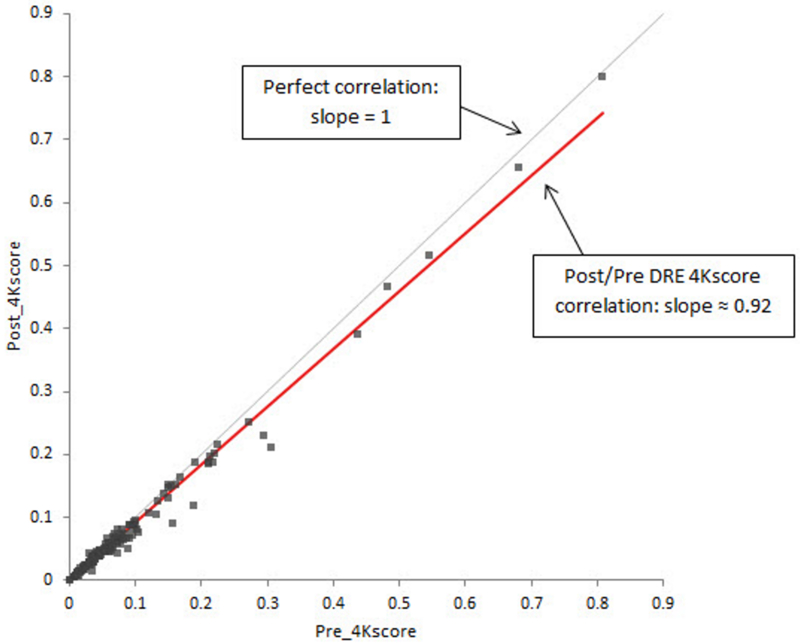
Results: A statistically significant increase was seen in levels of 3 kallikreins measured (total PSA, free PSA, and intact PSA; median <0.03 ng/mL for all). This resulted in a small but statistically significant decrease in post-DRE 4Kscore (median absolute score decrease 0.43%). Using a 4Kscore cutoff of 7.5% resulted in reclassification of 10 patients (6.2%), nine of whom were "downgraded" from above the cutoff to below.
Conclusions: If the blood draw for the 4 K score is performed after a screening DRE, there is a statistically significant difference in the 4 K score results, but in the vast majority of cases it would not affect clinical decision making.
Keywords: biomarker; prostate cancer; prostate cancer screening.
© 2018 Wiley Periodicals, Inc.
Figures

References
-
- Vickers AJ, Cronin AM, Aus G, Pihl CG, Becker C, Pettersson K, Scardino PT, Hugosson J, Lilja H. A panel of kallikrein markers can reduce unnecessary biopsy for prostate cancer: data from the European Randomized Study of Prostate Cancer Screening in Goteborg, Sweden. BMC.Med 2008; 6:19. - PMC - PubMed
-
- Vickers AJ, Cronin AM, Roobol MJ, Savage CJ, Peltola M, Pettersson K, Scardino PT, Schroder FH, Lilja H. A four-kallikrein panel predicts prostate cancer in men with recent screening: data from the European Randomized Study of Screening for Prostate Cancer, Rotterdam. Clinical Cancer Research 2010; 16(12):3232–3239. - PMC - PubMed
-
- Gupta A, Roobol MJ, Savage CJ, Peltola M, Pettersson K, Scardino PT, Vickers AJ, Schroder FH, Lilja H. A four-kallikrein panel for the prediction of repeat prostate biopsy: data from the European Randomized Study of Prostate Cancer screening in Rotterdam, Netherlands. British Journal of Cancer 2010; 103(5):708–714. - PMC - PubMed
-
- Vickers AJ, Gupta A, Savage CJ, Pettersson K, Dahlin A, Bjartell A, Manjer J, Scardino PT, Ulmert D, Lilja H. A panel of kallikrein marker predicts prostate cancer in a large, population-based cohort followed for 15 years without screening. Cancer Epidemiology, Biomarkers and Prevention 2011; 20(2):255–261. - PMC - PubMed
-
- Carlsson S, Maschino A, Schroder F, Bangma C, Steyerberg EW, Van der Kwast T, van LG, Vickers A, Lilja H, Roobol MJ. Predictive value of four kallikrein markers for pathologically insignificant compared with aggressive prostate cancer in radical prostatectomy specimens: results from the European Randomized Study of Screening for Prostate Cancer section Rotterdam. Eur.Urol 2013; 64(5):693–699. - PMC - PubMed
Publication types
MeSH terms
Substances
Grants and funding
LinkOut - more resources
Full Text Sources
Other Literature Sources
Medical
Research Materials
Miscellaneous
