doi: 10.3201/eid2403.171178.
Molecular and Epidemiologic Analysis of Reemergent Salmonella enterica Serovar Napoli, Italy, 2011-2015
- PMID: 29460759
- PMCID: PMC5823338
- DOI: 10.3201/eid2403.171178
Item in Clipboard
Molecular and Epidemiologic Analysis of Reemergent Salmonella enterica Serovar Napoli, Italy, 2011-2015
Emerg Infect Dis.
2018 Mar.
Abstract
Human infections with Salmonella enterica serovar Napoli are uncommon in Europe. However, these infections represented 5.9% of salmonellosis cases in Italy during 2014-2015. The source of infection is unknown. We analyzed surveillance data and compared strain genetic similarities and found that contaminated vegetables and surface water are probable sources of human infection.
Keywords: Italy; Salmonella enterica serovar Napoli; bacteria; environment; epidemiology; food contamination; food safety; human infections; infections; molecular analysis; reemergence; salmonellosis; surface water; vegetables; waterborne disease; zoonoses.
Figures
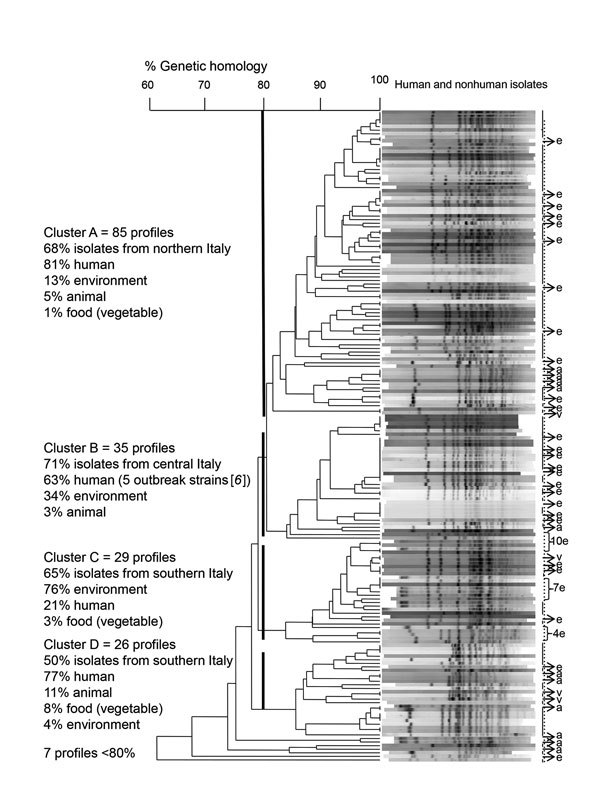
Dendrogram of 182 pulsed-field gel electrophoresis–based profiles of Salmonella enterica serovar Napoli strains isolated from human, environmental, animal, and food samples in Italy, 2011–2015. Four main clusters matched with the 3 main geographic areas in Italy (cluster A in northern Italy, cluster B in central Italy, and clusters C and D in southern Italy). Genetic analysis was based on 80% homology. Human strains (n = 124) are indicated by a solid vertical line. e indicates environmental strains (n = 46), a indicates animal strains (n = 8), and v indicates food (vegetable) strains (n = 4).
References
-
- Gizzarelli S, Salmaso S, Toti L, Zanoni D. [Microbiologic investigation of chocolate contaminated with Salmonella napoli] [in Italian]. Nuovi Ann Ig Microbiol. 1983;34:347–52. - PubMed
-
- Costa E, Pontello M, Pedroni M, Penna L. Epidemiological investigation on the diffusion of S. enterica ser. Napoli through equine meat in the province of Brescia [in Italian]. Arch Vet Ital. 1986;37:115–22.
-
- Graziani C, Luzzi I, Owczarek S, Dionisi AM, Busani L. Salmonella enterica serovar Napoli infection in Italy from 2000 to 2013: spatial and spatio-temporal analysis of cases distribution and the effect of human and animal density on the risk of infection. PLoS One. 2015;10:e0142419. 10.1371/journal.pone.0142419 - DOI - PMC - PubMed
Publication types
MeSH terms
LinkOut - more resources
Full Text Sources
Other Literature Sources
Medical