. 2018 May;31(5):e3903.
doi: 10.1002/nbm.3903. Epub 2018 Feb 20.

Towards an analytic solution for pulsed CEST

Affiliations

Towards an analytic solution for pulsed CEST

Daniel F Gochberg et al. NMR Biomed. 2018 May.

Abstract

Chemical exchange saturation transfer (CEST) is an imaging method based on magnetization exchange between solutes and water. This exchange generates changes in the measured signal after off-resonance radiofrequency irradiation. Although the analytic solution for CEST with continuous wave (CW) irradiation has been determined, most studies are performed using pulsed irradiation. In this work, we derive an analytic solution for the CEST signal after pulsed irradiation that includes both short-time rotation effects and long-time saturation effects in a two-pool system corresponding to water and a low-concentration exchanging solute pool. Several approximations are made to balance the accuracy and simplicity of the resulting analytic form, which is tested against numerical solutions of the coupled Bloch equations and is found to be largely accurate for amides at high fields, but less accurate at the higher exchange rates, lower offsets and typically higher irradiation powers of amines.

Keywords: CERT; CEST; analytic; exchange.


Figures

FIGURE A1
FIGURE A1
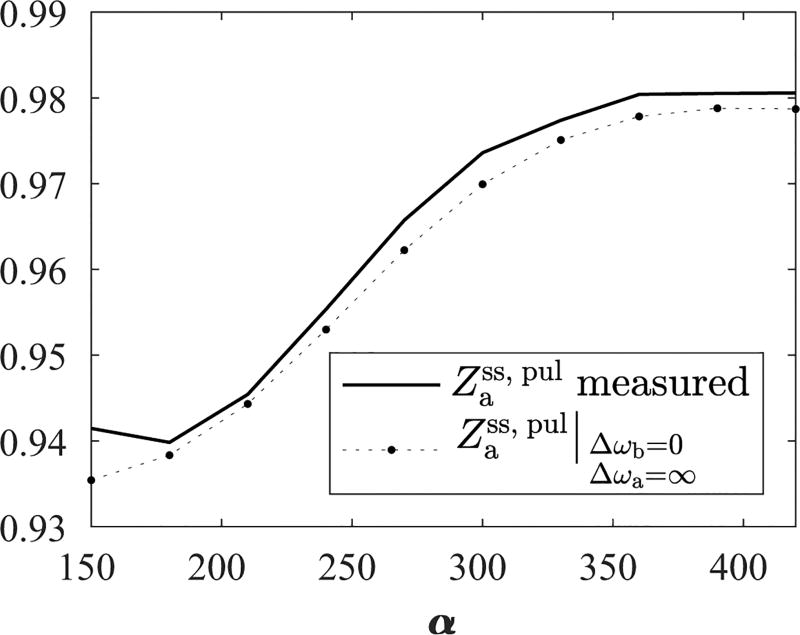
Zass,pul analytic results (dots, Equations 1, 2 and 4–12) versus experimental measures (lines) in a creatine phantom as a function of the B1-induced rotation angle when irradiating at the solute resonance (Δωb = 0). Pulsed irradiation is applied with α between 150 and 420°, tp = 16.8 ms and a root-mean-square B1 amplitude of 0.6 µT
FIGURE 1
FIGURE 1
(a) A chemical exchange saturation transfer (CEST) Z-spectrum is the steady-state normalized water z-magnetization (Zass) after radiofrequency irradiation at a frequency offset Δωa from the water resonant frequency ωa. (b) The radiofrequency irradiation pulse train consists of a series of shaped (typically Gaussian) pulses (blue line), which are approximated in this work by a train of square pulses (red line). The train is repeated until reaching a steady state, which may take hundreds of pulses. The transverse magnetization is spoiled between pulses
FIGURE 2
FIGURE 2
Zass, pul analytic (dots, Equations 1–3 and 5–12) versus numerical (lines) results as a function of irradiation offset (which changes Δωa and Δωb). Note the strong agreement, especially near the solute resonances at 3.5 ppm (amide) and 2.0 ppm (amine). Discrepancies occur at higher B1 values, faster exchange rates and small Δωa values. As in all the figures, the plot rows correspond to no exchange (kb = 0.0001 s−1, Δωb−Δωa = 3.5 ppm), amide exchange (kb = 50 s−1, Δωb−Δωa = 3.5 ppm) and amine exchange (kb = 1000 s−1, Δωb−Δωa = 2.0 ppm). The plot columns correspond to differing roots of the mean square B1 amplitudes. (In the continuous wave plots below, the columns correspond to simple differing B1 amplitudes)
FIGURE 3
FIGURE 3
Zass, pul analytic (dots, Equations 1, 2 and 4–12) versus numerical (lines) results as a function of the B1-induced rotation angle when irradiating at the solute resonance (Δωb = 0). Note the strong agreement for amides. This is the key result: that the analytic form accurately models the effect of solute rotation on the steady-state water magnetization, at least at the larger offsets and slower exchange rates of amides
FIGURE 4
FIGURE 4
Short-time evolution of Za(t) and Zb(t), together with the projection of Zai along the a-pool effective field. Note that the time scale of Zb(t) variations is large relative to that of Za(t) oscillations (at rate ωeff,a) and short relative to that of Za(t) exponential decay (at rate R). Hence, for purposes of deriving the Zb(t) evolution, Za(t) can be approximated by the projection of Zai. This approximation fails for amines at large irradiation powers, where Zb(t) oscillates quickly and Za(t) has non-trivial exponential decay
FIGURE 5
FIGURE 5
Analytic (dots) versus numerically determined (lines) eigenvalues of the 6 × 6 evolution matrix in Equation 14. Note the strong agreement
FIGURE 6
FIGURE 6
Analytic (Equations 15 and 16, dots) and numerical (lines) values of the a-pool component amplitudes as a function of the irradiation frequency offset. Note the reasonable agreement, as long as there is limited direct water (a-pool) rotation, which has been ignored in our analytic form. We have also ignored R1ρ,fast and ωeff,b contributions to the a-pool, all of which give negligible contributions
FIGURE 7
FIGURE 7
Analytic (Equations 17 and 23–27, dots) and numerical (lines) values of the b-pool component amplitudes as a function of the irradiation frequency. Note the reasonable agreement, as long as direct water (a-pool) rotation effects are limited by avoiding small offsets and high powers. We have ignored ωeff,a contributions to the b-pool, which appear to give small contributions, except for fast amine exchange near Δωa = 0
FIGURE 8
FIGURE 8
Analytic (dots) versus numerical (lines) Za(t) terms versus time, when irradiating at the solute resonance. Note the general agreement, which decreases for fast and small offset amine exchange and for high B1 = 6 µT irradiation amplitude
FIGURE 9
FIGURE 9
Analytic (dots) versus numerical (lines) Zb(t) terms versus time, when irradiating at the solute resonance. Note the very strong agreement, except for amine exchange at the highest (6 µT) irradiation amplitude
FIGURE 10
FIGURE 10
Analytic (dots) and numerical (lines) Za(t) and Zb(t) values during two Gaussian pulses applied at the solute resonance. An α = 3π rotation is applied in order to clearly illustrate the ability of the analytic solution to accurately model solute rotations. However, note the deviations, especially at fast amine exchange rates

References

    1. Zhou J, Lal B, Wilson DA, Laterra J, van Zijl PCM. Amide proton transfer (APT) contrast for imaging of brain tumors. Magn Reson Med. 2003;50:1120–1126. - PubMed
    1. Zhou J, Payen J-F, Wilson DA, Traystman RJ, van Zijl PCM. Using the amide proton signals of intracellular proteins and peptides to detect pH effects in MRI. Nat Med. 2003;9:1085–1090. - PubMed
    1. Haris M, Nanga RPR, Singh A, et al. Exchange rates of creatine kinase metabolites: feasibility of imaging creatine by chemical exchange saturation transfer MRI. NMR Biomed. 2012;25:1305–1309. - PMC - PubMed
    1. Walker-Samuel S, Ramasawmy R, Torrealdea F, et al. In vivo imaging of glucose uptake and metabolism in tumors. Nat Med. 2013;19:1067–1072. - PMC - PubMed
    1. Zaiss M, Bachert P. Exchange-dependent relaxation in the rotating frame for slow and intermediate exchange – modeling off-resonant spin-lock and chemical exchange saturation transfer. NMR Biomed. 2013;26:507–518. - PubMed

Publication types

MeSH terms

LinkOut - more resources