Case Reports
. 2018 Feb 20;18(1):202.
doi: 10.1186/s12885-018-4070-x.

Metastatic cardiac tumors: from clinical presentation through diagnosis to treatment

Affiliations
Case Reports

Metastatic cardiac tumors: from clinical presentation through diagnosis to treatment

Ivana Burazor et al. BMC Cancer. .

Abstract

Background: To evaluate the prevalence of metastatic tumors involving the myocardium and study their presentation in order to increase awareness to their existence.

Methods: Pathological reports from Sheba Medical Center (Israel, January 1, 2010 through December 31, 2015) and medical records from The Institute for Cardiovascular Diseases of Vojvodina, Sremska Kamenica (Serbia, 23 years period) were screened for cases of metastatic cardiac tumors. Medical, radiological and pathological data of identified cases was retrieved and reviewed.

Results: Out of thousands of registered cardiac surgeries we found less than a dozen cases of metastatic cardiac tumors classified as melanoma, carcinomas of lung, colon and kidney and sarcomas of uterine origin. We found that metastatic cardiac tumors comprised 15.8% of all the cardiac tumors.

Conclusions: Metastatic cardiac tumors are extremely rare. As new diagnostic technologies and improved survival of oncological patients may increase the incidence of metastatic cardiac tumors in the future, awareness to their existence and knowledge of their presentation are key factors in their timely recognition.

Keywords: Melanoma; Metastatic carcinoma; Metastatic cardiac tumors; Metastatic sarcoma; Myocardium.


Conflict of interest statement

Ethics approval and consent to participate

Radiological and pathological information was available only for the cases from SMC. The study was approved by the SMC Institutional Research Ethics Committee (approval no. 3235–16-SMC, valid till June 16, 2017) and conforms with Serbian and TICDV regulations for use of clinical data and research.

Competing interests

The authors declare that they have no competing interests.

Publisher’s Note

Springer Nature remains neutral with regard to jurisdictional claims in published maps and institutional affiliations.

Figures
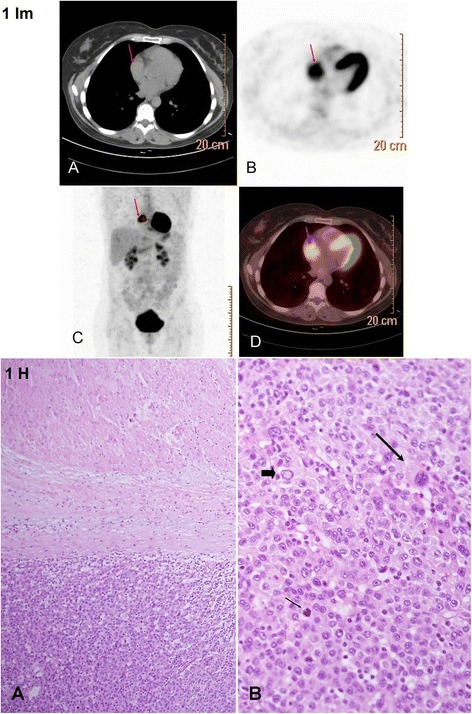
Fig. 1
Fig. 1
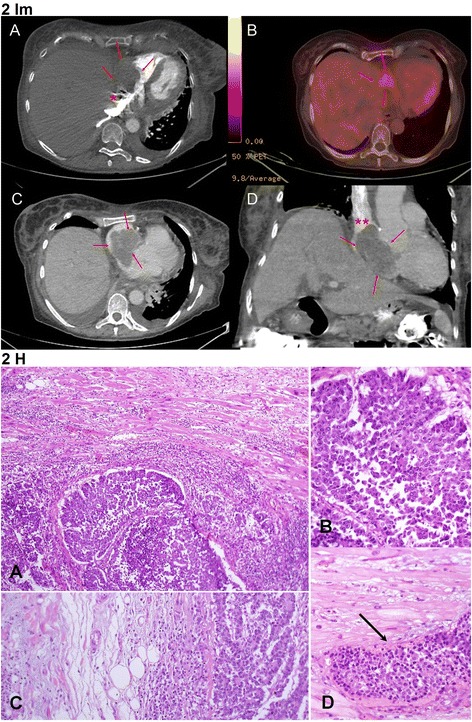
Im: Case no. 1: Metastatic melanoma in the right atrium - Imaging. a – Axial non contrast CT section (part of the positron emission tomography CT): no obvious mass is demonstrated in the RA (red arrow) due to the lack of contrast administration. b – positron emission tomography CT, axial section demonstrating the right atrium mass with significant fluorodeoxyglucose uptake (red arrow), consistent with high metabolic activity. c – Whole body positron emission tomography CT, coronal section, the right atrium mass depicts substantial fluorodeoxyglucose uptake (red arrow). d – Fused positron emission tomography CT image, axial section (parallel to a & b) showing the right atrium mass along with the fluorodeoxyglucose uptake (red arrow). Fig. 1 H: Case no. 1: Metastatic melanoma in the right atrium - Histology. a - Cardiac muscle is seen in the upper part, separated by fibrosis and mild inflammatory infiltrate from a metastatic melanoma mass seen in the lower part, HE X100. b – Metastatic melanoma growing in solid sheets of cells. The melanoma cells show typical features of abundant cytoplasm, large nuclei with prominent nucleoli, occasional intranuclear inclusions (wide short arrow), bizarre atypical cells (thin long arrow) and numerous mitotic figures (thin short arrow), HE X400
Fig. 2
Fig. 2
Im: Case no.2: Poorly differentiated adenocarcinoma of the colon, metastatic to the right atrium - Imaging a - Contrast enhanced CT axial section demonstrating a large right atrium mass (red arrows). The mass protrudes into the IVC (asterisks). b – Fused positron emission tomography CT image, axial section, the right atrium mass is highlighted by fluorodeoxyglucose uptake consistent with metabolic activity (red arrow). c – Contrast enhanced CT axial section demonstrating a non-enhancing right atrium mass filling the entire right atrium (red arrows). d – Contrast enhanced CT coronal section showing the large right atrium mass (red arrows) protruding into the superior vena cava (red asterisks). Fig. 2 H: Case no.2: Poorly differentiated adenocarcinoma of the colon, metastatic to the right atrium - Histology. a - Cardiac muscle is seen in the upper part, infiltrate by carcinoma growing in solid to vaguely glandular pattern, seen in the lower part. The cardiac cells show enlarged reactive nuclei and are surrounded by inflammatory infiltrate, HE X100. b – Poorly differentiated carcinoma, HE X400. c – Carcinoma invading into the pericardial adipose tissue, HE X 200. d – Vascular invasion of carcinoma into a small cardiac blood vessel (thin long arrow), HE X400
Fig. 3
Fig. 3
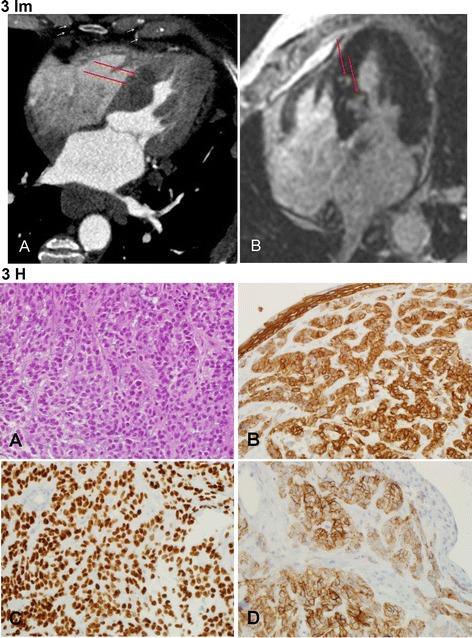
Im: Case no. 3: Metastatic lung basaloid squamous cell carcinoma in the septum and apex of the heart - Imaging. a - Cardiac CT: Four chamber view demonstrating hypodense round masses in the interventicular septum (red arrows). b - Cardiac MRI: Four chamber view, delayed enhancement; (normal muscle is hypo-intense - black), two enhancing foci (white) are demonstrated in the interventricular septum (red arrows). Fig. 3 H: Case no. 3: Metastatic lung basaloid squamous cell carcinoma in the septum and apex of the heart - Histology. This lung carcinoma is composed of monomorphic cells with moderate amount of cytoplasm and small prominent nucleoli growing in a trabecular-like pattern. Positive immunosatining for CK 5/6 and p63 demonstrate the basaloid features and enhance the trabecular-like growth pattern. Positive immunostaining for CD56 highlights some neuroendofrine features. a - HE X400. b – Immunosatin for CK5/6 X400. c - Immunosatin for p63 X400. d - Immunosatin for CD56 X400
Fig. 4
Fig. 4
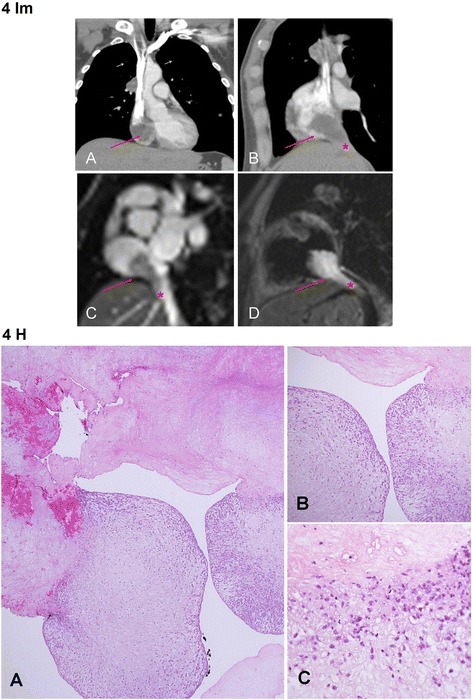
Im: Case no. 4: Metastatic testicular germ cells tumor in the liver with thrombus of the right atrium - Imaging. a – Contrast enhanced CT coronal reconstruction showing a hypodense right atrium mass (arrow). b - Contrast enhanced CT sagittal reconstruction demonstrating the hypodense right atrium mass (arrow) continuing into the IVC (asterisk). c – Cardiac MRI steady stated free precession sequence (“bright blood”): a plane through the right atrium and IVC. A hypointense mass is demonstrated in the right atrium (arrow) protruding into IVC (asterisk). d - Cardiac MRI T2 sequence: a plane through the right atrium and IVC- a hyperintense mass is demonstrated in the RA (arrow) protruding into IVC (asterisk). Fig. 4 H: Case no. 4: Metastatic testicular germ cells tumor in the liver with giant thrombus of the right atrium - Histology. a Most of the cardiac mass consisted of amorphic eosinophilic material, seen in the upper part, representing fibrin of a thrombus. Foci of initial thrombus organization are seen at the bottom, HE X40. In the areas of initial thrombus organization b) and c) spindled mesenchymal cells are present, haphazardly arranged. Unlike in myxoma, these mesenchymal cells do not create cords, vascular channels or nests. B – HE X100, C – HE. X400. (HE = Hematoxylin and Eosin stain)

References

    1. Al Mamgani A, Baartman L, Baaujens M, de Pree I, Incrocci L, Levendag P. Cardiac metastases. Int J Clin Onclol. 2008;13(4):369–372. doi: 10.1007/s10147-007-0749-8. - DOI - PubMed
    1. Radovanovic N. Tumors of the heart. In: Radovanovi N, Jakovljevic Dj KV, editors. editors Quality of life after open heart surgery. Serbian Academy of Sciences and arts. Belgrade, Serbia; 2008. p. 254–7.
    1. Vlachostregios P, Daliani D, Papandreou C. Basic Concepts in metastatic cardiac disease. Cardiol Res. 2012;3(2):47–48. - PMC - PubMed
    1. Borsaru A, Lau K, Solin P. Cardiac metastasis: a cause of recurrent pulmonary emboli. Br J Radiol. 2007;80(950):e50–e53. doi: 10.1259/bjr/94870835. - DOI - PubMed
    1. Tazelaar H. Metastatic tumours. In: Travis WD, Brambilla E, Burke AP, Marx A, Nicholson AG, editors. WHO classification of Tumours of the lung, pleura, thymus and heart. 4. Lyon, PA: IARC; 2015. pp. 342–343. - PubMed

Publication types

LinkOut - more resources