. 2018 Apr 26;62(5):e02107-17.
doi: 10.1128/AAC.02107-17. Print 2018 May.

Verapamil Targets Membrane Energetics in Mycobacterium tuberculosis

Affiliations

Verapamil Targets Membrane Energetics in Mycobacterium tuberculosis

Chao Chen et al. Antimicrob Agents Chemother. .

Abstract

Mycobacterium tuberculosis kills more people than any other bacterial pathogen and is becoming increasingly untreatable due to the emergence of resistance. Verapamil, an FDA-approved calcium channel blocker, potentiates the effect of several antituberculosis (anti-TB) drugs in vitro and in vivo This potentiation is widely attributed to inhibition of the efflux pumps of M. tuberculosis, resulting in intrabacterial drug accumulation. Here, we confirmed and quantified verapamil's synergy with several anti-TB drugs, including bedaquiline (BDQ) and clofazimine (CFZ), but found that the effect is not due to increased intrabacterial drug accumulation. We show that, consistent with its in vitro potentiating effects on anti-TB drugs that target or require oxidative phosphorylation, the cationic amphiphile verapamil disrupts membrane function and induces a membrane stress response similar to those seen with other membrane-active agents. We recapitulated these activities in vitro using inverted mycobacterial membrane vesicles, indicating a direct effect of verapamil on membrane energetics. We observed bactericidal activity against nonreplicating "persister" M. tuberculosis that was consistent with such a mechanism of action. In addition, we demonstrated a pharmacokinetic interaction whereby human-equivalent doses of verapamil caused a boost of rifampin exposure in mice, providing a potential explanation for the observed treatment-shortening effect of verapamil in mice receiving first-line drugs. Our findings thus elucidate the mechanistic basis for verapamil's potentiation of anti-TB drugs in vitro and in vivo and highlight a previously unrecognized role for the membrane of M. tuberculosis as a pharmacologic target.

Keywords: Mycobacterium tuberculosis; bioenergetics; efflux pump; verapamil.


Figures

FIG 1
FIG 1
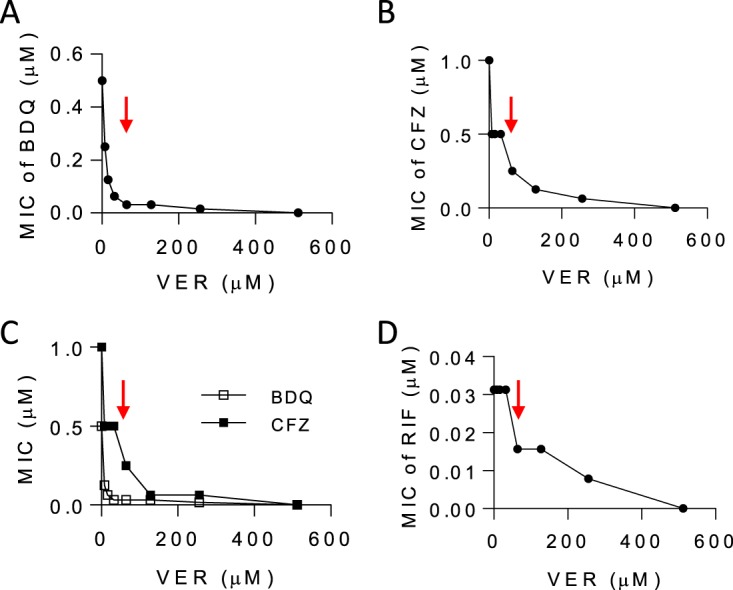
Pharmacodynamic interactions between verapamil and anti-TB drugs. (A to C) Verapamil (VER) was tested in combination with bedaquiline (BDQ) and clofazimine (CFZ) in checkerboard assays against wild-type M. tuberculosis H37Rv (A and B) as well as against multidrug-resistant M. tuberculosis strain R543 (resistant to rifampin, isoniazid, ethambutol, and pyrazinamide) (7) (C). The MIC of bedaquiline alone and the MIC of clofazimine alone against H37Rv and R543 were identical at 0.5 and 1.0 μM (0.28 and 0.47 mg/liter), respectively. (D) Efficacy of the verapamil-rifampin (RIF) combination. The MIC of RIF alone was 0.032 μM (0.025 mg/liter). The FICI values (MICdrugAB/MICdrugA + MICdrugBA/MICdrugB) were 0.06 and 0.19 (synergistic) for bedaquiline and clofazimine, respectively, and 0.75 (additive) for rifampin. The red arrows point to the verapamil concentration corresponding to one-fourth its MIC (128 μM [58 mg/liter]). Each experiment included technical duplicates and was performed three times independently. Data from one representative experiment are shown in each panel.
FIG 2
FIG 2
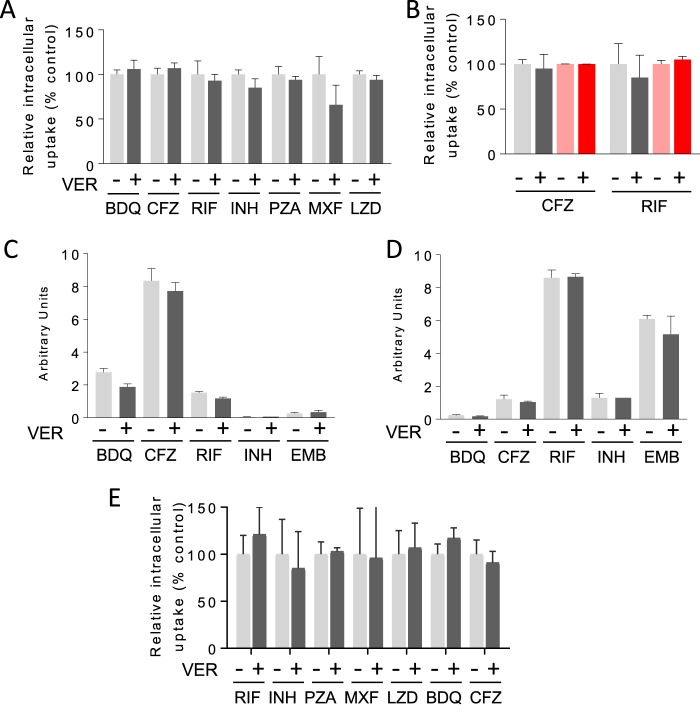
Effect of verapamil on the intracellular concentration of anti-TB drugs in M. tuberculosis bacilli and in THP-1 macrophages. (A) Intracellular accumulation of anti-TB agents in exponential-phase M. tuberculosis ΔpanCD ΔleuD (an attenuated strain that is noninfectious to mammals for use in biosafety level 2 [BSL2] settings). All drugs were supplemented at 4-fold their respective MIC values with or without verapamil at one/fourth its MIC (128 μM). (B) Intracellular accumulation of rifampin and clofazimine in wild-type (gray shades) and multidrug-resistant (red shades) R543 M. tuberculosis. (C and D) Effect of verapamil on the uptake of drugs by M. tuberculosis in solid-phase culture after 24 h of incubation at one/fourth its MIC: data corresponding to the recovery of bacterially associated drug (C) and drug remaining in media (D) with and without coincubation with verapamil are shown. (E) Intracellular accumulation of anti-TB drugs in uninfected human THP-1 macrophages. RIF, rifampin; INH, isoniazid; EMB, ethambutol; PZA, pyrazinamide; MXF, moxifloxacin, LZD, linezolid; BDQ, bedaquiline; CFZ, clofazimine. Values are means (n = 3) ± standard errors. Each experiment included technical duplicates and was performed three times independently. Data from one representative experiment are shown in each panel. Two-tailed unpaired t tests were performed to compare uptake data determined in the presence and absence of verapamil. All P values are >0.05 except for those corresponding to RIF and BDQ in panel C (P = 0.0054 and 0.0078, respectively, with lower intrabacterial uptake in the presence of verapamil).
FIG 3
FIG 3
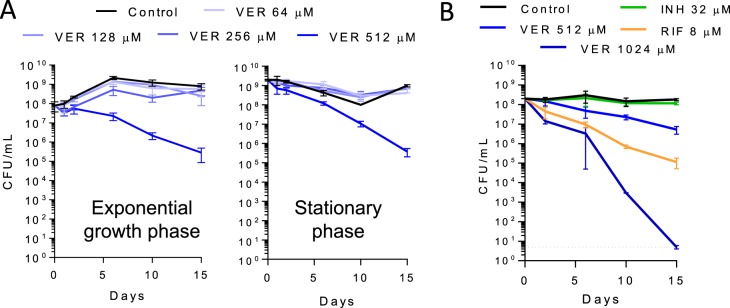
Time- and dose-dependent killing of (A) exponentially growing and stationary-phase and (B) nutrient-starved nonreplicating M. tuberculosis H37Rv by verapamil (MIC, 512 μM). The dotted line shows the detection limit (5 CFU/ml). In the nutrient starvation (Loebel) assay, rifampin (RIF) and isoniazid (INH) were used as positive and negative controls, at 8 and 32 μM or approximately 100-fold their respective 90% bactericidal concentrations (MBC90) against replicating M. tuberculosis (58). Each experiment included four technical replicates and was performed three times independently. Data from one representative experiment are shown in each panel.
FIG 4
FIG 4
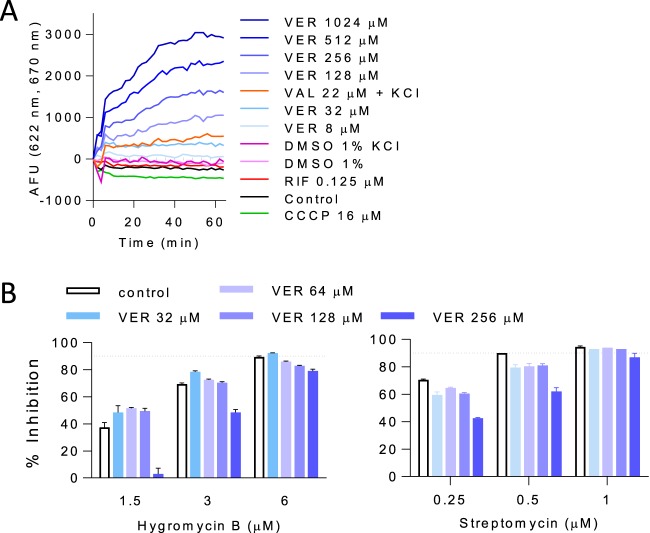
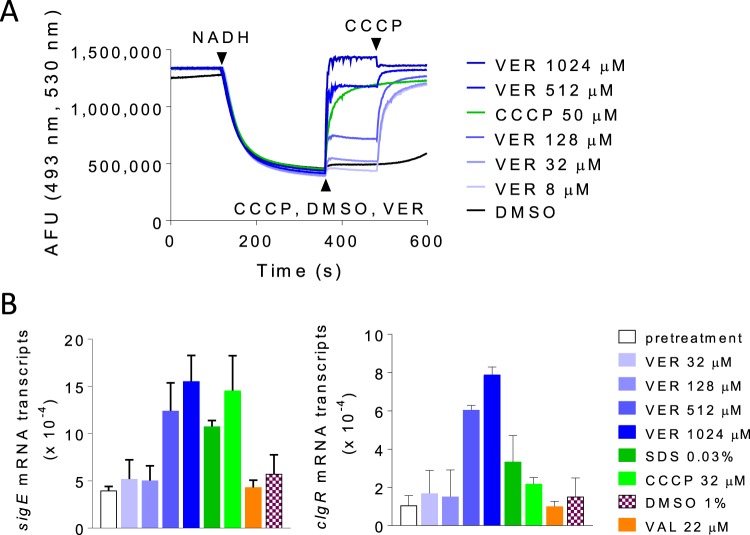
Effect of verapamil on membrane functions. (A) Dose-response effect of verapamil on M. tuberculosis membrane electric potential. Membrane depolarization was measured using the membrane potential-sensitive fluorescent DiSC3 dye (5), which concentrates in energized membranes such that high local concentrations lead to decreased fluorescence intensity due to quenching. Upon dissipation of the membrane potential, the dye is released in the extracellular space, resulting in increased fluorescence. VER, verapamil; VAL, valinomycin; RIF, rifampin; CCCP, carbonyl cyanide m-chlorophenyl hydrazine; AFU, arbitrary fluorescence units. (B) Effect of verapamil on the inhibitory activity of the aminoglycosides hygromycin B and streptomycin. The MIC of hygromycin B and that of streptomycin in the absence of verapamil were 6 and 0.5 μM, respectively.
FIG 5
FIG 5
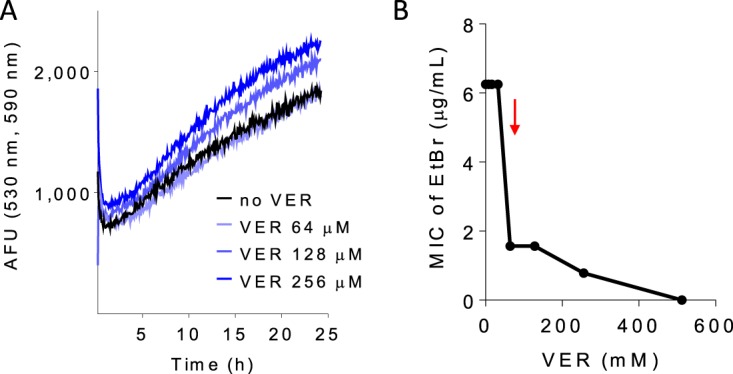
Effect of verapamil on ethidium bromide (EtBr) uptake and activity in M. tuberculosis H37Rv. (A) Dose response of verapamil on the uptake of EtBr measured by fluorescence at 590 nm (excitation wavelength,530 nm). (B) Pharmacodynamic interactions between verapamil and EtBr. The FIC index value (MICdrugAB/MICdrugA + MICdrugBA/MICdrugB) was 0.25, indicating synergy. The red arrow points to the level corresponding to one/fourth the verapamil MIC (128 μM). Each experiment was performed three times independently. Data from one representative experiment are shown in each panel.
FIG 6
FIG 6
Effect of verapamil on membrane energetics and envelope stress. (A) Dose response of verapamil effect on proton translocation in inverted membrane vesicles of M. bovis BCG, followed by reversal performed with the protonophore CCCP. (B) Transcriptional induction of membrane stress reporters by verapamil in comparison to SDS and agents that perturb the proton motive force.
FIG 7
FIG 7
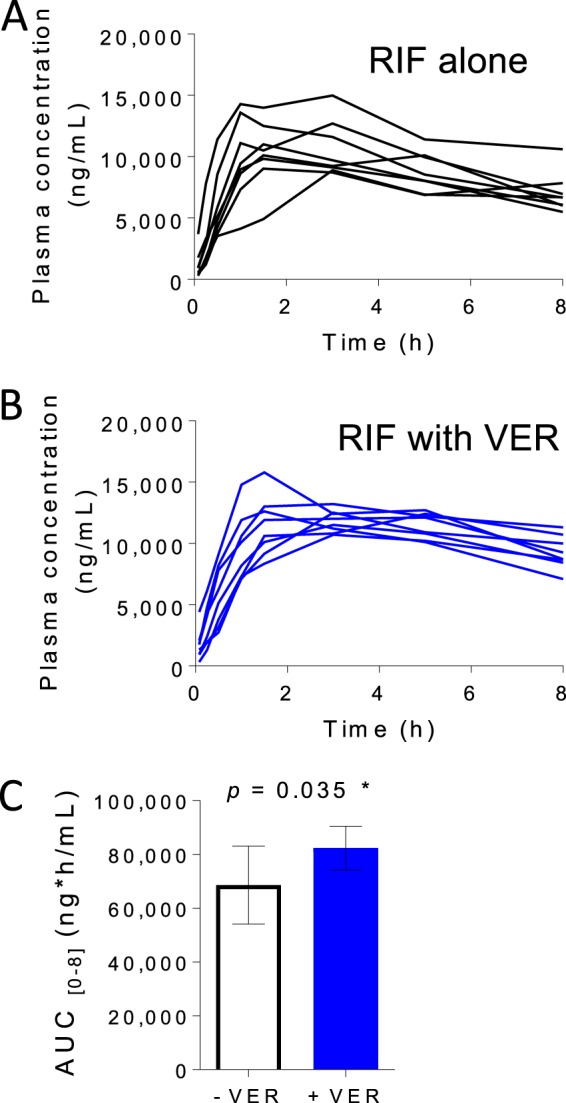
Effect of verapamil pretreatment on the pharmacokinetic parameters of rifampin (RIF) in CD-1 mice. Six-week-old female CD-1 mice were purchased from Charles River Laboratories (Wilmington, MA). Mice were dosed orally with 6.25 mg of verapamil/kg of body weight (area under the concentration-time curve from h 0 to h 8 [AUC0–8] = 255 ng · h/ml [human equivalent]) or vehicle (water) once daily for 8 days before a single oral dose of RIF was administered at 10 mg/kg on day 8. There were 8 mice in each treatment group. Blood was drawn by tail vein puncture at each time point, ranging from 0 to 8 h after administration of the RIF oral dose. Drug concentrations in mouse plasma were determined by liquid chromatography-mass spectrometry assays. (A) RIF plasma concentrations without verapamil pretreatment. Each line represents a single mouse. (B) RIF plasma concentrations with 7-day verapamil pretreatment. (C) Average AUC of RIF over 8 h with or without verapamil pretreatment (unpaired Student's t test).

References

    1. WHO. 2016. Global tuberculosis report. WHO, Geneva, Switzerland.
    1. McGoon MD, Vlietstra RE, Holmes DR Jr, Osborn JE. 1982. The clinical use of verapamil. Mayo Clin Proc 57:495–510. - PubMed
    1. Speelmans G, Staffhorst RW, De Wolf FA, De Kruijff B. 1995. Verapamil competes with doxorubicin for binding to anionic phospholipids resulting in increased internal concentrations and rates of passive transport of doxorubicin. Biochim Biophys Acta 1238:137–146. doi:10.1016/0005-2736(95)00119-N. - DOI - PubMed
    1. Pereira E, Teodori E, Dei S, Gualtieri F, Garnier-Suillerot A. 1995. Reversal of multidrug resistance by verapamil analogues. Biochem Pharmacol 50:451–457. doi:10.1016/0006-2952(95)00174-X. - DOI - PubMed
    1. Boxberger KH, Hagenbuch B, Lampe JN. 2014. Common drugs inhibit human organic cation transporter 1 (OCT1)-mediated neurotransmitter uptake. Drug Metab Dispos 42:990–995. doi:10.1124/dmd.113.055095. - DOI - PMC - PubMed

Publication types

LinkOut - more resources