Efficient and Scalable Precision Genome Editing in Staphylococcus aureus through Conditional Recombineering and CRISPR/Cas9-Mediated Counterselection
- PMID: 29463653
- PMCID: PMC5821094
- DOI: 10.1128/mBio.00067-18
Efficient and Scalable Precision Genome Editing in Staphylococcus aureus through Conditional Recombineering and CRISPR/Cas9-Mediated Counterselection
Erratum in
-
Erratum for Penewit et al., "Efficient and Scalable Precision Genome Editing in Staphylococcus aureus through Conditional Recombineering and CRISPR/Cas9-Mediated Counterselection".mBio. 2018 Oct 2;9(5):e01839-18. doi: 10.1128/mBio.01839-18. mBio. 2018. PMID: 30279289 Free PMC article. No abstract available.
-
Erratum for Penewit et al., "Efficient and Scalable Precision Genome Editing in Staphylococcus aureus through Conditional Recombineering and CRISPR/Cas9-Mediated Counterselection".mBio. 2019 Jan 15;10(1):e02698-18. doi: 10.1128/mBio.02698-18. mBio. 2019. PMID: 30647160 Free PMC article. No abstract available.
Abstract
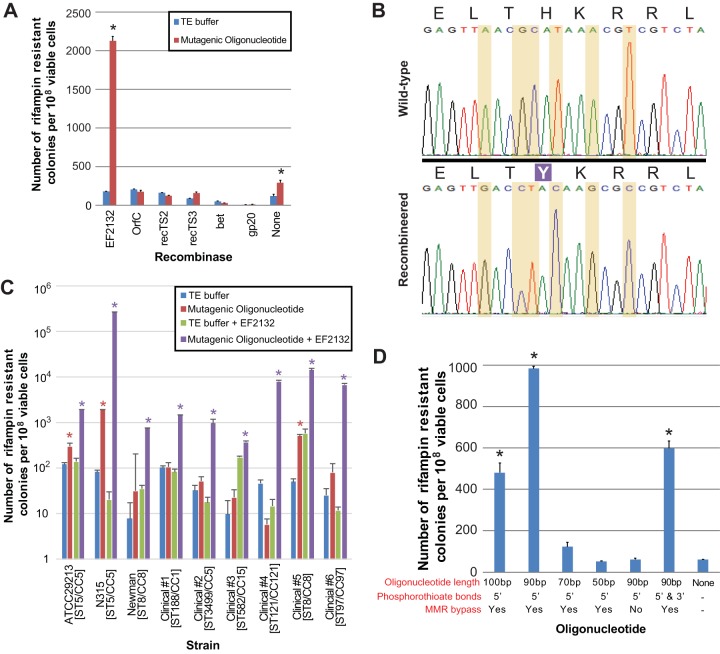
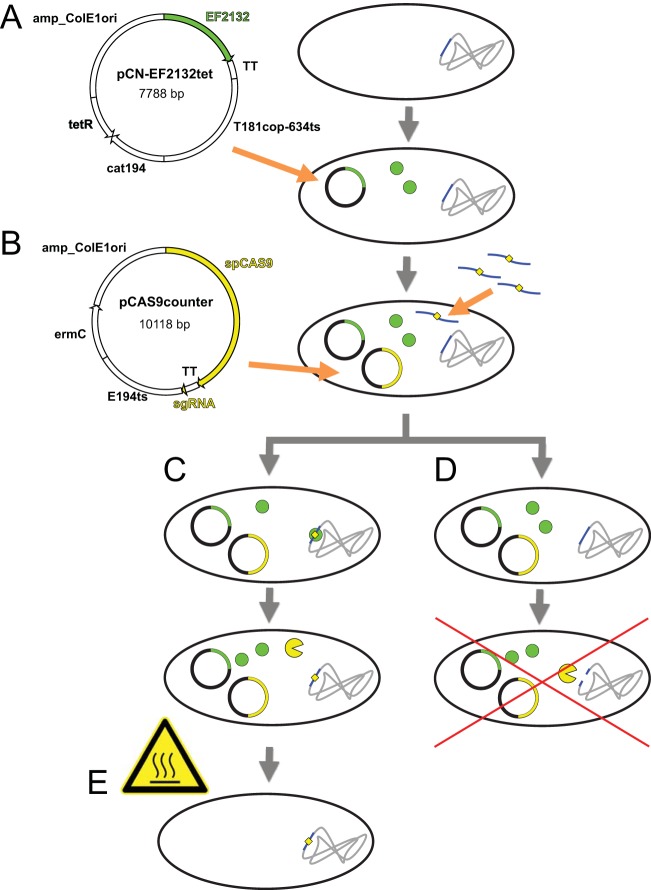
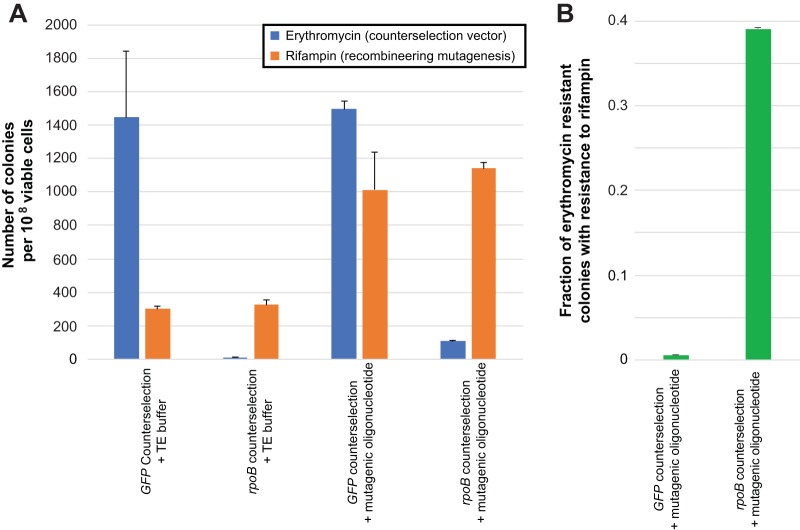
Staphylococcus aureus is an important human pathogen, but studies of the organism have suffered from the lack of a robust tool set for its genetic and genomic manipulation. Here we report the development of a system for the facile and high-throughput genomic engineering of S. aureus using single-stranded DNA (ssDNA) oligonucleotide recombineering coupled with clustered regularly interspaced short palindromic repeat (CRISPR)/Cas9-mediated counterselection. We identify recombinase EF2132, derived from Enterococcus faecalis, as being capable of integrating single-stranded DNA oligonucleotides into the S. aureus genome. We found that EF2132 can readily mediate recombineering across multiple characterized strains (3 of 3 tested) and primary clinical isolates (6 of 6 tested), typically yielding thousands of recombinants per transformation. Surprisingly, we also found that some S. aureus strains are naturally recombinogenic at measurable frequencies when oligonucleotides are introduced by electroporation, even without exogenous recombinase expression. We construct a temperature-sensitive, two-vector system which enables conditional recombineering and CRISPR/Cas9-mediated counterselection in S. aureus without permanently introducing exogenous genetic material or unintended genetic lesions. We demonstrate the ability of this system to efficiently and precisely engineer point mutations and large single-gene deletions in the S. aureus genome and to yield highly enriched populations of engineered recombinants even in the absence of an externally selectable phenotype. By virtue of utilizing inexpensive, commercially synthesized synthetic DNA oligonucleotides as substrates for recombineering and counterselection, this system provides a scalable, versatile, precise, inexpensive, and generally useful tool for producing isogenic strains in S. aureus which will enable the high-throughput functional assessment of genome variation and gene function across multiple strain backgrounds.IMPORTANCE Engineering genetic changes in bacteria is critical to understanding the function of particular genes or mutations but is currently a laborious and technically challenging process to perform for the important human pathogen Staphylococcus aureus In an effort to develop methods which are rapid, easy, scalable, versatile, and inexpensive, here we describe a system for incorporating synthetic, mutagenic DNA molecules into the S. aureus genome and for eliminating cells that lack the engineered mutation. This method allows efficient, precise, and high-throughput genetic engineering of S. aureus strains and will facilitate studies seeking to address a variety of issues about the function of particular genes and specific mutations.
Keywords: CRISPR; Cas9; Staphylococcus aureus; genetic engineering; genome editing; mutS; recombineering.
Copyright © 2018 Penewit et al.
Figures
References
-
- Klevens RM, Morrison MA, Nadle J, Petit S, Gershman K, Ray S, Harrison LH, Lynfield R, Dumyati G, Townes JM, Craig AS, Zell ER, Fosheim GE, McDougal LK, Carey RB, Fridkin SK; Active Bacterial Core surveillance (ABCs) MRSA Investigators . 2007. Invasive methicillin-resistant Staphylococcus aureus infections in the United States. JAMA 298:1763–1771. doi: 10.1001/jama.298.15.1763. - DOI - PubMed
-
- Wertheim HFL, Vos MC, Ott A, van Belkum A, Voss A, Kluytmans JAJW, van Keulen PHJ, Vandenbroucke-Grauls CMJE, Meester MHM, Verbrugh HA. 2004. Risk and outcome of nosocomial Staphylococcus aureus bacteraemia in nasal carriers versus non-carriers. Lancet 364:703–705. doi: 10.1016/S0140-6736(04)16897-9. - DOI - PubMed
-
- Liu C, Bayer A, Cosgrove SE, Daum RS, Fridkin SK, Gorwitz RJ, Kaplan SL, Karchmer AW, Levine DP, Murray BE, J. Rybak M, Talan DA, Chambers HF. 2011. Clinical practice guidelines by the infectious diseases society of America for the treatment of methicillin-resistant Staphylococcus aureus infections in adults and children: executive summary. Clin Infect Dis 52:285–292. doi: 10.1093/cid/cir034. - DOI - PubMed
Publication types
MeSH terms
Substances
LinkOut - more resources
Full Text Sources
Other Literature Sources
Research Materials