. 2018 Mar 6;115(10):E2386-E2392.
doi: 10.1073/pnas.1716771115. Epub 2018 Feb 20.

Defining the sizes of airborne particles that mediate influenza transmission in ferrets

Affiliations

Defining the sizes of airborne particles that mediate influenza transmission in ferrets

Jie Zhou et al. Proc Natl Acad Sci U S A. .

Abstract

Epidemics and pandemics of influenza are characterized by rapid global spread mediated by non-mutually exclusive transmission modes. The relative significance between contact, droplet, and airborne transmission is yet to be defined, a knowledge gap for implementing evidence-based infection control measures. We devised a transmission chamber that separates virus-laden particles by size and determined the particle sizes mediating transmission of influenza among ferrets through the air. Ferret-to-ferret transmission was mediated by airborne particles larger than 1.5 µm, consistent with the quantity and size of virus-laden particles released by the donors. Onward transmission by donors was most efficient before fever onset and may continue for 5 days after inoculation. Multiple virus gene segments enhanced the transmissibility of a swine influenza virus among ferrets by increasing the release of virus-laden particles into the air. We provide direct experimental evidence of influenza transmission via droplets and fine droplet nuclei, albeit at different efficiency.

Keywords: airborne particles; airborne transmission; droplet transmission; ferrets; influenza virus.


Conflict of interest statement

Conflict of interest statement: B.J.C. received research funding from Sanofi. The other authors declare no conflict of interests.

Figures
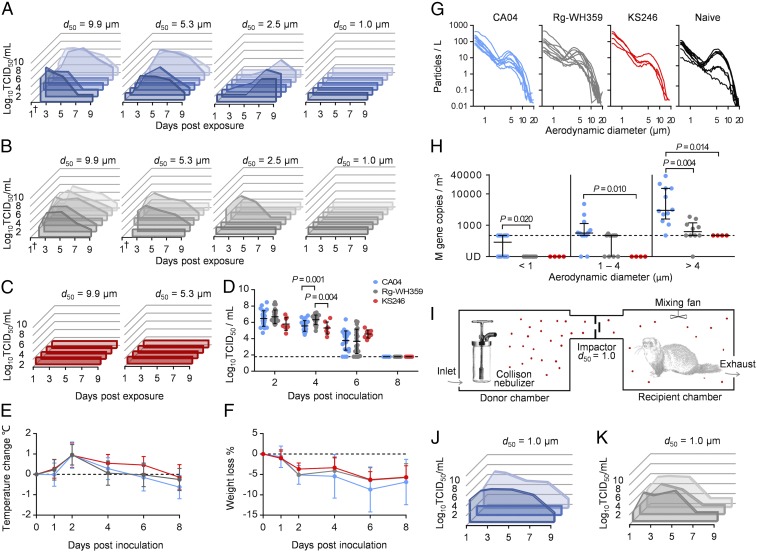
Fig. 1.
Fig. 1.
Ferret-to-ferret transmissibility is associated with the quantity and size of virus-laden particles in air released by the donor ferrets. Transmission of (A) CA04, (B) Rg-WH359, and (C) KS246 among ferrets via virus-laden particles that passed through the impactors with 50% collection efficiency at 9.9 µm, 5.3 µm, 2.5 µm, or 1 µm. Viral titers (log10TCID50/mL) detected in the nasal washes from recipient ferrets (detection limit at 1.789 log10TCID50/mL). For each impactor, the experiments were independently repeated three times for CA04 and Rg-WH359 (recipient, n = 6) and twice for KS246 (recipient, n = 4). (D) Viral titers detected in donor nasal washes after inoculation with CA04 (n = 24), Rg-WH359 (n = 24), or KS246 (n = 8) influenza viruses and overlaid with mean ± SD. (E) Temperature and (F) weight changes of donor ferrets after inoculation with CA04 (n = 22–24), Rg-WH359 (n = 20–24), or KS246 (n = 8) viruses and overlaid with mean ± SD. (G) APS was applied to determine size distribution (range, 0.52–20.53 µm) of total particles released in air by donor ferrets (n = 9, n = 10, and n = 4 for CA04, Rg-WH359, and KS246, respectively) at 2 dpi or by noninoculated ferrets (n = 9). (H) Quantity and size distribution of influenza virus-laden particles sampled from the donor chambers during the exposure period using the NIOSH bioaerosol sampler. The limit of linear range of quantification (476 M gene copies per cubic millimeter) is shown with the dotted line. Data from each exposure (n = 12, n = 10, and n = 4 for CA04, Rg-WH359, and KS246, respectively) are shown and overlaid with median and interquartile range. (I) Schematic representation of the transmission experiment with artificially generated aerosols. (J) Viral titers (log10TCID50/mL) detected in the nasal washes of recipients ferrets after exposure to nebulized CA04 aerosols that passed through the 1.0-µm impactor; the experiments were independently repeated three times. (K) Viral titers (log10TCID50/mL) detected in the nasal washes of recipients ferrets after exposing to nebulized Rg-WH359 aerosols that passed through the 1.0-µm impactor; the experiments were independently repeated three times. P values <0.05 from Dunn’s multiple comparisons after Kruskal–Wallis test are shown.
Fig. 2.
Fig. 2.
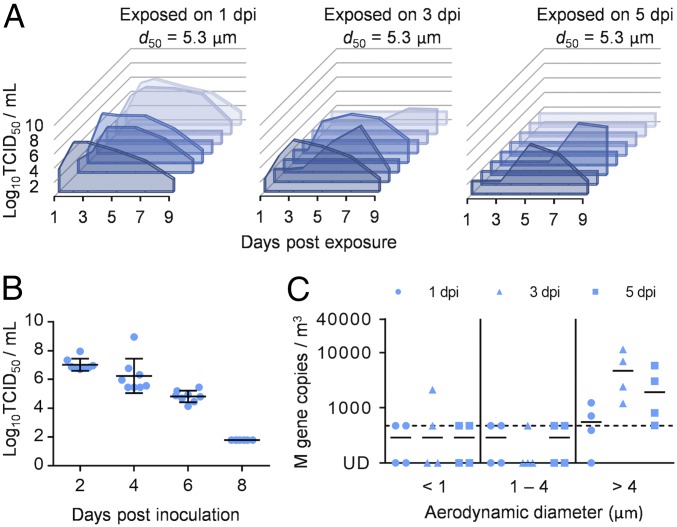
Airborne transmissibility of CA04-inoculated ferrets gradually decreases over time and may last at least 5 d. (A) Viral titers (log10TCID50/mL) detected from the nasal washes of recipient ferrets after exposure for 8 h to CA04-inoculated donors at 1 dpi (n = 7), 3 dpi (n = 8), or 5 dpi (n = 8). The 5.3-µm impactor was applied to all experiments. Exposure at each dpi was independently repeated four times, and data were plotted for individual recipient ferrets. (B) Viral titers detected from the nasal washes of donor ferrets. Data were plotted for individual ferrets (n = 8) and overlaid with mean ± SD. (C) Quantity and size distribution of virus-laden particles sampled from the donor chambers at 1, 3, and 5 dpi during exposure. Data were plotted for each exposure event (n = 4) at each time point and overlaid with median.
Fig. 3.
Fig. 3.
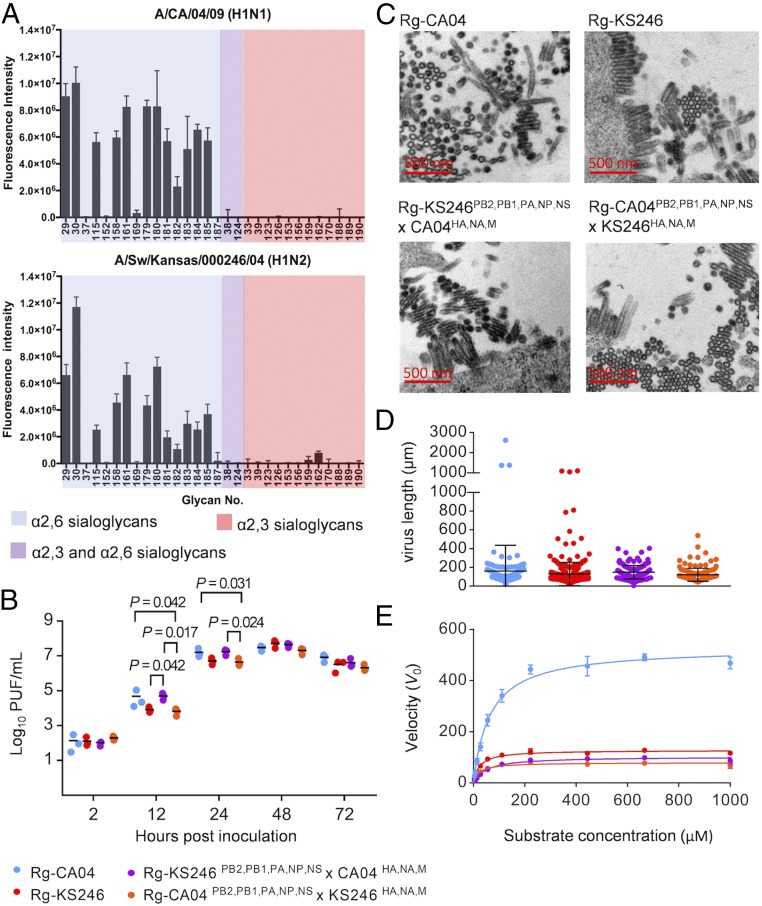
Characterization of CA04 and KS246 recombinant viruses in vitro. (A) Glycan array analysis of CA04 and KS246 viruses. CA04 and KS246 viruses were inactivated by 0.025% formaldehyde and diluted to 16 HA titers (0.5% turkey red blood cells) for analysis. The fluorescence signal was acquired by using the NimbleGen MS 200 Microarray Scanner. The experiment was repeated independently twice with six replicates at each repeat. (B) Replication kinetics of recombinant Rg-CA04, Rg-KS246, Rg-KS246PB2,PB1,PA,NP,NS×CA04HA,NA,M, and Rg-CA04PB2,PB1,PA,NP,NS×KS246HA,NA,M in differentiated HAE cells. The viral replication efficiencies in HAE cells at a multiplicity of infection (MOI) of 0.01 PFU/cell were determined (mean ± SD of three replicates shown). P values <0.05 from Dunn’s multiple comparisons after Kruskal–Wallis test are shown. (C) Representative images of virion morphology under a transmission electron microscope (8,900×) after 14 h propagation in MDCK cells at an MOI of 2 PFU/cell. (D) Comparison of virion length of recombinant viruses of different gene constellations. One hundred virions were randomly selected from images taken from transmission EM to determine the virion length (one-way ANOVA, P = 0.0761). (E) NA enzyme kinetics using the fluorogenic substrate MUNANA. The viruses were diluted to 106 PFU/mL, and the kinetic data were fit to the Michaelis–Menten equation by nonlinear regression to determine Km and Vmax of substrate conversion. The experiment was repeated independently twice, and mean ± SD is shown.
Fig. 4.
Fig. 4.
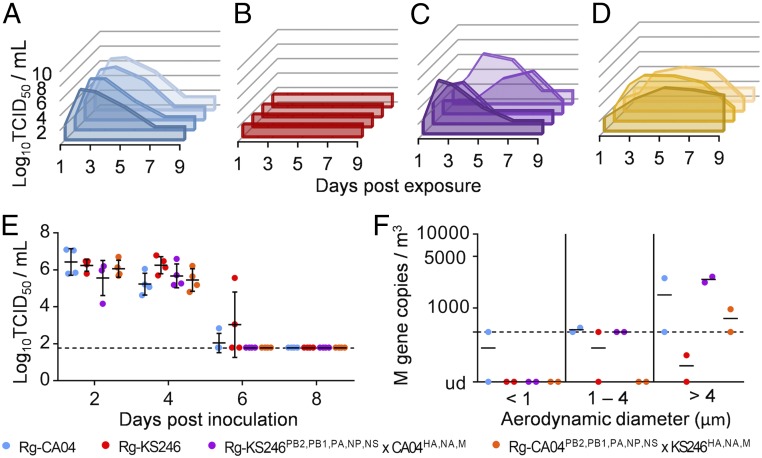
Multiple viral gene segments from CA04 confer enhanced transmissibility of KS246 by increasing the release of virus-laden particles into the air. Transmission of (A) Rg-CA04, (B) Rg-KS246, (C) Rg-KS246PB2,PB1,PA,NP,NS×CA04HA,NA,M, and (D) Rg-CA04PB2,PB1,PA,NP,NS×KS246HA,NA,M recombinant viruses among ferrets via virus-laden particles that passed through the 5.3-µm impactor. Viral titers (log10TCID50/mL, detection limit at 1.789 log10TCID50/mL) detected in the nasal washes of each recipient ferret. For each recombinant virus, the experiments were independently repeated twice with a total of four recipients. (E) Viral titers detected in the nasal washes of donor ferrets inoculated with 105 TCID50 of the recombinant viruses. Data were plotted for individual donor ferrets (n = 4) and overlaid with mean ± SD. (F) Quantity and size distribution of influenza virus-laden particles sampled from the donor chambers during the exposure period by using the NIOSH bioaerosol sampler. The limit of linear range of quantification (476 M gene copies per cubic meter) is shown. Data were plotted for two independent exposures and overlaid with medians.

References

    1. Dawood FS, et al. Estimated global mortality associated with the first 12 months of 2009 pandemic influenza A H1N1 virus circulation: A modelling study. Lancet Infect Dis. 2012;12:687–695. - PubMed
    1. WHO 2018 Influenza (Seasonal). Available at www.who.int/mediacentre/factsheets/fs211/en. Accessed January 16, 2018.
    1. Johnson NP, Mueller J. Updating the accounts: Global mortality of the 1918-1920 “Spanish” influenza pandemic. Bull Hist Med. 2002;76:105–115. - PubMed
    1. Brankston G, Gitterman L, Hirji Z, Lemieux C, Gardam M. Transmission of influenza A in human beings. Lancet Infect Dis. 2007;7:257–265. - PubMed
    1. Tellier R. Aerosol transmission of influenza A virus: A review of new studies. J R Soc Interface. 2009;6(6 suppl 6):S783–S790. - PMC - PubMed

Publication types

LinkOut - more resources