Review
. 2018 May;15(5):274-282.
doi: 10.1038/nrgastro.2018.10. Epub 2018 Feb 21.

Noninvasive imaging biomarker assessment of liver fibrosis by elastography in NAFLD

Affiliations
Review

Noninvasive imaging biomarker assessment of liver fibrosis by elastography in NAFLD

Elliot B Tapper et al. Nat Rev Gastroenterol Hepatol. 2018 May.

Abstract

NAFLD is a global epidemic. The prevalence of NAFLD is 20-30% in North America, northern Europe, Australia, Japan, India and China. It is crucial that patients with NAFLD receive an assessment for their risk of advanced fibrosis, which increases the risk of hepatocellular carcinoma and other complications of cirrhosis. Risk stratification that is efficient, cost-effective, patient-centred and evidence-based is one of the most important issues facing clinicians who care for those with liver disease. Given patients' preference to avoid liver biopsy, noninvasive alternatives to assess liver fibrosis are in high demand. The most accurate noninvasive methods are based on liver elastography. Research on these techniques - which include vibration-controlled transient elastography (VCTE), magnetic resonance elastography (MRE), shear-wave elastography and acoustic radiation force impulse - has proliferated. Unfortunately, the literature has not kept pace with clinical practice. There is limited guidance for how clinicians should anticipate and manage the pitfalls of these tests. Furthermore, guidance is unavailable for clinicians regarding the optimal incorporation of VCTE, MRE or the emerging elastographic techniques into their clinical strategy, particularly for patients with NAFLD. In this Review, we summarize the available evidence, highlight gaps to address in further research and explore optimization of these techniques in clinical practice.


Figures
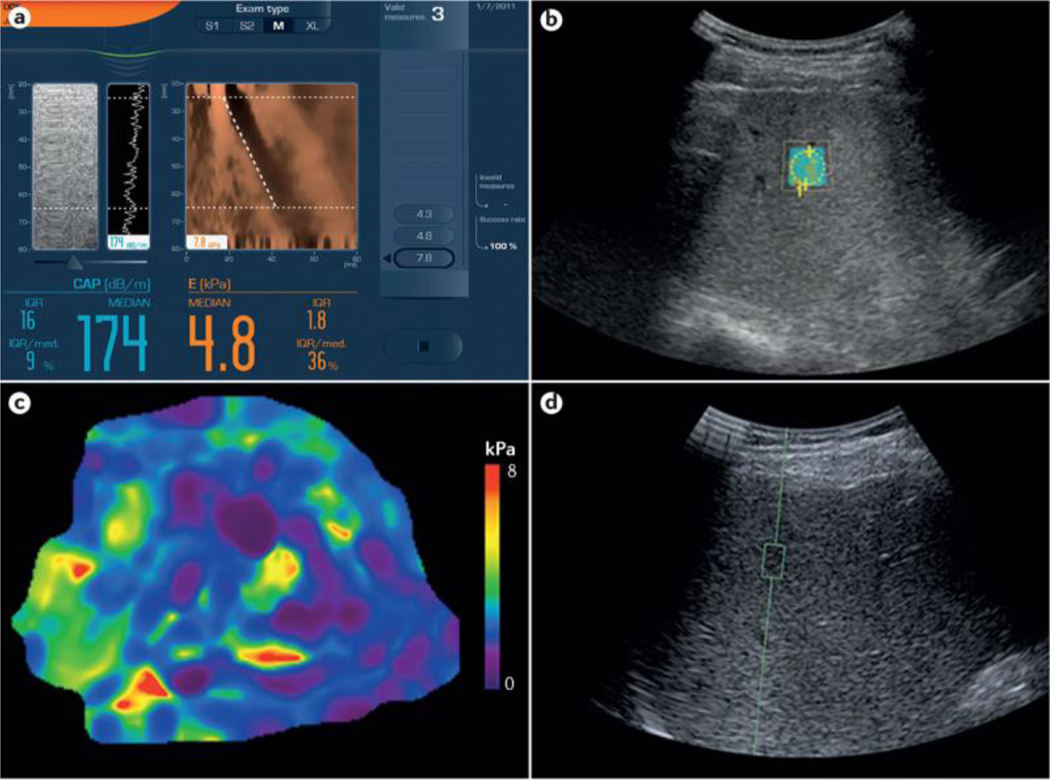
Figure 1 |
Figure 1 |. Example images from elastographic techniques.
Four methods have been investigated for the assessment of liver fibrosis in patients with NAFLD. a | Vibration-controlled transient elastography (VCTE). The screen (captured directly from a Fibroscan machine; Echosens, France) shows a limited ultrasonic window with a reconstructed view of the wavefront (in brown) that passes through the liver from the handheld probes (M or XL). b | Shear-wave elastography (SWE). SWE is performed in the defined region of interest (ROI). The liver stiffness readout, in m/s, is provided by the software. c | Magnetic resonance elastography (MRE). MRE provides liver stiffness values, in kPa, across the hepatic parenchyma from an average of multiple ROIs. d | Acoustic radiation force impulse (ARFI). This panel is a view of a standard liver ultrasonography image with ARFI performed in the defined ROI (green square). The readout, in m/s, is provided by the software. Image for VCTE (part a) courtesy of Echosens, France. Images for SWE (part b), MRE (part c) and ARFI (part d) were all taken from the same patient at the NAFLD Research Center of the University of California at San Diego, USA.
Figure 2 |
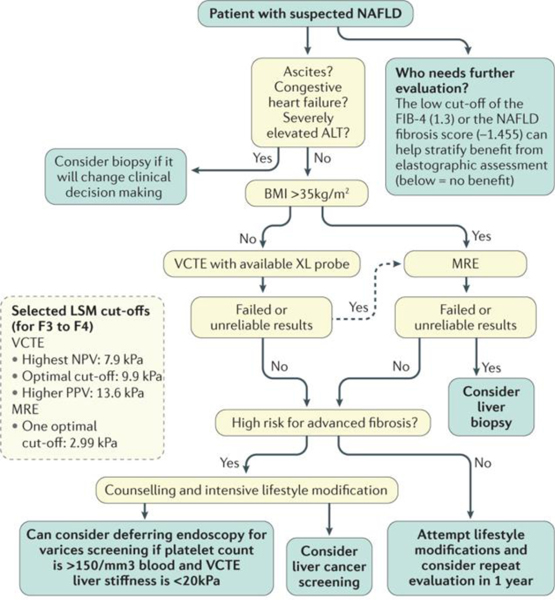
Figure 2 |. A suggested strategy for risk stratification of patients with NAFLD using multiple elastographic methods.
Many patients with low-risk FIB-4 (<1.3) and NAFLD Fibrosis scores (<–1.455) can be excluded from further evaluation by elastography. For higher-risk patients, for example, patients with indeterminate or high FIB-4 or NAFLD fibrosis scores, we suggest using vibration-controlled transient elastography (VCTE) — and potentially shear-wave elastography (SWE) or acoustic radiation force imaging (ARFI) — for patients with a BMI ≤35 kg/m2 followed by magnetic resonance elastography (MRE) for a BMI >35 kg/m2 or patients with failed and/or unreliable VCTE exams. Selected cut-offs for liver stiffness by modality are chosen from TABLE 2. As patients with advanced fibrosis and cirrhosis are at increased risk of liver cancer, we suggest consideration of screening. Guidelines from the American Association for the Study of Liver Disease suggest that for patients with platelet counts >150/mm3 blood and liver stiffness <20 kPa, one can consider forgoing screening for varices by endoscopy. ALT, alanine aminotransferase; LSM, liver stiffness measurement; NPV, negative predictive value; PPV, positive predictive value.

References

    1. Vernon G, Baranova A & Younossi Z Systematic review: the epidemiology and natural history of non-alcoholic fatty liver disease and non-alcoholic steatohepatitis in adults. Aliment. Pharmacol. Ther. 34, 274–285 (2011). - PubMed
    1. Williams CD et al. Prevalence of nonalcoholic fatty liver disease and nonalcoholic steatohepatitis among a largely middle-aged population utilizing ultrasound and liver biopsy: a prospective study. Gastroenterology 140, 124–131 (2011). - PubMed
    1. Mozumdar A & Liguori G Persistent increase of prevalence of metabolic syndrome among US adults: NHANES III to NHANES 1999–2006. Diabetes Care 34, 216–219 (2011). - PMC - PubMed
    1. Peery AF et al. Burden of gastrointestinal disease in the United States: 2012 update. Gastroenterology 143, 1179–1187. e3 (2012). - PMC - PubMed
    1. Ekstedt M et al. Fibrosis stage is the strongest predictor for disease-specific mortality in NAFLD after up to 33 years of follow-up. Hepatology 61, 1547–1554 (2015). - PubMed

Publication types

MeSH terms