


Implications of KRAS mutations in acquired resistance to treatment in NSCLC
- PMID: 29464099
- PMCID: PMC5814239
- DOI: 10.18632/oncotarget.23553
Implications of KRAS mutations in acquired resistance to treatment in NSCLC
Abstract
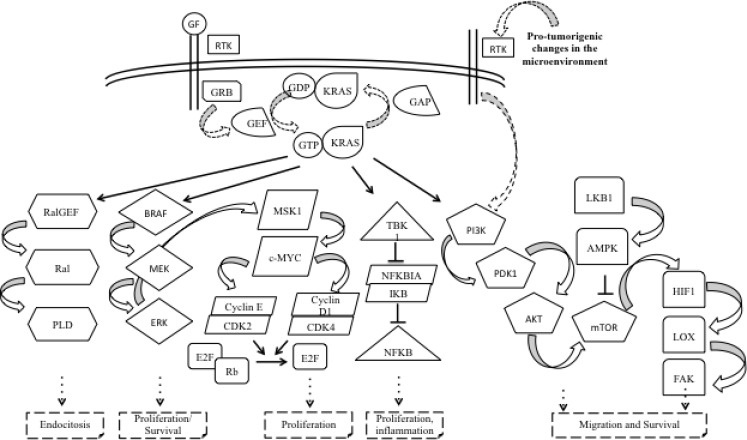
Rationale: KRAS is the most common and, simultaneously, the most ambiguous oncogene implicated in human cancer. Despite KRAS mutations were identified in Non Small Cell Lung Cancers (NSCLCs) more than 20 years ago, selective and specific inhibitors aimed at directly abrogating KRAS activity are not yet available. Nevertheless, many therapeutic approaches have been developed potentially useful to treat NSCLC patients mutated for KRAS and refractory to both standard chemotherapy and targeted therapies.The focus of this review will be to provide an overview of the network related to the intricate molecular KRAS pathways, stressing on preclinical and clinical studies that investigate the predictive value of KRAS mutations in NSCLC patients.
Materials and methods: A bibliographic search of the Medline database was conducted for articles published in English, with the keywords KRAS, KRAS mutations in non-small cell lung cancer, KRAS and tumorigenesis, KRAS and TKIs, KRAS and chemotherapy, KRAS and monoclonal antibody, KRAS and immunotherapy, KRAS and drugs, KRAS and drug resistance.
Keywords: KRAS; NSCLC; TKI; pharmacogenetics; treatment acquired resistance.
Conflict of interest statement
CONFLICTS OF INTEREST None.
Figures
References
-
- Siegel RL, Miller KD, Jemal A. Cancer statistics, 2016. CA Cancer J Clin. 2016;66:7–30. - PubMed
-
- Sholl LM, Aisner DL, Varella-Garcia M, Berry LD, Dias-Santagata D, Wistuba II, Chen H, Fujimoto J, Kugler K, Franklin WA, Iafrate AJ, Ladanyi M, Kris MG, et al. Multi-institutional Oncogenic Driver Mutation Analysis in Lung Adenocarcinoma: The Lung Cancer Mutation Consortium Experience. J Thorac Oncol. 2015;10:768–777. - PMC - PubMed
-
- Khozin S, Blumenthal GM, Jiang X, He K, Boyd K, Murgo A, Justice R, Keegan P, Pazdur R. U.S. Food and Drug Administration approval summary: Erlotinib for the first-line treatment of metastatic non-small cell lung cancer with epidermal growth factor receptor exon 19 deletions or exon 21 (L858R) substitution mutations. Oncologist. 2014;19:774–779. - PMC - PubMed
-
- Khozin S, Blumenthal GM, Zhang L, Tang S, Brower M, Fox E, Helms W, Leong R, Song P, Pan Y, Liu Q, Zhao P, Zhao H, et al. FDA approval: ceritinib for the treatment of metastatic anaplastic lymphoma kinase-positive non-small cell lung cancer. Clin Cancer Res. 2015;21:2436–2439. - PubMed
Publication types
LinkOut - more resources
Full Text Sources
Other Literature Sources
Miscellaneous
