


Herpes Simplex Virus Type 2 Seroprevalence Among Different National Populations of Middle East and North African Men
- PMID: 29465656
- PMCID: PMC6012054
- DOI: 10.1097/OLQ.0000000000000791
Herpes Simplex Virus Type 2 Seroprevalence Among Different National Populations of Middle East and North African Men
Abstract
Background: There are limited data on herpes simplex virus type 2 (HSV-2) seroprevalence in the Middle East and North Africa (MENA). We examined country- and age-specific HSV-2 seroprevalence among select MENA populations residing in Qatar.
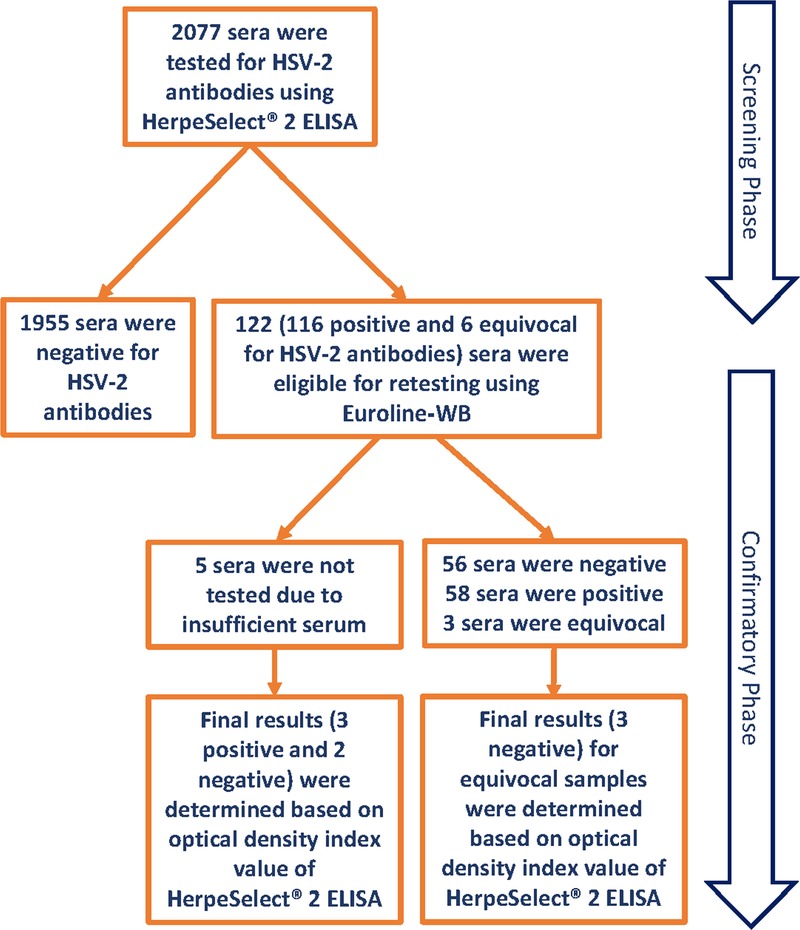
Methods: Sera were collected from male blood donors attending Hamad Medical Corporation between June 2013 and June 2016. Specimens were screened for anti-HSV-2 IgG antibodies following a 2-test algorithm: HerpeSelect 2 ELISA was used to identify HSV-2-positive specimens, and Euroline-WB was used to confirm positive and equivocal specimens for final HSV-2 status. Trends and associations with HSV-2 seropositivity were assessed.
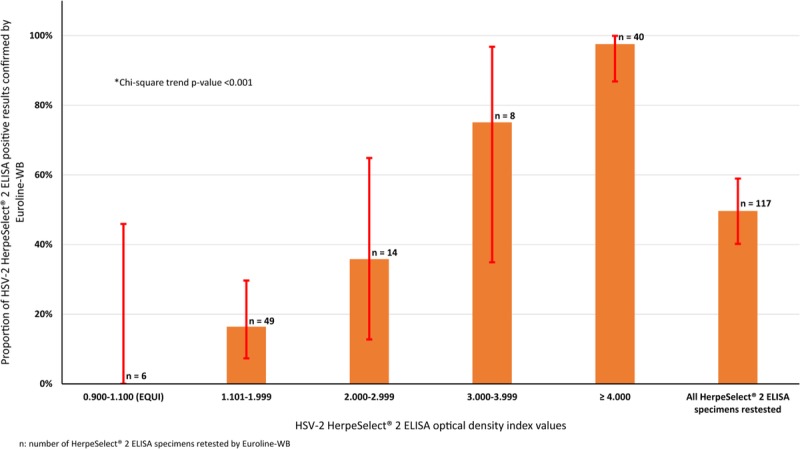
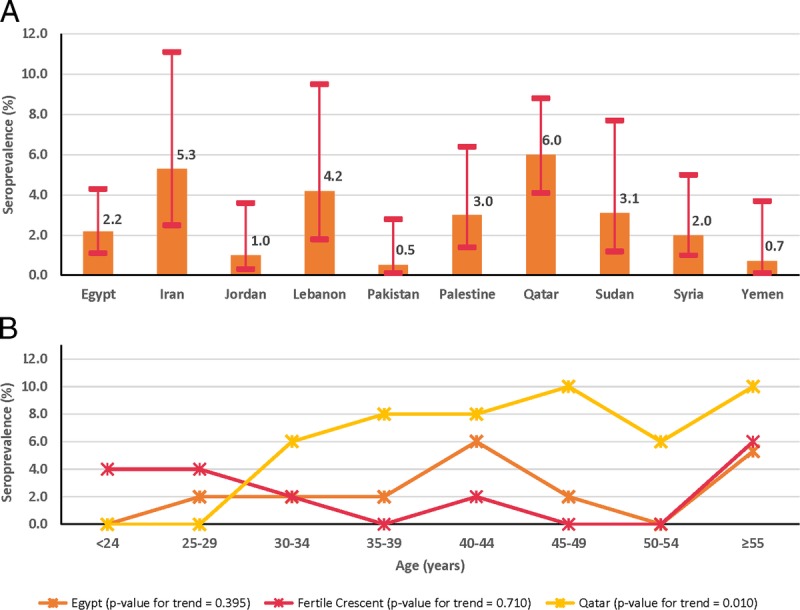
Results: Of the 2077 tested sera, 61 were found and confirmed positive. The proportion of those confirmed positive increased steadily with HerpeSelect 2 ELISA index value, ranging from 16.3% for index values of 1.101 to 1.999 to 92.9% for index values of 4 or greater. Nationality-specific seroprevalence was 6.0% (95% confidence interval [CI], 4.1%-8.8%) in Qataris, 5.3% (95% CI, 2.5%-11.1%) in Iranians, 4.2% (95% CI, 1.8%-9.5%) in Lebanese, 3.1% (95% CI, 1.2%-7.7%) in Sudanese, 3.0% (95% CI, 1.4%-6.4%) in Palestinians, 2.2% (95% CI, 1.1%-4.3%) in Egyptians, 2.0% (95% CI, 1.0%-5.0%) in Syrians, 1.0% (95% CI, 0.3%-3.6%) in Jordanians, 0.7% (95% CI, 0.1%-3.7%) in Yemenis, and 0.5% (95% CI, 0.1%-2.8%) in Pakistanis. There was evidence for higher seroprevalence in older age groups.
Conclusions: The seroprevalence of HSV-2 was in the range of few percentage points. There were no major differences in seroprevalence by nationality. These findings add to our understanding of HSV-2 epidemiology in MENA and indicate unmet needs for sexual health and control of sexually transmitted infections.
Conflict of interest statement
Conflict of Interest and Sources of Funding: The authors have no conflicts of interest to disclose.
Figures
References
-
- Smith JS, Robinson NJ. Age-specific prevalence of infection with herpes simplex virus types 2 and 1: A global review. J Infect Dis 2002; 186(Suppl 1):S3–S28. - PubMed
-
- Weiss H. Epidemiology of herpes simplex virus type 2 infection in the developing world. Herpes 2004; 11(Suppl 1):24A–35A. - PubMed
-
- Holmes KK. Sexually Transmitted Diseases. 4th ed New York: McGraw-Hill Medical, 2008.
-
- Morse SA. Etiology of genital ulcer disease and its relationship to HIV infection. Sex Transm Dis 1999; 26:63–65. - PubMed
Publication types
MeSH terms
Substances
LinkOut - more resources
Full Text Sources
Other Literature Sources
Medical
Research Materials
