Comparative Study
. 2018 Mar 8;555(7695):269-273.
doi: 10.1038/nature25758. Epub 2018 Jan 24.

Structure of the D2 dopamine receptor bound to the atypical antipsychotic drug risperidone

Affiliations
Comparative Study

Structure of the D2 dopamine receptor bound to the atypical antipsychotic drug risperidone

Sheng Wang et al. Nature. .

Abstract

Dopamine is a neurotransmitter that has been implicated in processes as diverse as reward, addiction, control of coordinated movement, metabolism and hormonal secretion. Correspondingly, dysregulation of the dopaminergic system has been implicated in diseases such as schizophrenia, Parkinson's disease, depression, attention deficit hyperactivity disorder, and nausea and vomiting. The actions of dopamine are mediated by a family of five G-protein-coupled receptors. The D2 dopamine receptor (DRD2) is the primary target for both typical and atypical antipsychotic drugs, and for drugs used to treat Parkinson's disease. Unfortunately, many drugs that target DRD2 cause serious and potentially life-threatening side effects due to promiscuous activities against related receptors. Accordingly, a molecular understanding of the structure and function of DRD2 could provide a template for the design of safer and more effective medications. Here we report the crystal structure of DRD2 in complex with the widely prescribed atypical antipsychotic drug risperidone. The DRD2-risperidone structure reveals an unexpected mode of antipsychotic drug binding to dopamine receptors, and highlights structural determinants that are essential for the actions of risperidone and related drugs at DRD2.


Conflict of interest statement

The authors declare no competing financial interests.

Figures
Extended Data Figure 1
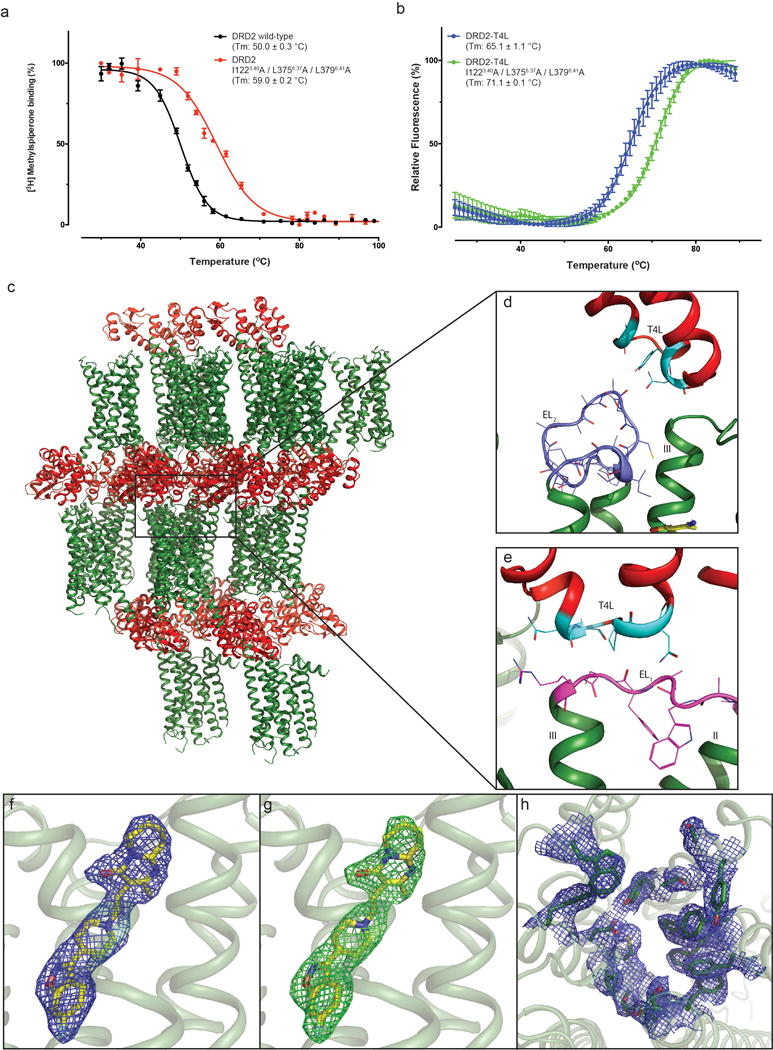
Extended Data Figure 1. Thermo-stability of DRD2 constructs, crystal packing of the DRD2/Risperidone complex and representative electron density of the DRD2 structure
a, DRD2 or thermo-stability mutation membrane with 1nM [3H]-N-methylspiperone were heated for 30 min, the amount of [3H]-ligand bound determined. b, Purified DRD2-T4L (with or without thermo-stability mutation) protein with 10 μM risperidone and 1 μM BODIPY FL L-cystine dye were heated by a temperature gradient and the amount of dye bound to unfolding protein determined. Data were analyzed by nonlinear regression and apparent Tm values (transition temperature where 50% of the receptor is inactive) were determined from analysis of the sigmoidal dose-response curves. All data in a-b are the mean  ± SEM of three independent assays. Error bars in a-b denote SEM from three independent assays. c, d, e, Packing of the DRD2/Risperidone complex crystallized in the P212121 spacegroup. The DRD2 is shown in green and T4L fusion protein is shown in red or cyan (interact with DRD2). EL1 and EL2 of DRD2 were shown in magenta and blue, respectively. f, 2Fo-Fc electron density map (blue mesh) of risperidone (yellow) contoured at 1σ. g, Fo-Fc omit map (green mesh) contoured at 3.0σ of risperidone (yellow). h, 2Fo-Fc electron density map of DRD2 binding pocket residues (blue mesh) contoured at 1σ.
Extended Data Figure 2
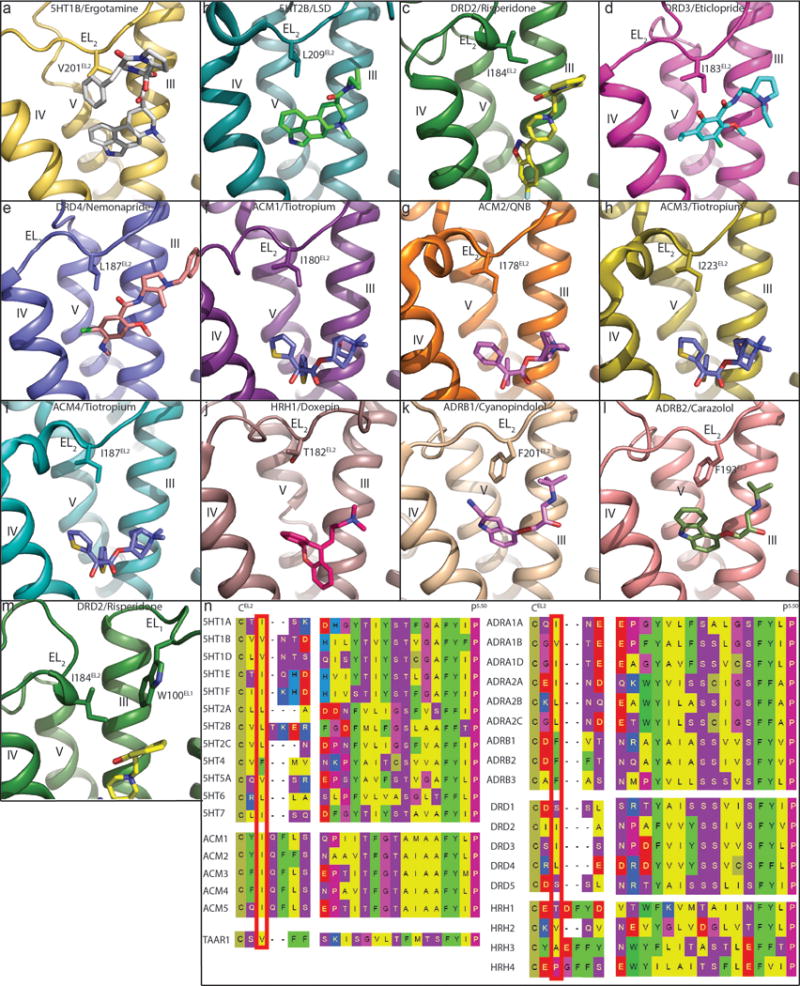
Extended Data Figure 2. Conserved hydrophobic residue of EL2 in all available aminergic receptor structures
In all panels, receptors are shown as cartoon. Ligands and residues are shown as sticks. a, 5HT1B (PDB code 4IAR). b, 5HT2B (PDB code 5TVN). c, DRD2. d, DRD3 (PDB code 3PBL). e, DRD4 (PDB code 5WIU). f, ACM1 (PDB code 5CXV). g, ACM2 (PDB code 3UON). h, ACM3 (PDB code 4ADJ). i, ACM4 (PDB code 4DSG). j, HRH1 (PDB code 3RZE). k, ADRB1 (PDB code 2VT4). l, ADRB2 (PDB code 2RH1). m, DRD2. n, Conserved EL2 hydrophobic residues (red box) are located two residues away from conserved cysteine that forms a disulfide bridge between EL2 and helix III. Notable exceptions to the presence of a hydrophobic residue are DRD1 and DRD5, which contain a serine, and HRH1 and HRH4, which contain a threonine and proline, respectively.
Extended Data Figure 3
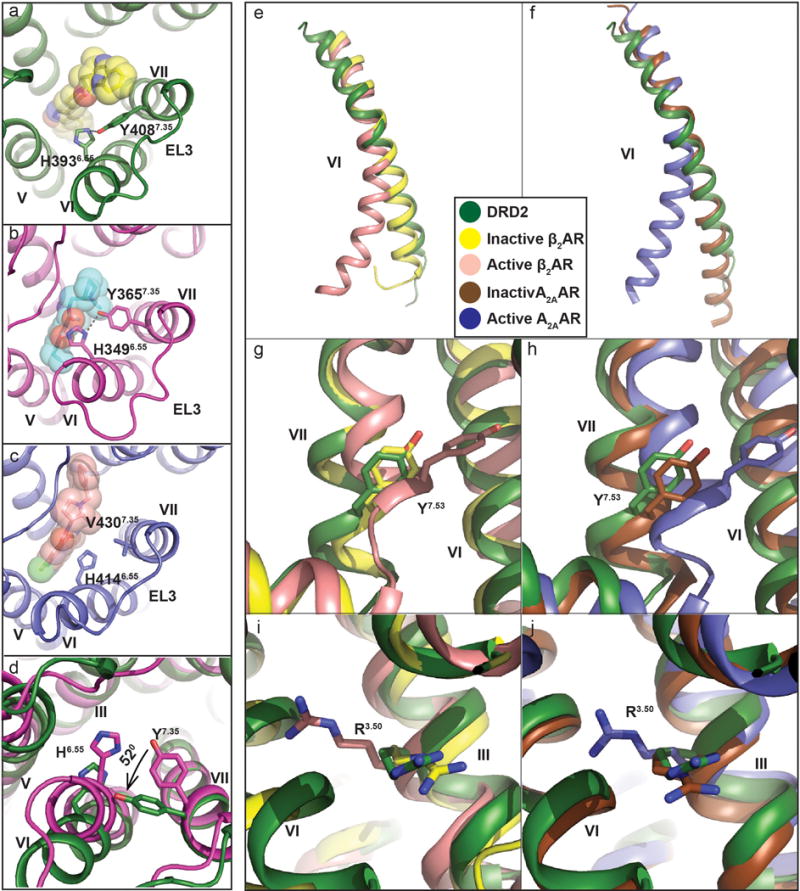
Extended Data Figure 3. Comparison of D2 receptors view from the extracellular side and structural alignment with the β2 adrenergic receptor (β2AR) and A2A adenosine (A2AAR) reveals inactive-state of the DRD2
In a-d panels, the DRD2 colored in green; DRD3 in magenta (PDB code 3PBL), and DRD4 in blue (PDB code 5WIU). Risperidone (yellow), eticlopride (cyan) and nemonapride (lightpink) are shown sticks and spheres. a, b, c, Displacements of H6.55 and Y/V7.35 are shown at DRD2 (a), DRD3 (b) and DRD4 (c). d, The views from extracellular side of DRD2 and DRD3. e, f, Superposition of TM VI at DRD2 (green), inactive β2AR (yellow) (PDB code: 2RH1), active β2AR (lightpink) (PDB code: 3SN6), inactive A2AAR (brown) (PDB code: 3REY) and active A2AAR (blue) (PDB code: 5G53) aligned through helices I-IV. g, h, i, j, Cytoplasmic view of an alignment between DRD2 and active/inactive β2AR (g, h) or A2AAR (i, j). Rearrangements of two highly conserved residues (Y7.53 and R3.50) within the core of the receptor are shown as sticks. Ligands are omitted for clarity, hydrogen bonds are shown as grey dotted line and the Ballesteros-Weinstein numbering is shown as superscript.
Extended Data Figure 4
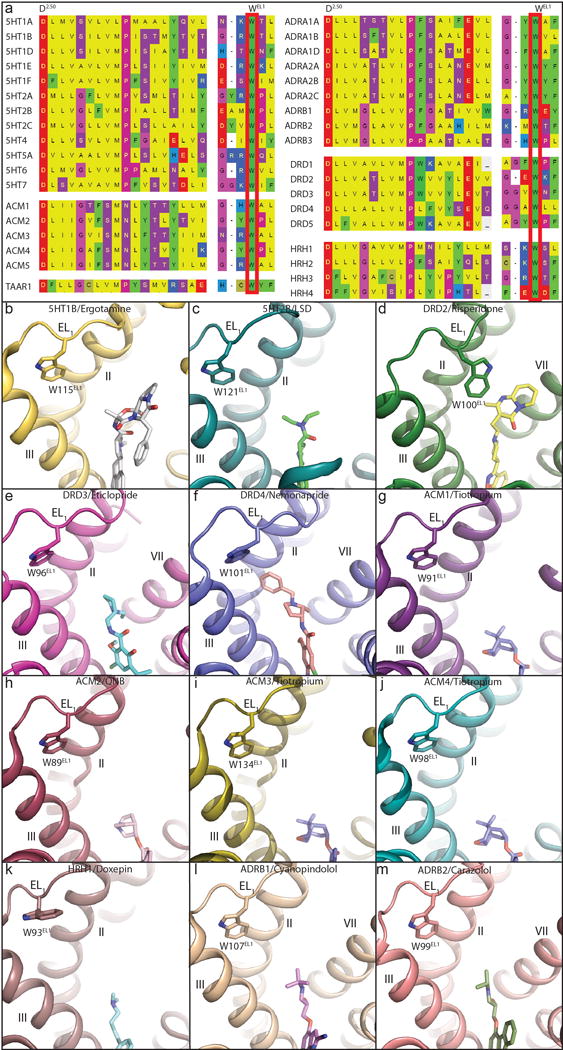
Extended Data Figure 4. Conserved Trp of EL1 in all available aminergic receptor structures illustrates unique position in DRD2/risperidone
In all panels, receptors are shown as cartoon. Ligands and residues are shown as sticks. a, Conserved Trp of EL1 was show in red box. b, 5HT1B (PDB code 4IAR). c, 5HT2B (PDB code 5TVN). d, DRD2. e, DRD3 (PDB code 3PBL). f, DRD4 (PDB code 5WIU). g, ACM1 (PDB code 5CXV). h, ACM2 (PDB code 3UON). i, ACM3 (PDB code 4ADJ). j, ACM4 (PDB code 4DSG). k, HRH1 (PDB code 3RZE). l, ADRB1 (PDB code 2VT4). m, ADRB2 (PDB code 2RH1).
Extended Data Figure 5
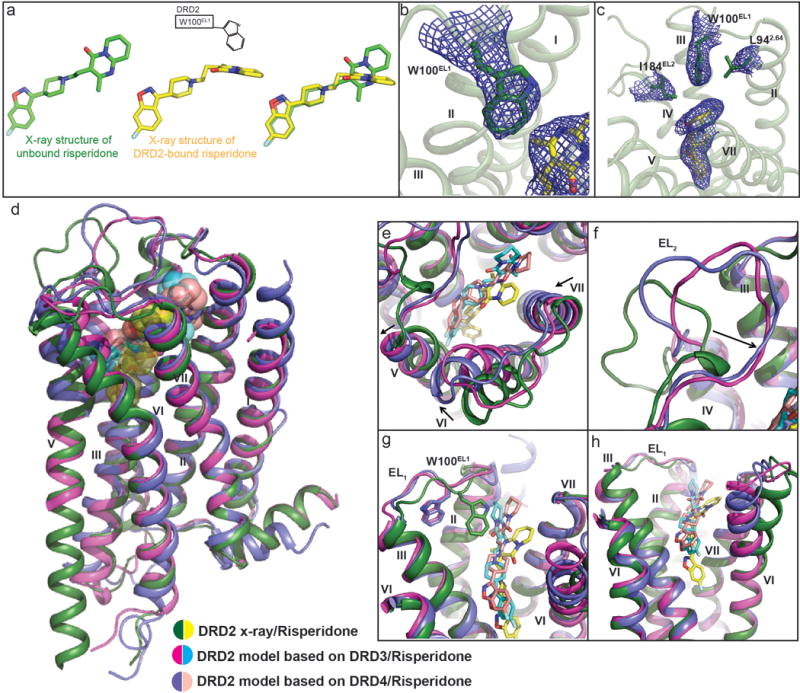
Extended Data Figure 5. Risperidone has distinct poses in solution and in complex with DRD2 and comparison of x-ray structure and model of DRD2
a, Trp100EL1 determines the configuration of the tetrahydropyridopyrimidinone moiety of risperidone. Structure of unbound risperidone colored in green and DRD2-bound risperidone in yellow. b, Electron density (2Fo-Fc maps, blue mesh) for W100EL1 in the DRD2/Risperidone complex (contoured at 1.0σ). c, 2Fo-Fc electron density map (blue mesh) of Leu942.64, Trp100EL1, Ile184EL2 and risperidone (yellow) contoured at 0.8σ. Ballesteros-Weinstein numbering is shown as superscript. d, Overall view of DRD2/Risperidone x-ray structure and model. e, f, g, h, Comparison of x-ray structure and model of DRD2. In d-h panels, DRD2 x-ray structure and model is shown as cartoons, with the x-ray structure colored in green and model in magenta or blue. Risperidone in x-ray structure is shown as yellow spheres or sticks and model as cyan or lightpink.
Extended Data Figure 6
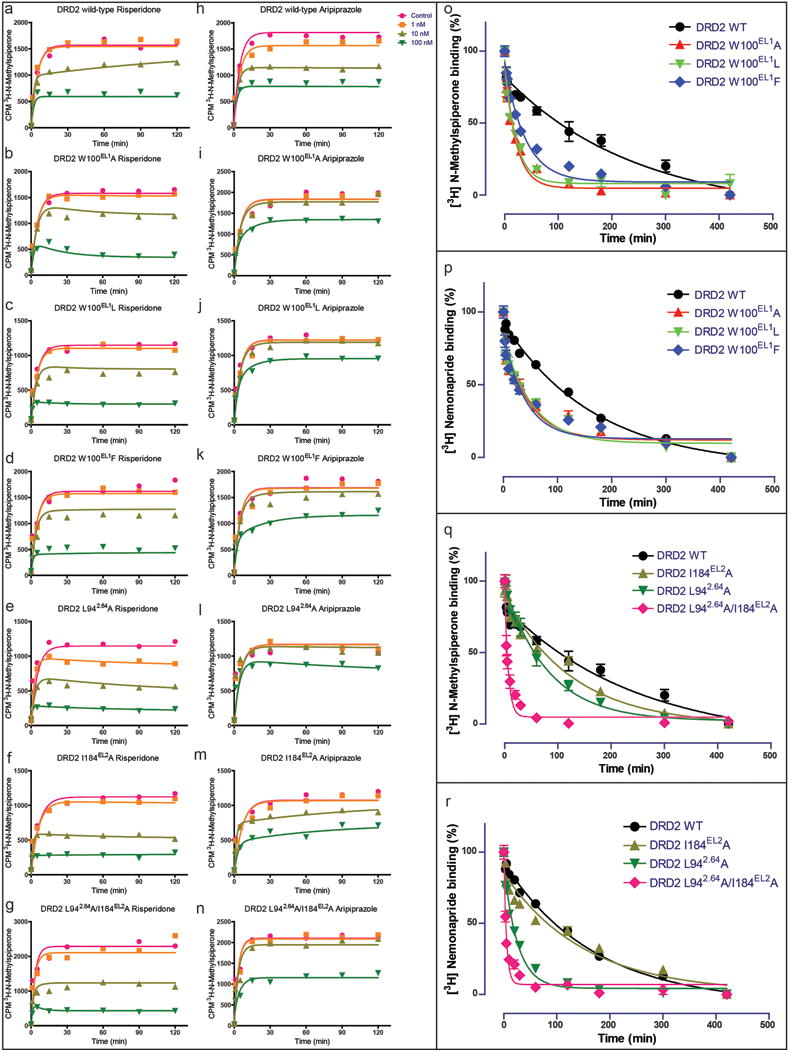
Extended Data Figure 6. Patch residues of the DRD2 orthosteric pocket impair the dissociation rates of risperidone, aripiprazole, N-methylspiperone and nemonapride
a, b, c, e, f, g, Comparison of risperidone dissociation from wild-type DRD2 (a) and W100EL1A (b), W100EL1L (c), W100EL1F (d), L942.64 A (e), I184EL2A (f) or L942.64A /I184EL2A (g) mutants. h, i, j, k, l, m, n, Comparison of aripiprazole dissociation from wild-type DRD2 (h) and W100EL1A (i), W100EL1L (j), W100EL1F (k), L942.64 A (l), I184EL2A (m) or L942.64A /I184EL2A (n) mutants. o, p, Comparison of N-methylspiperone (o) or nemonapride (p) dissociation from wild-type DRD2 and W100EL1A, W100EL1L or W100EL1F mutants(n=3). q, r, Comparison of N-methylspiperone (q) or nemonapride (r) dissociation from wild-type DRD2 and L942.64 A, I184EL2A or L942.64A /I184EL2A mutants. All data are the mean  ± SEM of four independent assays (n = 4 independent experiments). Error bars in o-r denote SEM from four independent assays. Ballesteros-Weinstein numbering is shown as superscript.
Figure 1
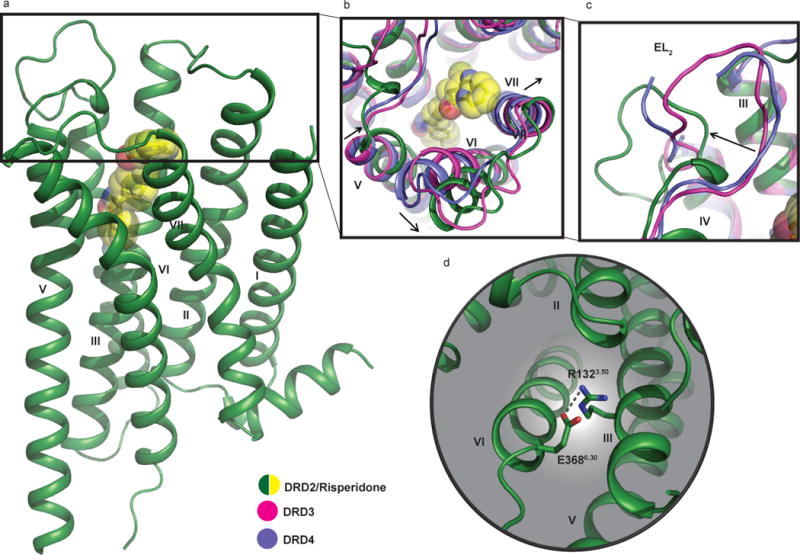
Figure 1. Structural details of DRD2 and comparison with DRD3 and DRD4
In all panels, dopamine receptor structures are shown aligned to the DRD2, with the DRD2 colored in green; DRD3 in magenta (PDB code 3PBL), and DRD4 in blue (PDB code 5WIU). Risperidone (yellow) is shown in sphere representation. a, Overall structure of the DRD2/Risperidone complex. b, c, Comparison of the view from the extracellular side. d, Cytoplasmic surface showing salt-bridge interaction (grey dotted line) between R1323.50 and E3686.30. In all panels, the Ballesteros-Weinstein numbering is shown as superscript.
Figure 2
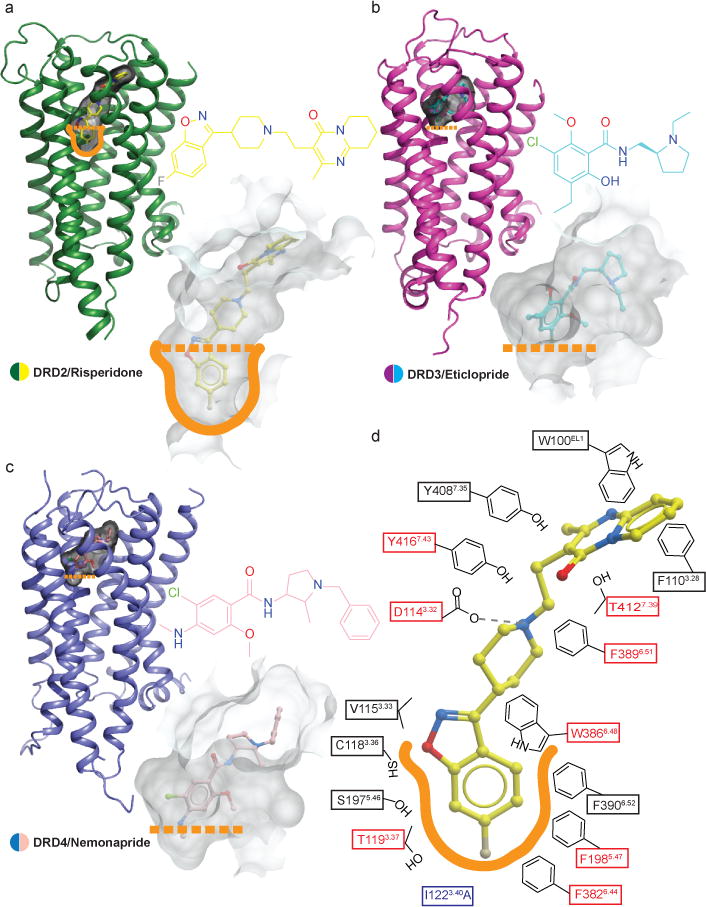
Figure 2. Comparison of the ligand binding pocket across the D2-like family receptors
a, b, c, Surface representations of the ligand binding pockets of DRD2 (a), DRD3 (b) (PDB code 3PBL) and DRD4 (c) (PDB code 5WIU) are shown in transparent gray. d, A schematic representation of risperidone binding interactions at a 4.0 Å cut-off is shown. Hydrogen bonds are shown in grey dashed lines. Mutations of the amino acid in the red boxes reduces risperidone binding affinity by more than tenfold. The thermo-stabilizing mutation (I1223.40A) colored in blue. The outline of deeper hydrophobic pocket is colored as orange.
Figure 3
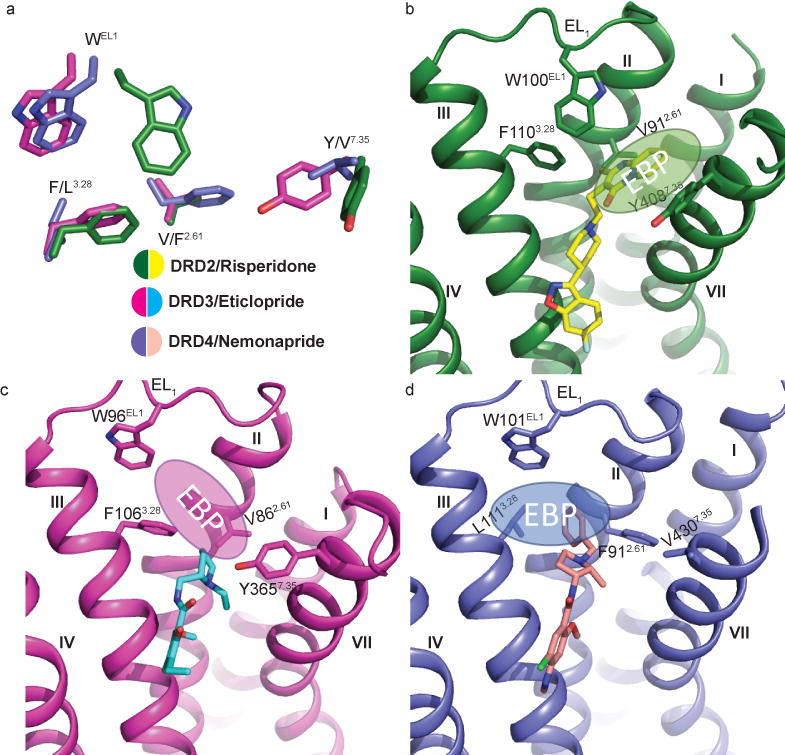
Figure 3. Different extended binding pockets revealed across D2-like family receptors
a, The distinctive selective extended binding pocket (EBP) defined by four key residues in the D2-like family receptors are delineated. The residues of DRD2 (green), DRD3 (pink) (PDB code 3PBL) and DRD4 (blue) (PDB code 5WIU) are shown as sticks. b, c, d, Structural differences in the EBPs of DRD2 (b), DRD3 (c) and DRD4 (d) are evident. Residues and ligands are colored as in (a). The position of each EBP is shown as an ellipse with the Ballesteros-Weinstein numbering as superscript.
Figure 4
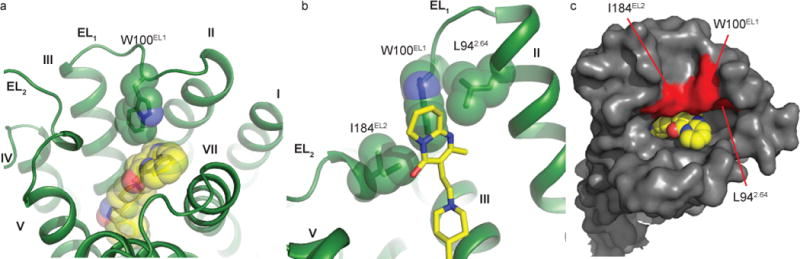
Figure 4. The hydrophobic “patch” of the DRD2 binding pocket
a, Risperidone (yellow) bound to DRD2 (green) orthosteric pocket viewed from extracellular space. b, The W100EL1 side chain forms extensive hydrophobic contacts with residues L942.64 and I184EL2. c, The residues L942.64, W 100EL1 and I184EL2 form a patch (red, with other residues in grey) that narrows DRD2’s binding pocket.

Comment in

References

    1. Missale C, Nash SR, Robinson SW, Jaber M, Caron MG. Dopamine receptors: from structure to function. Physiol Rev. 1998;78:189–225. - PubMed
    1. Creese I, Burt DR, Snyder SH. Dopamine receptor binding predicts clinical and pharmacological potencies of antischizophrenic drugs. Science. 1976;192:481–483. - PubMed
    1. Meltzer HY, Matsubara S, Lee JC. Classification of typical and atypical antipsychotic drugs on the basis of dopamine D-1, D-2 and serotonin2 pKi values. J Pharmacol Exp Ther. 1989;251:238–246. - PubMed
    1. Roth BL, Sheffler DJ, Kroeze WK. Magic shotguns versus magic bullets: selectively non-selective drugs for mood disorders and schizophrenia. Nat Rev Drug Discov. 2004;3:353–359. - PubMed
    1. Roth BL. Drugs and valvular heart disease. N Engl J Med. 2007;356:6–9. - PubMed

Publication types

MeSH terms