. 2018 Feb 21;9(1):743.
doi: 10.1038/s41467-018-03207-x.

A low cost and high performance polymer donor material for polymer solar cells

Affiliations

A low cost and high performance polymer donor material for polymer solar cells

Chenkai Sun et al. Nat Commun. .

Abstract

The application of polymer solar cells requires the realization of high efficiency, high stability, and low cost devices. Here we demonstrate a low-cost polymer donor poly[(thiophene)-alt-(6,7-difluoro-2-(2-hexyldecyloxy)quinoxaline)] (PTQ10), which is synthesized with high overall yield of 87.4% via only two-step reactions from cheap raw materials. More importantly, an impressive efficiency of 12.70% is obtained for the devices with PTQ10 as donor, and the efficiency of the inverted structured PTQ10-based device also reaches 12.13% (certificated to be 12.0%). Furthermore, the as-cast devices also demonstrate a high efficiency of 10.41% and the devices exhibit insensitivity of active layer thickness from 100 nm to 300 nm, which is conductive to the large area fabrication of the devices. In considering the advantages of low cost and high efficiency with thickness insensitivity, we believe that PTQ10 will be a promising polymer donor for commercial application of polymer solar cells.


Conflict of interest statement

The authors declare no competing financial interests.

Figures

Fig. 1
Fig. 1
Photovoltaic materials and device structure of the PSCs. a Molecular structures of the polymer donor PTQ10 and the n-OS acceptor IDIC. b Devices architecture of the traditional structured PSCs. c Synthetic route of PTQ10. d Energy level diagram of the related materials used in the PSCs. e Normalized absorption spectra of the donor PTQ10 and the acceptor IDIC
Fig. 2
Fig. 2
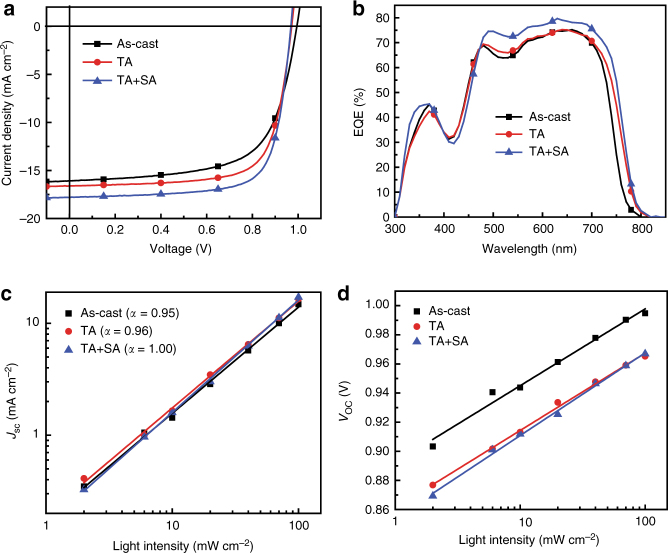
Photovoltaic performance of the PSCs based on PTQ10: IDIC. a JV curves of the traditional structured PSCs based on PTQ10: IDIC (1:1, w/w), under the illumination of AM1.5G, 100 mW cm−2. b EQE spectra of the corresponding PSCs. The dependence of Jsc (c) and Voc (d) on light intensity (Plight) of the optimized PSCs
Fig. 3
Fig. 3
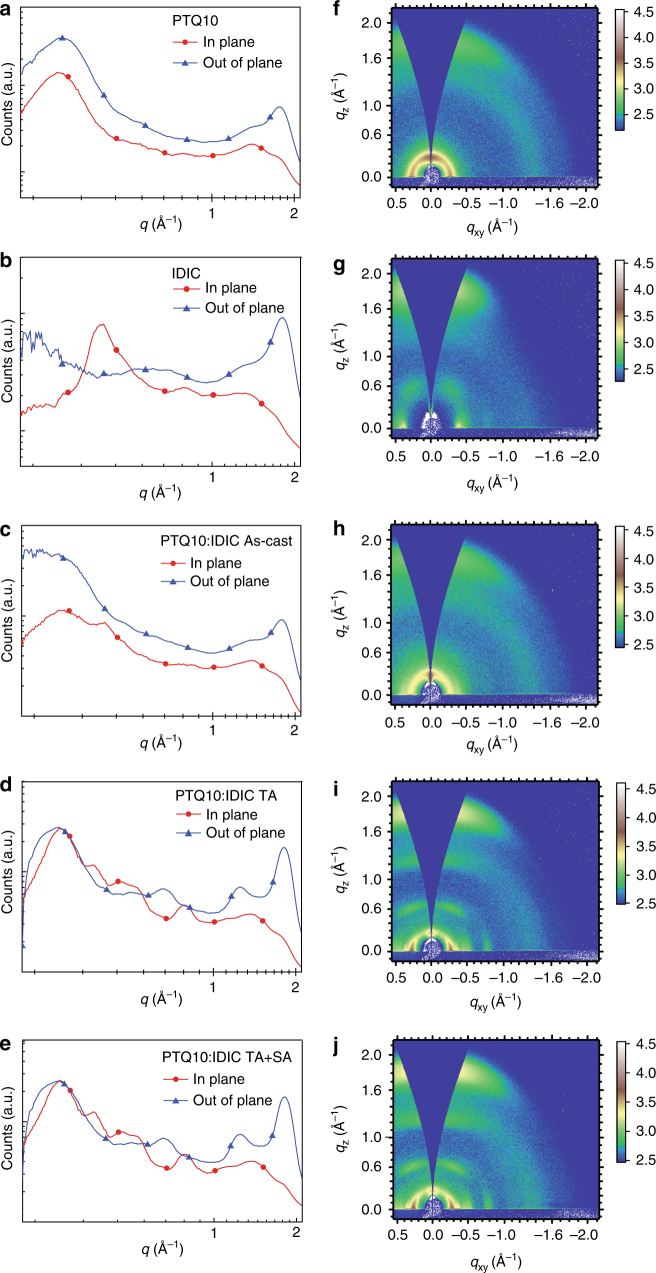
Plots and images of the GIWAXS measurements. Line cuts of the GIWAXS images of neat PTQ10 film (a), neat IDIC film (b), and PTQ10: IDIC blend films without (as-cast) (c), with TA treatment (d), and with TA + SA treatment (e). GIWAXS images of neat PTQ10 film (f), neat IDIC film (g), and PTQ10: IDIC blend films without (as-cast) (h), with TA treatment (i), and with TA + SA treatment (j)
Fig. 4
Fig. 4
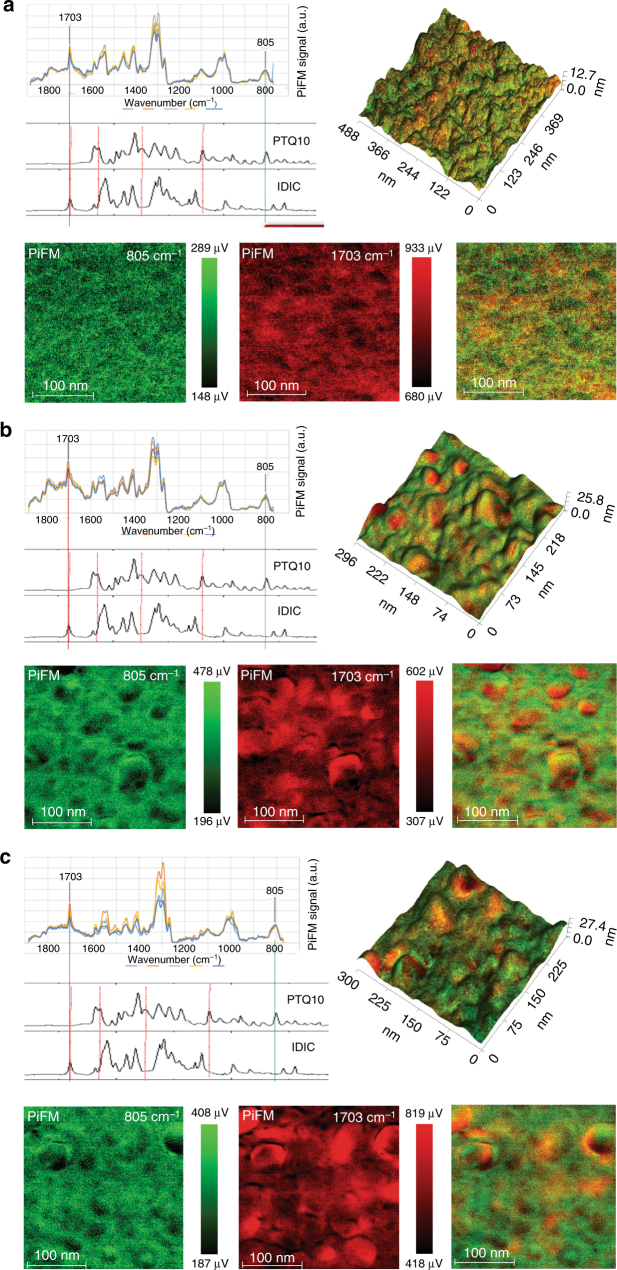
FTIR spectra and PiFM topography images. FTIR spectra and PiFM images of PTQ10: IDIC blend films based on FTIR absorption at different wave numbers (PTQ10, 805 cm−1 and IDIC, 1703 cm−1): without (as-cast) (a), with TA treatment (b), and with TA + SA treatment (c)
Fig. 5
Fig. 5
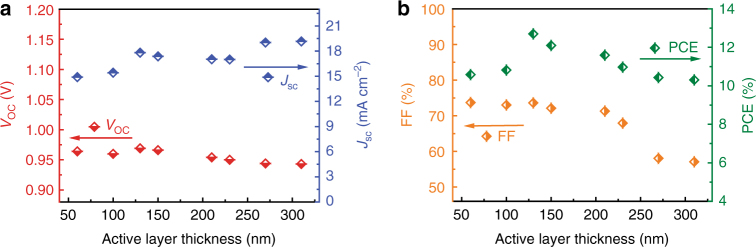
Thickness dependence of the photovoltaic performance. Plots of Voc or Jsc (a) and FF or PCE (b) vs. the active layer thickness ranging from 60 to 310 nm for the traditional structured PSCs
Fig. 6
Fig. 6
Cost and PCE analysis of the PSCs. Plots of PCE vs. synthesis steps (a) and overall yield (b) of the polymer donors reported in literatures with PCE over 10%

References

    1. Service RF. Outlook brightens for plastic solar cells. Science. 2011;332:293. doi: 10.1126/science.332.6027.293. - DOI - PubMed
    1. Li C, Liu M, Pschirer NG, Baumgarten M, Mullen K. Polyphenylene-based materials for organic photovoltaics. Chem. Rev. 2010;110:6817–6855. doi: 10.1021/cr100052z. - DOI - PubMed
    1. Yu G, Gao J, Hummelen JC, Wudl F, Heeger AJ. Polymer photovoltaic cells: enhanced efficiencies via a network of internal donor-acceptor heterojunctions. Science. 1995;270:1789–1791. doi: 10.1126/science.270.5243.1789. - DOI
    1. Thompson BC, Frechet JM. Polymer-fullerene composite solar cells. Angew. Chem. Int. Ed. 2008;47:58–77. doi: 10.1002/anie.200702506. - DOI - PubMed
    1. Li G, Zhu R, Yang Y. Polymer solar cells. Nat. Photon. 2012;6:153–161. doi: 10.1038/nphoton.2012.11. - DOI

Publication types