


Local Anesthetics' Toxicity toward Human Cultured Chondrocytes: A Comparative Study between Lidocaine, Bupivacaine, and Ropivacaine
- PMID: 29468902
- PMCID: PMC6585294
- DOI: 10.1177/1947603518758436
Local Anesthetics' Toxicity toward Human Cultured Chondrocytes: A Comparative Study between Lidocaine, Bupivacaine, and Ropivacaine
Abstract
Objective: In orthopedic joint injection, the most frequently used local anesthetics are ropivacaine, bupivacaine, and 1% or 2% lidocaine. The aim of this study was to examine effects of these various anesthetics on the viability of human chondrocytes. Our hypothesis was that all local anesthetics tested damage human chondrocytes in vitro.
Methods: Primary human chondrocytes were isolated and cultured from 6 donated human knee joints (mean age of donors 61.2 years). Local anesthetics were added to these cultures. Toxicity analysis was performed by visualization of cell structure using light microscopy. Determination of vital chondrocytes was performed by use of a Casy cell counter. Chondrocytes' cell death was examined by fluorescence microscopy and an XTT ELISA assay.
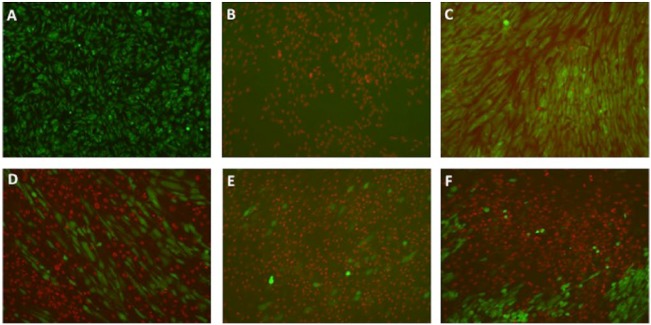
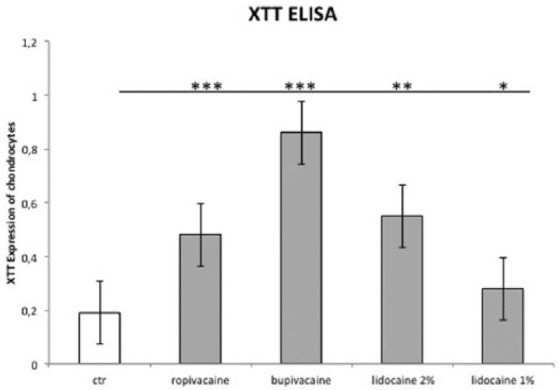
Results: Light microscope and fluorescence microscope data revealed a defect cell structure and increased number of dead cells after addition of 1% or 2% lidocaine and bupivacaine but not ropivacaine. We were able to show an increased level of XTT activity after treatment with bupivacaine, 2% lidocaine or ropivacaine. The count of vital chondrocytes was significantly decreased after treatment with bupivacaine, 1% or 2% lidocaine, and ropivacaine.
Conclusions: The data show that treatment with local anesthetics induces cell damage of human chondrocytes in vitro. Ropivacaine seems to be a local anesthetic with the lowest toxic potential on human chondrocytes, a feature that may favor its preference for use in joint injection.
Keywords: cell damage; human chondrocytes; local anesthetics; toxicity.
Conflict of interest statement
Figures


References
-
- Lefevre N, Klouche S, de Pamphilis O, Herman S, Gerometta A, Bohu Y. Peri-articular local infiltration analgesia versus femoral nerve block for postoperative pain control following anterior cruciate ligament reconstruction: prospective, comparative, non-inferiority study. Orthop Traumatol Surg Res. 2016;102(7):873-7. - PubMed
-
- Ravnihar K, Barlič A, Drobnič M. Effect of intra-articular local anesthesia on articular cartilage in the knee. Arthroscopy. 2014;30(5):607-12. - PubMed
-
- Zhou Y, Yang TB, Wei J, Zeng C, Li H, Yang T, et al. Single-dose intra-articular ropivacaine after arthroscopic knee surgery decreases post-operative pain without increasing side effects: a systematic review and meta-analysis. Knee Surg Sports Traumatol Arthrosc. 2016;24(5):1651-9. - PubMed
-
- Barastegui D, Robert I, Palau E, Haddad S, Reverte-Vinaixa M, Lorente L, et al. Can local infiltration analgesia increase satisfaction in postoperative short-term pain control in total knee arthroplasty? J Orthop Surg (Hong Kong). 2017;25(1):2309499017690461. - PubMed
Publication types
MeSH terms
Substances
LinkOut - more resources
Full Text Sources
Other Literature Sources
