Review
. 2018 Feb 22;18(2):645.
doi: 10.3390/s18020645.

Flexible, Stretchable Sensors for Wearable Health Monitoring: Sensing Mechanisms, Materials, Fabrication Strategies and Features

Affiliations
Review

Flexible, Stretchable Sensors for Wearable Health Monitoring: Sensing Mechanisms, Materials, Fabrication Strategies and Features

Yan Liu et al. Sensors (Basel). .

Abstract

Wearable health monitoring systems have gained considerable interest in recent years owing to their tremendous promise for personal portable health watching and remote medical practices. The sensors with excellent flexibility and stretchability are crucial components that can provide health monitoring systems with the capability of continuously tracking physiological signals of human body without conspicuous uncomfortableness and invasiveness. The signals acquired by these sensors, such as body motion, heart rate, breath, skin temperature and metabolism parameter, are closely associated with personal health conditions. This review attempts to summarize the recent progress in flexible and stretchable sensors, concerning the detected health indicators, sensing mechanisms, functional materials, fabrication strategies, basic and desired features. The potential challenges and future perspectives of wearable health monitoring system are also briefly discussed.

Keywords: flexibility and stretchability; sensors; wearable health monitoring.


Conflict of interest statement

The authors declare no conflict of interest.

Figures
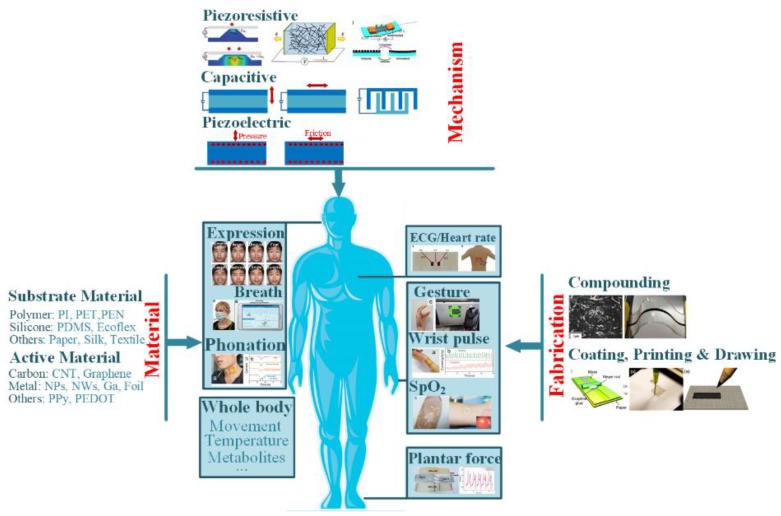
Figure 1
Figure 1
Illustration of the basic concerns of wearable sensors for health monitoring.
Figure 2
Figure 2
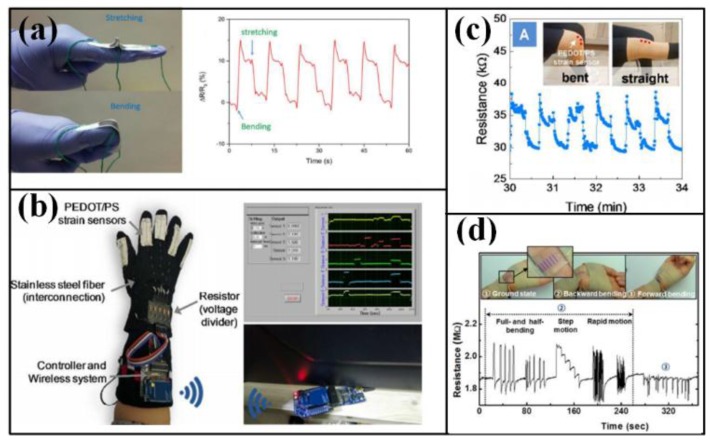
Movement detection of fingers, wrist and knee: (a)detection of finger movement by single strip; (b) detection of finger movement by glove-like device; (c) detection of knee and wrist movement. Reproduced from [38] with permission of The Royal Society of Chemistry. Reprinted with permission from [36]. Copyright 2107 American Chemical Society. Reprinted with permission from [49], Copyright (2015) American Chemical Society.
Figure 3
Figure 3
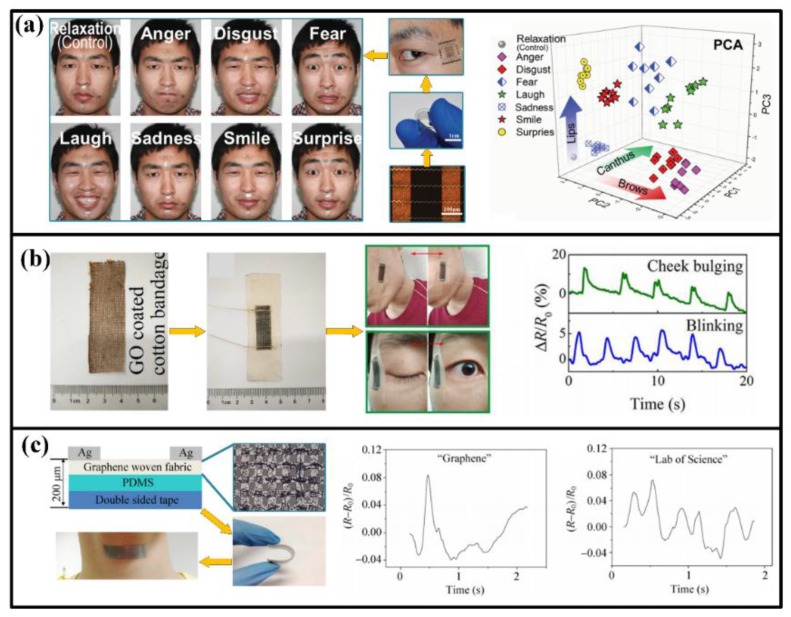
Detected indicators in face and throat: (a) Facial expression; (b) blinking and cheek bulging; (c) vocalization of “graphene” and” lab of science”. Reproduced from [9] with permission of WILEY. Adapted with permission from [72], Copyright (2017) American Chemical Society. Adapted with permission from [10], Copyright (2015) Springer.
Figure 4
Figure 4
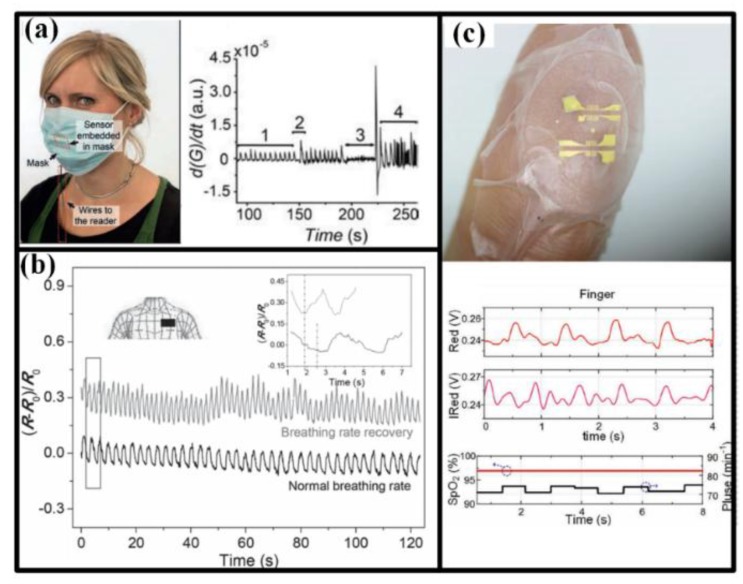
Detection of breath and SpO2: (a) Detecting breath with a sensor embedded in mask, and the curve shows the results under normally breathing (1), taking a deep breath (2), paused (3) and randomly breathing (4); (b) Detecting breath with a strip sensor worn in the chest; (c) Detecting the SpO2 with a sensor attached on fingertip. Reproduced from [5] with permission of WILEY. Reproduced from [7] with permission of WILEY. Reproduced from [79] with permission of WILEY.
Figure 5
Figure 5
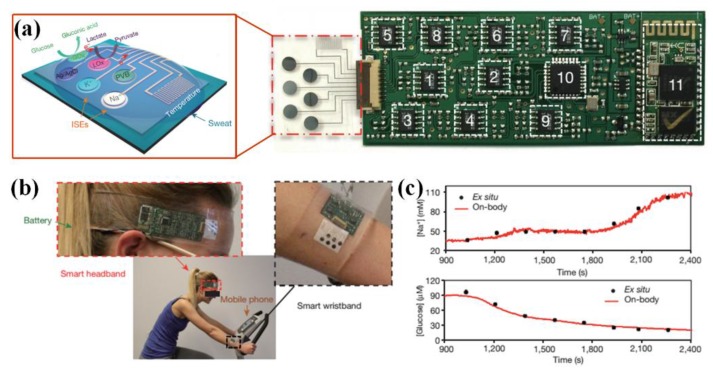
Detection of metabolism parameters: (a) the sensor array for simultaneously and selectively measuring the Na+, K+, glucose and lactate in sweat; (b) the devices worn in forehead and wrist to monitor the stationary cycling process; (c) the detected concentrations of Na+ and glucose, which were compared with the Ex situ calibration data. Adapted with permission from [15], Copyright (2016) Nature.
Figure 6
Figure 6
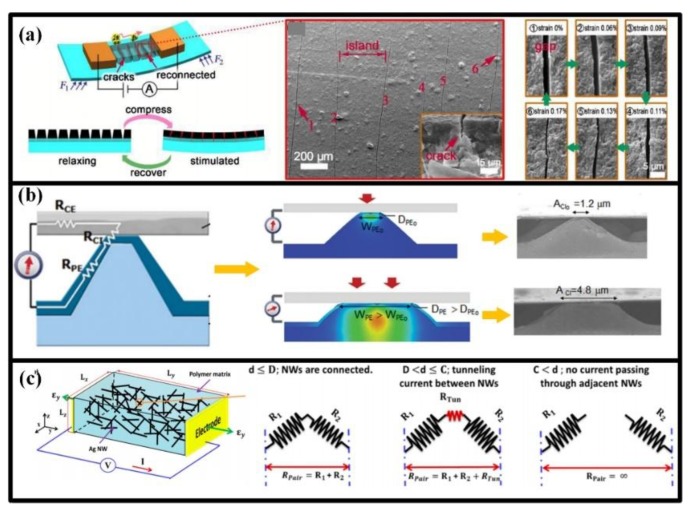
Available working concepts for piezoresistive wearable sensors: (a) micro-scale crack; (b) the connecting area between the active and electrode layers; (c) the connecting, disconnecting and tunneling effect between the adjacent active elements. Reproduced from [122] with permission of The Royal Society of Chemistry. Reproduced from [124] with permission of WILEY. Reprinted with permission from [35], Copyright (2014) American Chemical Society.
Figure 7
Figure 7
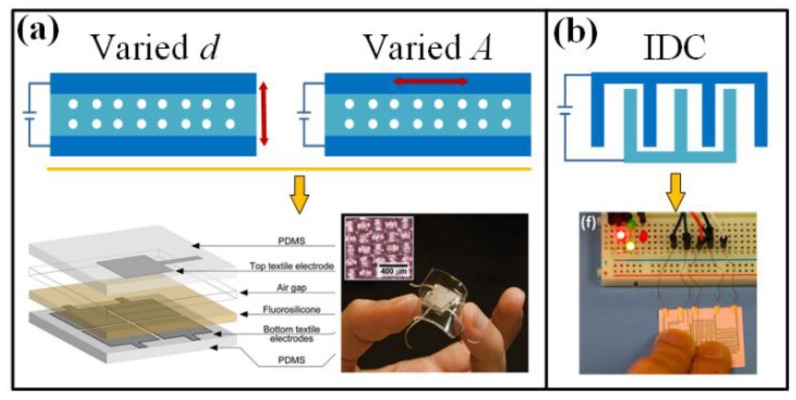
Available working concepts for capacitive wearable sensors, including varying d, A and IDC. Reproduced from [126] with permission of WILEY. Adapted with permission from [131], Copyright (2014) American Chemical Society.
Figure 8
Figure 8
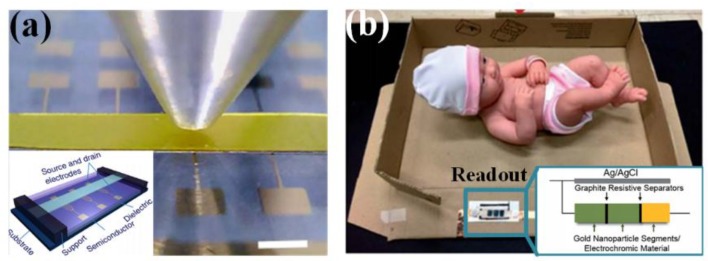
Other working mechanism for wearable sensors; (a) FET-based sensor; (b) visual sensing mechanism in the balance-in-a-box for infant birth weight determination. Adapted from [136] with permission of The Royal Society of Chemistry.
Figure 9
Figure 9
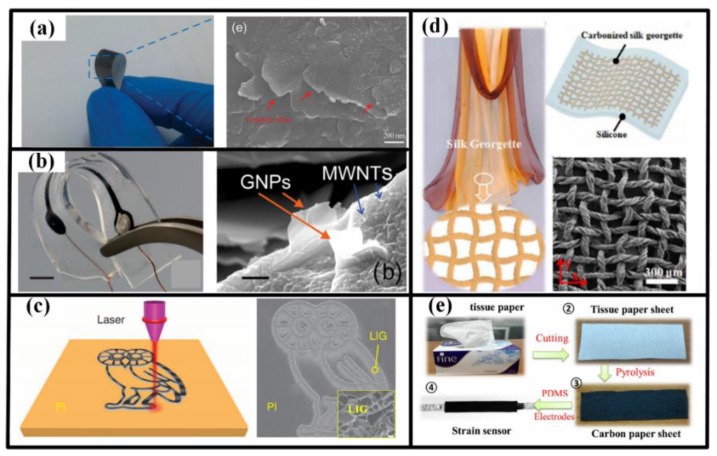
Carbon-based materials for sensing element: (a) graphene flakes from commercial pencil; (b) graphene flakes and MWCNTs compounded in substrate; (c) laser induced graphene on PI film; the carbonized silk georgette (d) and tissue paper (e). Reproduced from [139] with permission of WILEY. Reprinted from [138], with the permission of AIP Publishing. Adapted with permission from [149], Copyright (2014) Nature. Reproduced from [150] with permission of The Royal Society of Chemistry. Reprinted with permission from [152], Copyright (2016) American Chemical Society.
Figure 10
Figure 10
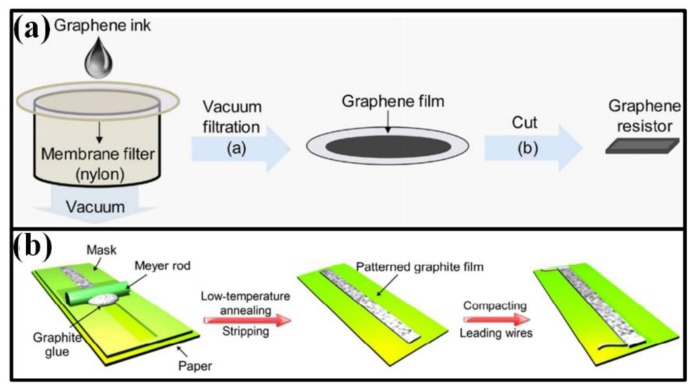
Available schemes for mask-needed printing: (a) vacuum filtration; (b) Mayer rod coating. Reprinted from [171], with the permission of Elsevier. Reproduced from [50] with permission of The Royal Society of Chemistry.
Figure 11
Figure 11
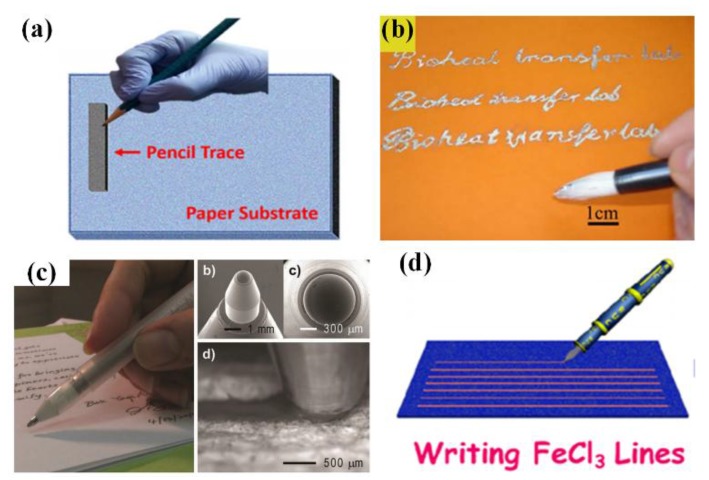
Directly writing electronics with different writing instruments: (a) Pencil; (b) Chinses brush pen; (c) Rollerball pen and (d) fountain pen. Reprinted from [133], with the permission of Elsevier. Reproduced from [189] with permission of WILEY. Reprinted with permission from [160], Copyright (2014) American Chemical Society.
Figure 12
Figure 12
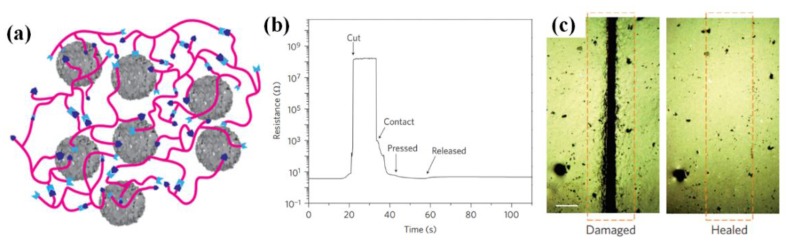
The tactile sensor with self-healing ability: (a) The interaction of oligomer chains with μNi particles; (b) The electrical healing process of resistance for 15 s healing time at room temperature; (c) Optical image of damaged sample and complete scar healing. Adapted with permission from [198], Copyright (2012) Nature.
Figure 13
Figure 13
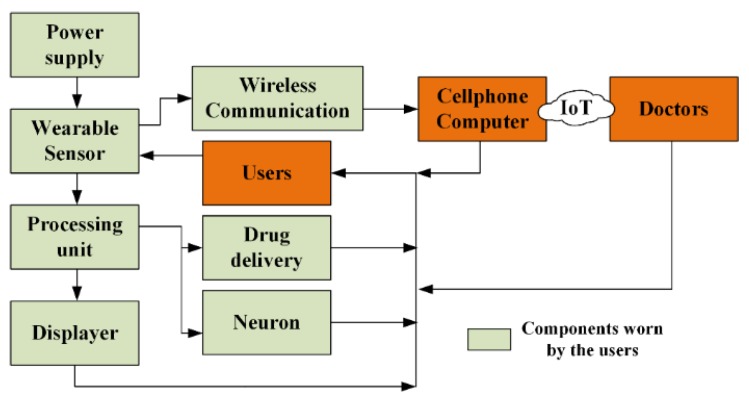
The ideal composition of wearable health monitoring system.

References

    1. Kosack C.S., Page A.L., Klatser P.R. A guide to aid the selection of diagnostic tests. Bull. World Health Organ. 2017;95:639–645. doi: 10.2471/BLT.16.187468. - DOI - PMC - PubMed
    1. Haghi M., Thurow K., Stoll R. Wearable devices in medical internet of things: Scientific research and commercially available devices. Healthc. Inform. Res. 2017;23:4–15. doi: 10.4258/hir.2017.23.1.4. - DOI - PMC - PubMed
    1. Wang X., Liu Z., Zhang T. Flexible sensing electronics for wearable/attachable health monitoring. Small. 2017;13:1602790. doi: 10.1002/smll.201602790. - DOI - PubMed
    1. Wang X., Gu Y., Xiong Z., Cui Z., Zhang T. Silk-molded flexible, ultrasensitive, and highly stable electronic skin for monitoring human physiological signals. Adv. Mater. 2014;26:1336–1342. doi: 10.1002/adma.201304248. - DOI - PubMed
    1. Guder F., Ainla A., Redston J., Mosadegh B., Glavan A., Martin T.J., Whitesides G.M. Paper-based electrical respiration sensor. Angew. Chem. Int. Ed. 2016;55:5727–5732. doi: 10.1002/anie.201511805. - DOI - PubMed