


Offspring sex impacts DNA methylation and gene expression in placentae from women with diabetes during pregnancy
- PMID: 29470513
- PMCID: PMC5823368
- DOI: 10.1371/journal.pone.0190698
Offspring sex impacts DNA methylation and gene expression in placentae from women with diabetes during pregnancy
Abstract
Aims/hypothesis: We hypothesized that diabetes during pregnancy (DDP) alters genome-wide DNA methylation in placenta resulting in differentially methylated loci of metabolically relevant genes and downstream changes in RNA and protein expression.
Methods: We mapped genome-wide DNA methylation with the Infinium 450K Human Methylation Bead Chip in term fetal placentae from Native American and Hispanic women with DDP using a nested case-control design (n = 17 pairs). RNA expression and protein levels were assayed via RNA-Seq and Western Blot.
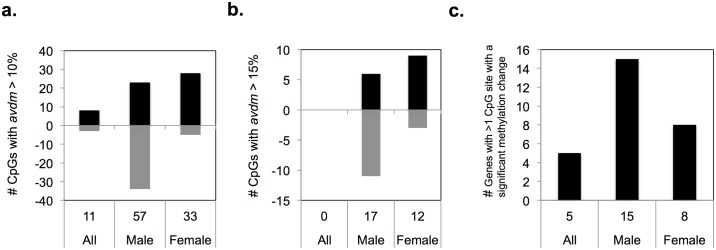
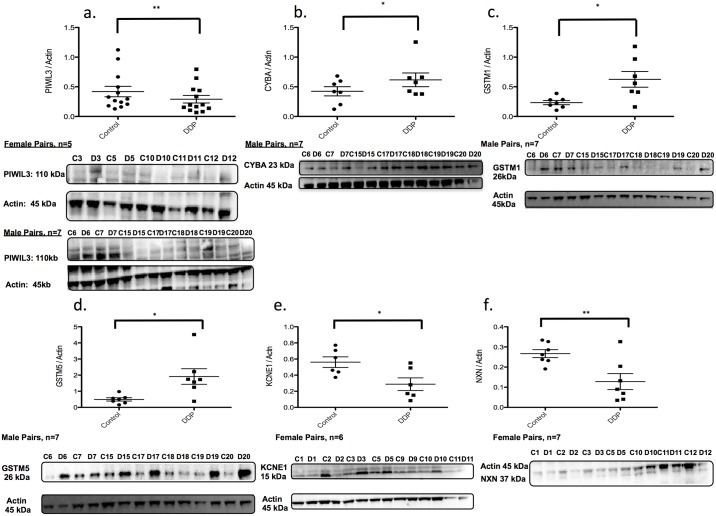
Results: Genome-wide DNA methylation analysis revealed 465 CpG sites with significant changes for male offspring, 247 for female offspring, and 277 for offspring of both sexes (p<0.001). Placentae from female offspring were 40% more likely to have significant gains in DNA methylation compared with placentae from male offspring exposed to DDP (p<0.001). Changes in DNA methylation corresponded to changes in RNA and protein levels for 6 genes: PIWIL3, CYBA, GSTM1, GSTM5, KCNE1 and NXN. Differential DNA methylation was detected at loci related to mitochondrial function, DNA repair, inflammation, oxidative stress.
Conclusions/interpretation: These findings begin to explain mechanisms responsible for the increased risk for obesity and type 2 diabetes in offspring of mothers with DDP.
Conflict of interest statement
Figures
References
-
- Pettitt DJ, Baird HR, Aleck KA, Bennett PH, Knowler WC. Excessive obesity in offspring of Pima Indian women with diabetes during pregnancy. N Engl J Med. 1983;308(5):242–5. Epub 1983/02/03. doi: 10.1056/NEJM198302033080502 - DOI - PubMed
-
- Pettitt DJ, Aleck KA, Baird HR, Carraher MJ, Bennett PH, Knowler WC. Congenital susceptibility to NIDDM. Role of intrauterine environment. Diabetes. 1988;37(5):622–8. . - PubMed
-
- Silverman BL, Metzger BE, Cho NH, Loeb CA. Impaired glucose tolerance in adolescent offspring of diabetic mothers. Relationship to fetal hyperinsulinism. Diabetes Care. 1995;18(5):611–7. . - PubMed
-
- Armitage JA, Taylor PD, Poston L. Experimental models of developmental programming: consequences of exposure to an energy rich diet during development. The Journal of physiology. 2005;565(Pt 1):3–8. doi: 10.1113/jphysiol.2004.079756 . - DOI - PMC - PubMed
-
- Bartolomei MS, Webber AL, Brunkow ME, Tilghman SM. Epigenetic mechanisms underlying the imprinting of the mouse H19 gene. Genes & development. 1993;7(9):1663–73. . - PubMed
Publication types
MeSH terms
Substances
Grants and funding
LinkOut - more resources
Full Text Sources
Other Literature Sources
Medical
Research Materials
Miscellaneous
