Increased HIV-1 transcriptional activity and infectious burden in peripheral blood and gut-associated CD4+ T cells expressing CD30
- PMID: 29470552
- PMCID: PMC5823470
- DOI: 10.1371/journal.ppat.1006856
Increased HIV-1 transcriptional activity and infectious burden in peripheral blood and gut-associated CD4+ T cells expressing CD30
Abstract
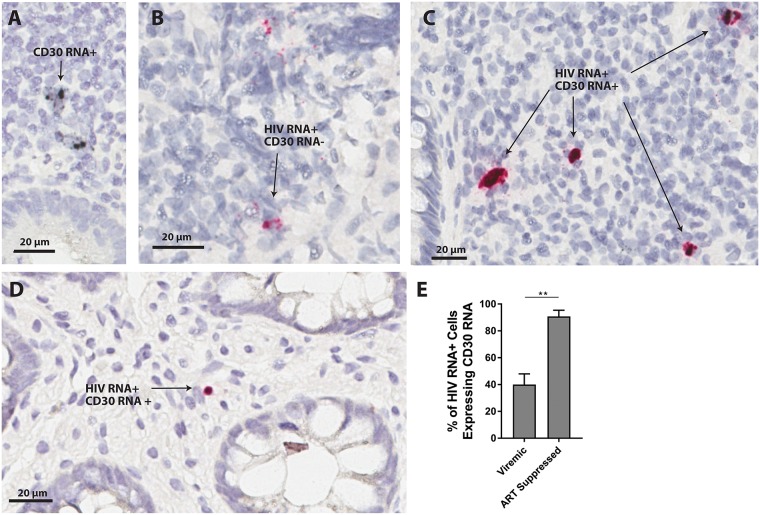
HIV-1-infected cells persist indefinitely despite the use of combination antiretroviral therapy (ART), and novel therapeutic strategies to target and purge residual infected cells in individuals on ART are urgently needed. Here, we demonstrate that CD4+ T cell-associated HIV-1 RNA is often highly enriched in cells expressing CD30, and that cells expressing this marker considerably contribute to the total pool of transcriptionally active CD4+ lymphocytes in individuals on suppressive ART. Using in situ RNA hybridization studies, we show co-localization of CD30 with HIV-1 transcriptional activity in gut-associated lymphoid tissues. We also demonstrate that ex vivo treatment with brentuximab vedotin, an antibody-drug conjugate (ADC) that targets CD30, significantly reduces the total amount of HIV-1 DNA in peripheral blood mononuclear cells obtained from infected, ART-suppressed individuals. Finally, we observed that an HIV-1-infected individual, who received repeated brentuximab vedotin infusions for lymphoma, had no detectable virus in peripheral blood mononuclear cells. Overall, CD30 may be a marker of residual, transcriptionally active HIV-1 infected cells in the setting of suppressive ART. Given that CD30 is only expressed on a small number of total mononuclear cells, it is a potential therapeutic target of persistent HIV-1 infection.
Conflict of interest statement
The authors have declared that no competing interests exist.
Figures



References
-
- Stein H, Mason DY, Gerdes J, O'Connor N, Wainscoat J, et al. (1985) The expression of the Hodgkin's disease associated antigen Ki-1 in reactive and neoplastic lymphoid tissue: evidence that Reed-Sternberg cells and histiocytic malignancies are derived from activated lymphoid cells. Blood 66: 848–858. - PubMed
-
- Falini B, Pileri S, Pizzolo G, Durkop H, Flenghi L, et al. (1995) CD30 (Ki-1) molecule: a new cytokine receptor of the tumor necrosis factor receptor superfamily as a tool for diagnosis and immunotherapy. Blood 85: 1–14. - PubMed
-
- Chiarle R, Podda A, Prolla G, Gong J, Thorbecke GJ, et al. (1999) CD30 in normal and neoplastic cells. Clin Immunol 90: 157–164. doi: 10.1006/clim.1998.4636 - DOI - PubMed
-
- Biswas P, Mantelli B, Delfanti F, Ferrarini M, Poli G, et al. (2003) CD30 ligation differentially affects CXCR4-dependent HIV-1 replication and soluble CD30 secretion in non-Hodgkin cell lines and in gamma delta T lymphocytes. Eur J Immunol 33: 3136–3145. doi: 10.1002/eji.200324344 - DOI - PubMed
-
- Biswas P, Smith CA, Goletti D, Hardy EC, Jackson RW, et al. (1995) Cross-linking of CD30 induces HIV expression in chronically infected T cells. Immunity 2: 587–596. - PubMed
Publication types
MeSH terms
Substances
Grants and funding
- R33 AI116205/AI/NIAID NIH HHS/United States
- U19 AI096109/AI/NIAID NIH HHS/United States
- K24 AI069994/AI/NIAID NIH HHS/United States
- R21AI116205 /NH/NIH HHS/United States
- K01 HL140804/HL/NHLBI NIH HHS/United States
- R21 AI116205/AI/NIAID NIH HHS/United States
- HHSN272201400002C/AI/NIAID NIH HHS/United States
- P30 AI027763/AI/NIAID NIH HHS/United States
- K24 AI069994 /NH/NIH HHS/United States
- R01 AI141003/AI/NIAID NIH HHS/United States
- AI096109 /NH/NIH HHS/United States
- UM1 AI126611/AI/NIAID NIH HHS/United States
- P30 AI027763 /NH/NIH HHS/United States
- UM1 068636 /NH/NIH HHS/United States
LinkOut - more resources
Full Text Sources
Other Literature Sources
Medical
Research Materials