Review
. 2018 Dec;67(12):1885-1896.
doi: 10.1007/s00262-018-2132-1. Epub 2018 Feb 22.

Mucosa-associated invariant T cells in malignancies: a faithful friend or formidable foe?

Affiliations
Review

Mucosa-associated invariant T cells in malignancies: a faithful friend or formidable foe?

S M Mansour Haeryfar et al. Cancer Immunol Immunother. 2018 Dec.

Abstract

Mucosa-associated invariant T (MAIT) cells are a subset of innate-like T lymphocytes known for their ability to respond to MHC-related protein 1 (MR1)-restricted stimuli and select cytokine signals. They are abundant in humans and especially enriched in mucosal layers, common sites of neoplastic transformation. MAIT cells have been found within primary and metastatic tumors. However, whether they promote malignancy or contribute to anticancer immunity is unclear. On the one hand, MAIT cells produce IL-17A in certain locations and under certain circumstances, which could in turn facilitate neoangiogenesis, intratumoral accumulation of immunosuppressive cell populations, and cancer progression. On the other hand, they can express a potent arsenal of cytotoxic effector molecules, NKG2D and IFN-γ, all of which have established roles in cancer immune surveillance. In this review, we highlight MAIT cells' characteristics as they might pertain to cancer initiation, progression, or control. We discuss recent findings, including our own, that link MAIT cells to cancer, with a focus on colorectal carcinoma, as well as some of the outstanding questions in this active area of research. Finally, we provide a hypothetical picture in which MAIT cells constitute attractive targets in cancer immunotherapy.

Keywords: CITIM 2017; Cancer; IFN-γ; IL-17; MAIT cells; Tumor-infiltrating leukocytes.


Conflict of interest statement

The authors declare that they have no conflict of interest.

Figures
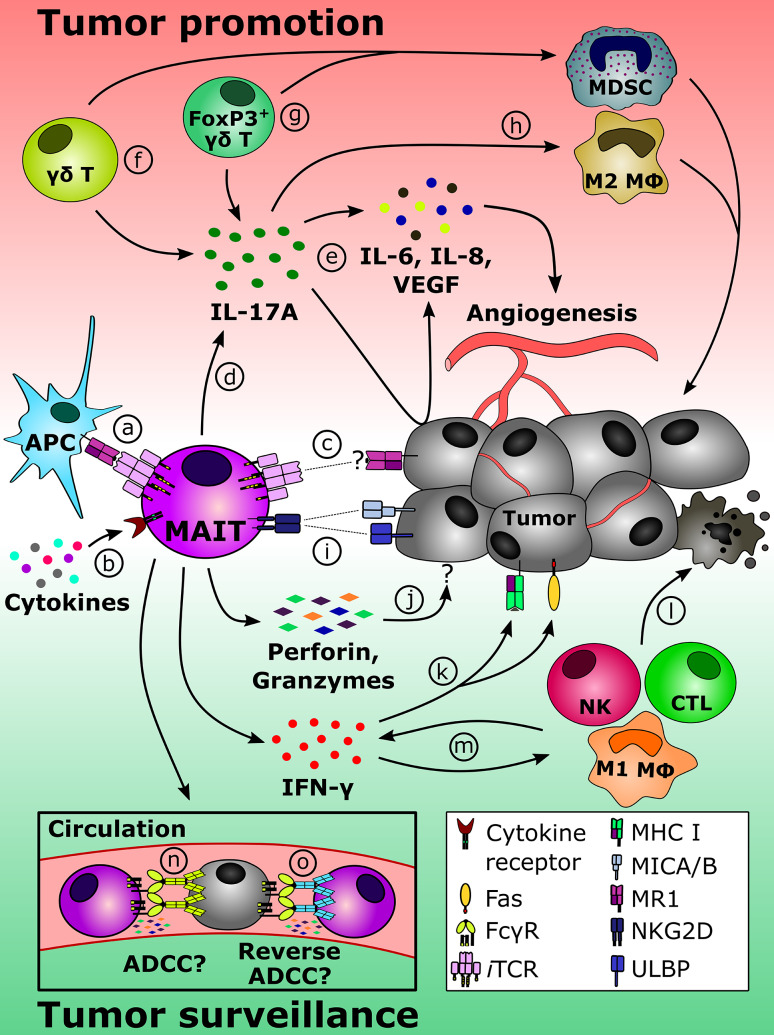
Fig. 1
Fig. 1
Potential MAIT cell roles in tumor promotion/progression and in antitumor immune surveillance. MAIT cells residing within and outside TMEs may recognize MR1-restricted Ags displayed by APCs (a) and/or respond to select cytokines including IL-7, IL-12 and IL-18 (b). There also exists a possibility that tumor cells themselves present MR1 ligands to directly activate MAIT cells (c). Once primed, MAIT cells in certain locations may release IL-17A (d) whose pro-tumorigenic effects include the induction of angiogenic factors such as IL-6, IL-8 and/or VEGF in tumor cells and other cell types (e). Therefore, MAIT cells can join forces with other sources of IL-17A within the TME, including γδT17 cells (f) and IL-17A-producing FoxP3+ γδ T cells (g) that facilitate the intratumoral accumulation of MDSCs. Regardless of its cellular origin, IL-17A can favor tumor progression also by promoting the differentiation of M2 macrophages (h). Conversely, a different scenario can be envisaged in which MAIT cells play a protective role against cancer. The expression of NKG2D by MAIT cells should enable them to sense the presence of MIC A/B and/or ULBPs on malignant cells (i). MAIT cells harbor a lethal arsenal and may release cytotoxic effector molecules (e.g., perforin and granzymes) upon target cell recognition (j). In addition, activated MAIT cells are among the most powerful sources of IFN-γ, a cytokine known to upregulate MHC class I and Fas (CD95) on tumor cells (k), thus making them prone to the cytolytic action of various killer cell types (l). IFN-γ also transactivates NK cells, CD8+ CTLs and M1 macrophages among other secondary effector cell types (m), thereby accelerating tumor cell demise (l). MAIT cells reportedly express CD16 (FcγRIII) in some individuals, which should allow for Ab-coated tumor cell destruction via ADCC (n). We propose that MAIT cells’ cytolytic potentials may be exploited in therapeutic settings where MAIT cell-specific Abs mediate the elimination of FcR+ tumor cells through reverse ADCC (o)

References

    1. Porcelli S, Yockey CE, Brenner MB, Balk SP. Analysis of T cell antigen receptor (TCR) expression by human peripheral blood CD4-8- alpha/beta T cells demonstrates preferential use of several V beta genes and an invariant TCR alpha chain. J Exp Med. 1993;178(1):1–16. doi: 10.1084/jem.178.1.1. - DOI - PMC - PubMed
    1. Lantz O, Bendelac A. An invariant T cell receptor alpha chain is used by a unique subset of major histocompatibility complex class I-specific CD4 + and CD4-8- T cells in mice and humans. J Exp Med. 1994;180(3):1097–1106. doi: 10.1084/jem.180.3.1097. - DOI - PMC - PubMed
    1. Tilloy F, Treiner E, Park SH, Garcia C, Lemonnier F, de la Salle H, Bendelac A, Bonneville M, Lantz O. An invariant T cell receptor alpha chain defines a novel TAP-independent major histocompatibility complex class Ib-restricted alpha/beta T cell subpopulation in mammals. J Exp Med. 1999;189(12):1907–1921. doi: 10.1084/jem.189.12.1907. - DOI - PMC - PubMed
    1. Treiner E, Duban L, Bahram S, Radosavljevic M, Wanner V, Tilloy F, Affaticati P, Gilfillan S, Lantz O. Selection of evolutionarily conserved mucosal-associated invariant T cells by MR1. Nature. 2003;422(6928):164–169. doi: 10.1038/nature01433. - DOI - PubMed
    1. Yamaguchi H, Hirai M, Kurosawa Y, Hashimoto K. A highly conserved major histocompatibility complex class I-related gene in mammals. Biochem Biophys Res Commun. 1997;238(3):697–702. doi: 10.1006/bbrc.1997.7379. - DOI - PubMed

MeSH terms

LinkOut - more resources
