


Phase-based treatment versus immediate trauma-focused treatment in patients with childhood trauma-related posttraumatic stress disorder: study protocol for a randomized controlled trial
- PMID: 29471855
- PMCID: PMC5824601
- DOI: 10.1186/s13063-018-2508-8
Phase-based treatment versus immediate trauma-focused treatment in patients with childhood trauma-related posttraumatic stress disorder: study protocol for a randomized controlled trial
Abstract
Background: The treatment of posttraumatic stress disorder (PTSD) related to a history of sexual and/or physical abuse in childhood is the subject of international debate, with some favouring a phase-based approach as their preferred treatment, while others argue for immediate trauma-focused treatment. A history of (chronic) traumatisation during childhood has been linked to the development of distinct symptoms that are often labelled as symptoms of complex PTSD. Many therapists associate the presence of symptoms of complex PTSD with a less favourable treatment prognosis. The purpose of this study is to determine whether a phase-based approach is more effective than stand-alone trauma-focused therapy in individuals with PTSD and possible symptoms of complex PTSD resulting from a history of repeated sexual and/or physical abuse in childhood. An additional aim is to investigate moderators, predictors of treatment (non) response and drop-out.
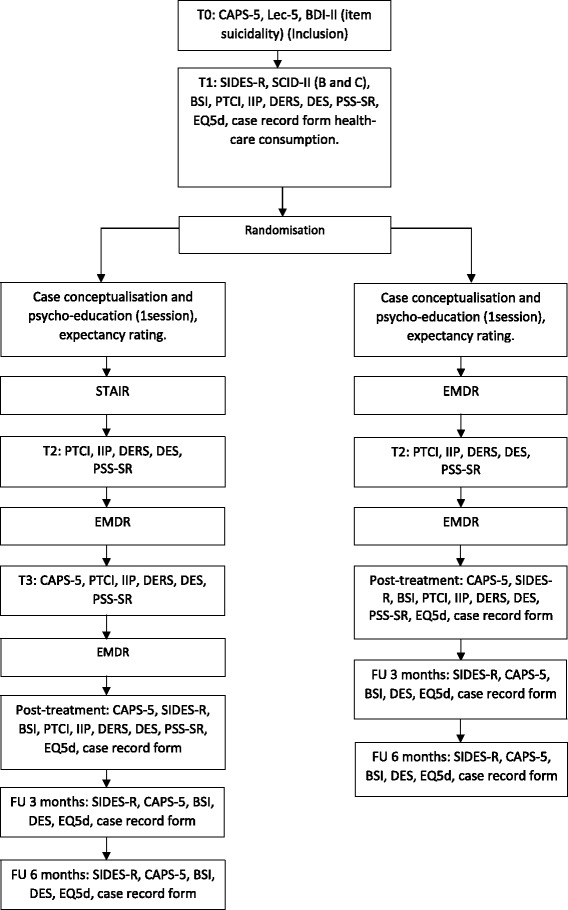
Method: The sample consists of patients between 18 and 65 years old with a diagnosis of PTSD who report a history of repeated sexual and/or physical abuse in childhood (N = 122). Patients will be blindly allocated to either 16 sessions of eye movement desensitization and reprocessing (EMDR) therapy preceded by a stabilization phase (eight sessions of Skills Training in Affect and Interpersonal Regulation (STAIR)) or only 16 sessions of EMDR therapy. Assessments are carried out pre-treatment, after every eighth session, post-treatment, and at 3 and 6 months follow up. The main parameter will be the severity of PTSD symptoms (PTSD Symptoms Scale-Self Report). Secondary outcome variables are the presence of a PTSD diagnosis (Clinician-Administered PTSD Scale for DSM-5), severity of complex PTSD symptoms (Structured Interview for Disorders of Extreme Stress-Revised and symptoms-specific questionnaires), changes in symptoms of general psychopathology (Brief Symptom Inventory), and quality of life (Euroqol-5D). Health care consumption and productivity loss in patients will also be indexed.
Discussion: The study results may help to inform the ongoing debate about whether a phase-based approach has added value over immediate trauma-focused therapy in patients suffering from PTSD due to childhood abuse. Furthermore, the results will contribute to knowledge about the safety, efficacy, and cost-effectiveness of treatments in this target group.
Trial registration: Nederlands Trialregister, NTR5991 . Registered on 23 august 2016. http://www.trialregister.nl/trialreg/admin/rctview.asp?TC=5991.
Keywords: Complex PTSD; EMDR; PTSD; STAIR; Trauma-focused therapy; Treatment.
Conflict of interest statement
Ethics approval and consent to participate
This study was ethically approved by the Institutional Review Board of Twente, reference number P16–03. We will obtain signed informed consent from all participating patients.
Consent for publication
Not applicable.
Competing interests
Ad de Jongh receives income for published books on EMDR therapy and for the training of postdoctoral professionals in this method. There is no conflict of interest in the present study for any of the other authors.
Publisher’s Note
Springer Nature remains neutral with regard to jurisdictional claims in published maps and institutional affiliations.
Figures

References
-
- National Collaborating Centre for Mental Health . Post-traumatic stress disorder: The management of PTSD in adults and children in primary and secondary care. Clinical guideline 26. London: National Institute for Clinical Excellence; 2005.
-
- World Health Organization . Guidelines for the management of conditions specifically related to stress. Geneva: World Health Organization; 2013. - PubMed
-
- Foa EB, McLean CP, Capaldi S, Rosenfield D. Prolonged exposure versus supportive counselling for abuse-related PTSD in adolescent girls, a randomized clinical trial. JAMA. 2013;310(Suppl 22):1–8. - PubMed
Publication types
MeSH terms
Grants and funding
LinkOut - more resources
Full Text Sources
Other Literature Sources
Medical
