Fork Protection and Therapy Resistance in Hereditary Breast Cancer
- PMID: 29472318
- PMCID: PMC6041132
- DOI: 10.1101/sqb.2017.82.034413
Fork Protection and Therapy Resistance in Hereditary Breast Cancer
Abstract
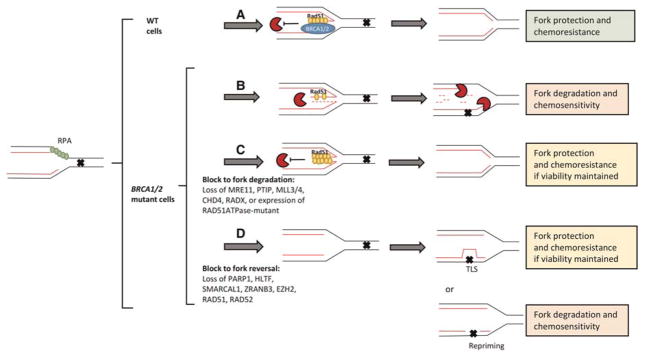
The BRCA-Fanconi anemia (FA) pathway preserves the genome and suppresses cancer and is a main determinant of chemotherapeutic efficacy. The hereditary breast cancer genes BRCA1 and BRCA2 function in DNA double-strand break repair mediating distinct steps of homologous recombination (HR). More recently, independent of DNA repair, functions in the replication stress response have come to light, providing insight as to how the BRCA-FA pathway also balances genome preservation with proliferation. The BRCA-FA proteins associate with the replisome and contribute to the efficiency and recovery of replication following perturbations that slow or arrest DNA replication. Although the full repertoire of functions in the replication stress response remains to be elucidated, the function of BRCA1 and BRCA2 in protecting stalled replication forks contributes along with HR to the sensitivity of BRCA-associated tumors to chemotherapy. Moreover, chemoresistance evolves from restoration of either HR and/or fork protection. Although mechanisms underlying the restoration of HR have been characterized, it remains less clear how restoration of fork protection is achieved. Here, we outline mechanisms of "rewired" fork protection and chemotherapy resistance in BRCA cancer. We propose that mechanisms are linked to permissive replication that limits fork remodeling and therefore opportunities for fork degradation. Combating this chemoresistance mechanism will require drugs that inactivate replication bypass mechanisms.
© 2017 Cantor and Calvo; Published by Cold Spring Harbor Laboratory Press.
Figures
References
-
- Actis M, Inoue A, Evison B, Perry S, Punchihewa C, Fujii N. Small molecule inhibitors of PCNA/PIP-box interaction suppress translesion DNA synthesis. Bioorg Med Chem. 2013;21:1972–1977. - PubMed
-
- Adamo A, Collis SJ, Adelman CA, Silva N, Horejsi Z, Ward JD, Martinez-Perez E, Boulton SJ, La Volpe A. Preventing nonhomologous end joining suppresses DNA repair defects of Fanconi anemia. Mol Cell. 2010;39:25–35. - PubMed
Grants and funding
LinkOut - more resources
Full Text Sources
Other Literature Sources
Miscellaneous