. 2018 Feb 22;8(1):3507.
doi: 10.1038/s41598-018-21574-9.

P2X7 receptor regulates osteoclast function and bone loss in a mouse model of osteoporosis

Affiliations

P2X7 receptor regulates osteoclast function and bone loss in a mouse model of osteoporosis

Ning Wang et al. Sci Rep. .

Abstract

Post-menopausal osteoporosis is a condition that affects millions worldwide and places a huge socio-economic burden on society. Previous research has shown an association of loss of function SNPs in the gene for the purinergic receptor P2X7R with low bone mineral density, increased rates of bone loss and vertebral fractures in post-menopausal women. In this study we use a mouse model of oestrogen deficiency-induced bone loss and the BALB/cJ P2X7R-/- to show that absence of the P2X7R resulted in increased bone loss. Osteoclast precursors were isolated from both BALB/cJ P2X7R-/- and BALB/cJ P2X7R+/+ mice and then cultured in vitro to form mature resorbing osteoclasts. The BALB/cJ P2X7R-/- derived precursors generated slightly more osteoclasts but with a significant reduction in the amount of resorption per osteoclast. Furthermore, when using modified culture conditions osteoclast activity was additionally increased in the absence of the P2X7R suggest that P2X7R may regulate the lifespan and activity of osteoclasts. Finally using mechanical loading as an anabolic stimulus for bone formation, we demonstrated that the increased oestrogen-deficient bone loss could be rescued, even in the absence of P2X7R. This study paves the way for clinical intervention for women with post-menopausal osteoporosis and P2XR7 loss of function polymorphisms.


Conflict of interest statement

The authors declare no competing interests.

Figures
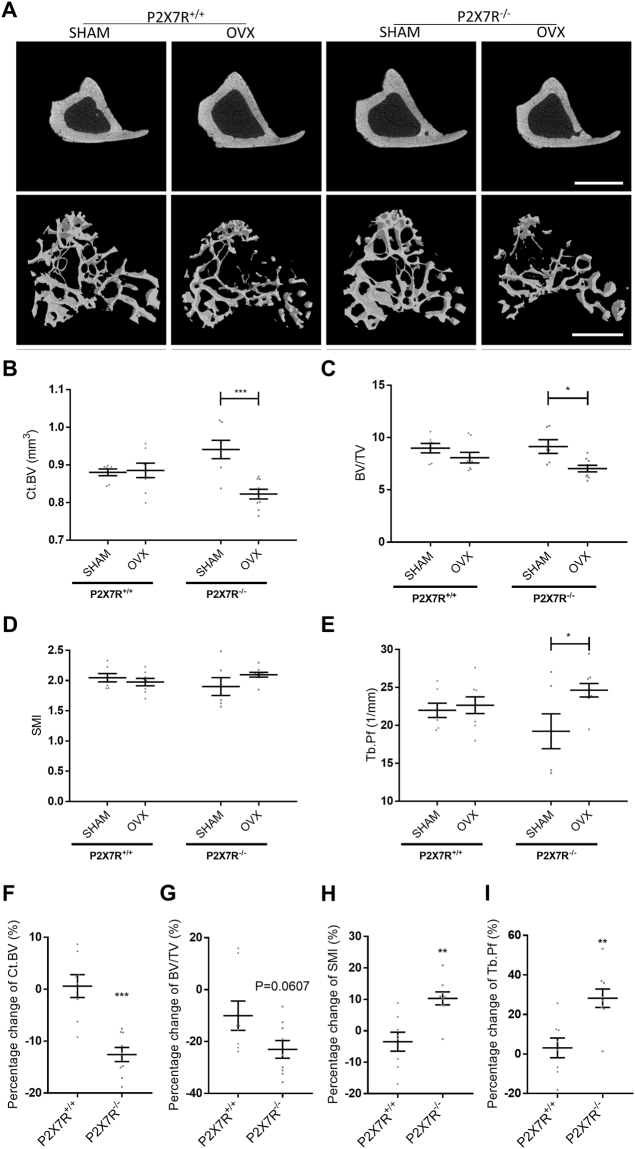
Figure 1
Figure 1
Absence of the P2X7R alters bone loss in a mouse model of osteoporosis. Sixteen week old, virgin, female BALB/cJ P2X7R+/+ and BALB/cJ P2X7R−/− mice were bilaterally ovariectomized (OVX) or ovaries were exposed without removal (SHAM). Six weeks after surgery, proximal ends of tibiae were μCT scanned. (A) Representative μCT images of the tibial cortical bone is shown in the top panel and 3D models of the trabecular bone, built from a region of 1.0 mm thick trabecular bone 0.2 mm below the growth plate in the tibia, is shown in the bottom panel. Scale bar = 1 mm. The bone structural changes were characterized by measuring parameters including (B) cortical bone volume (Ct.BV), (C) trabecular bone volume fraction (BV/TV), (D) trabecular Structure Model Index (SMI) and (E) trabecular pattern factor (Tb.Pf). (H to I) To further determine the differential respond to OVX between the two strains, the percentage changes in the bone architecture after OVX (% of (1-OVX/mean of SHAM) were also compared. All values are mean ± SEM, n = 6–9 mice per group. *p < 0.05, **p<0.01, ***p<0.001, indicate statistically significant differences, using unpaired parametric t-test or non-parametric Mann-Whitney test as appropriate.
Figure 2
Figure 2
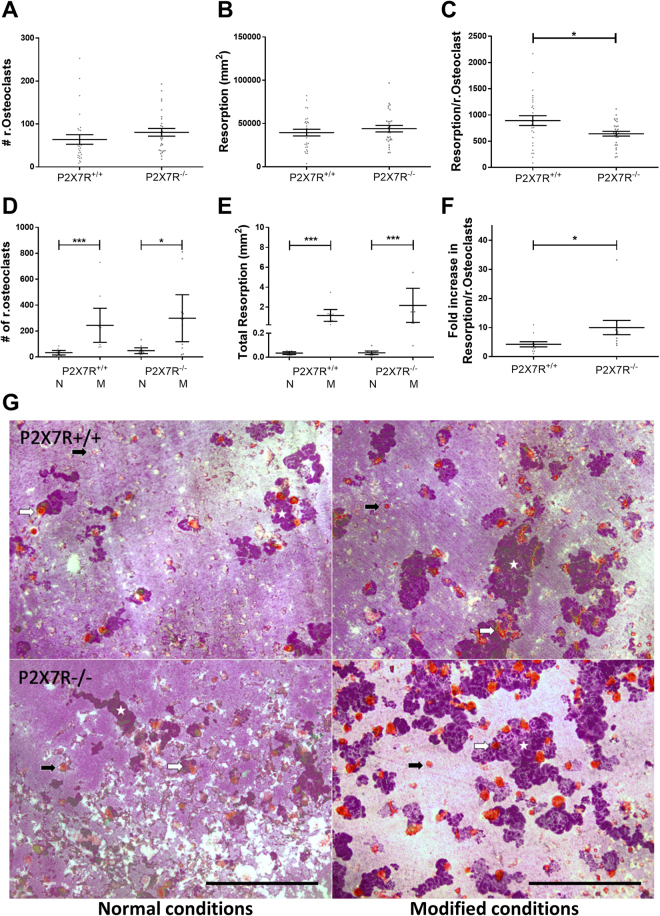
Absence of the P2X7R renders osteoclast precursor cells sensitive to exogenous stimuli. Precursor cells from bone marrow aspirates of BALB/cJ P2X7R+/+ and BALB/cJ P2X7R−/− were differentiated on dentine and TRAP stained. In normal (N) conditions the (A) total number of resorbing osteoclasts, (B) total resorption and (C) the resorptive ability (resorption/resorbing osteoclast) was determined. In modified (M) conditions the (D) total number of resorbing osteoclasts, (E) total resorption and (F) response to modified conditions on the resorptive ability of osteoclasts (expressed as a fold change of the mean resorption/resorbing osteoclast of the normal conditions (N) in either genotype) was determined. Values are mean ± SEM, n = 3 repeat cultures containing a total of 11 dentine discs. *p<0.05 **p<0.01, ***p<0.001, unpaired parametric t-test or non-parametric Mann-Whitney test as appropriate. (G) Representative images show non-resorbing (black arrows) and resorbing (white arrows) osteoclasts and resorption trails (white stars) excavated by the cells on dentine in both normal and modified conditions. Scale bar = 500 µm.
Figure 3
Figure 3
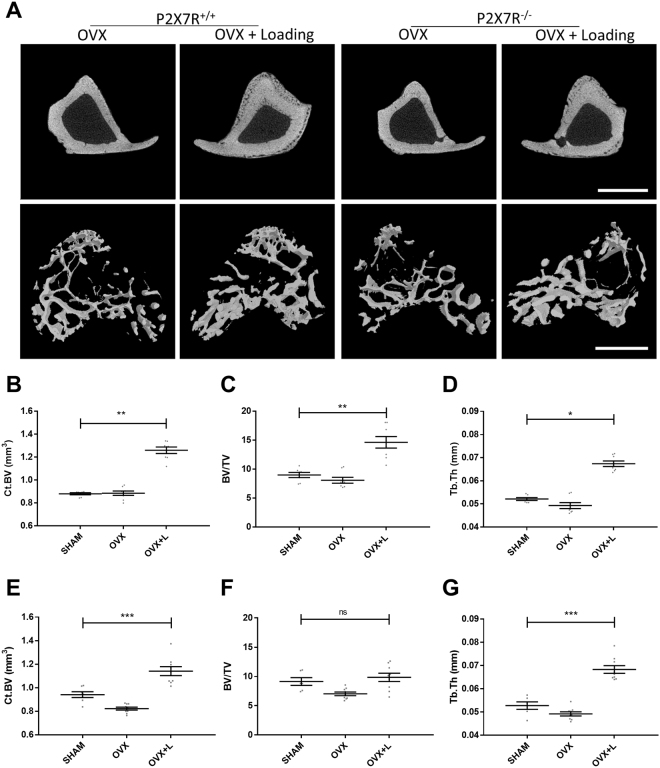
Mechanical loading rescues bone loss in a mouse model of osteoporosis even in the absence of the P2X7R. BALB/cJ P2X7R+/+ and BALB/cJ P2X7R−/− OVX and SHAM mice underwent mechanical loading 4 weeks after surgery. A 13.5 N dynamic load was superimposed onto a 0.5 N pre-load at rate of 160,000 N/s. Forty trapezoidal-waveform load cycles (0.2 s hold at 14 N) with 10 s interval between each cycle were applied to mice tibiae, three times a week for 2 weeks. The proximal ends of tibiae were μCT scanned and representative μCT images of the tibial cortical bone are shown in the top panel in A, and three-dimension models of the trabecular bone, built from a region of 1.0 mm thick trabecular bone 0.2 mm below the growth plate of tibiae, are shown in the bottom panel in A. Scale bar = 1 mm. Bone architectural changes were characterized by measuring structural parameters including cortical bone volume (Ct.BV), trabecular bone volume/tissue volume (BV/TV), and trabecular thickness (Tb.Th) in both (B,C,D) BALB/cJ P2X7R+/+ and (E,F,G) BALB/cJ P2X7R−/− mice. All values are mean ± SEM, n = 6–9 mice per group. *p < 0.05, **p < 0.01, **p < 0.001, 1-way ANOVA with multiple comparison post-test appropriate to the data set.

References

    1. Kameda T, et al. Estrogen inhibits bone resorption by directly inducing apoptosis of the bone-resorbing osteoclasts. J Exp Med. 1997;186:489–495. doi: 10.1084/jem.186.4.489. - DOI - PMC - PubMed
    1. Boyle WJ, Simonet WS, Lacey DL. Osteoclast differentiation and activation. Nature. 2003;423:337–342. doi: 10.1038/nature01658. - DOI - PubMed
    1. Vaananen HK, Harkonen PL. Estrogen and bone metabolism. Maturitas. 1996;23:Suppl, S65–69. doi: 10.1016/0378-5122(96)01015-8. - DOI - PubMed
    1. Russell RG, Watts NB, Ebetino FH, Rogers MJ. Mechanisms of action of bisphosphonates: similarities and differences and their potential influence on clinical efficacy. Osteoporos Int. 2008;19:733–759. doi: 10.1007/s00198-007-0540-8. - DOI - PubMed
    1. McClung MR. Inhibition of RANKL as a treatment for osteoporosis: preclinical and early clinical studies. Curr Osteoporos Rep. 2006;4:28–33. doi: 10.1007/s11914-006-0012-7. - DOI - PubMed

Publication types

Substances