. 2018 Sep;43(10):2118-2125.
doi: 10.1038/s41386-018-0024-x. Epub 2018 Feb 22.

Interaction between noradrenergic and cholinergic signaling in amygdala regulates anxiety- and depression-related behaviors in mice

Affiliations

Interaction between noradrenergic and cholinergic signaling in amygdala regulates anxiety- and depression-related behaviors in mice

Yann S Mineur et al. Neuropsychopharmacology. 2018 Sep.

Abstract

Medications that target the noradrenergic system are important therapeutics for depression and anxiety disorders. More recently, clinical studies have shown that the α2-noradrenergic receptor (α2AR) agonist guanfacine can decrease stress-induced smoking relapse during acute abstinence, suggesting that targeting the noradrenergic system may aid in smoking cessation through effects on stress pathways in the brain. Acetylcholine (ACh), like the nicotine in tobacco, acts at nicotinic acetylcholine receptors (nAChRs) to regulate behaviors related to anxiety and depression. We therefore investigated interactions between guanfacine and ACh signaling in tests of anxiolytic and antidepressant efficacy in female and male C57BL/6J mice, focusing on the amygdala as a potential site of noradrenergic/cholinergic interaction. The antidepressant-like effects of guanfacine were blocked by shRNA-mediated knockdown of α2AR in amygdala. Knockdown of the high-affinity β2 nAChR subunit in amygdala also prevented antidepressant-like effects of guanfacine, suggesting that these behavioral effects require ACh signaling through β2-containing nAChRs in this brain area. Ablation of NE terminals prevented the anxiolytic- and antidepressant-like effects of the nicotinic partial agonist cytisine, whereas administration of the cholinesterase antagonist physostigmine induced a depression-like phenotype that was not altered by knocking down α2AR in the amygdala. These studies suggest that ACh and NE have opposing actions on behaviors related to anxiety and depression and that cholinergic signaling through β2-containing nAChRs and noradrenergic signaling through α2a receptors in neurons of the amygdala are critical for regulation of these behaviors.


Conflict of interest statement

The authors declare that they have no conflict of interest.

Figures
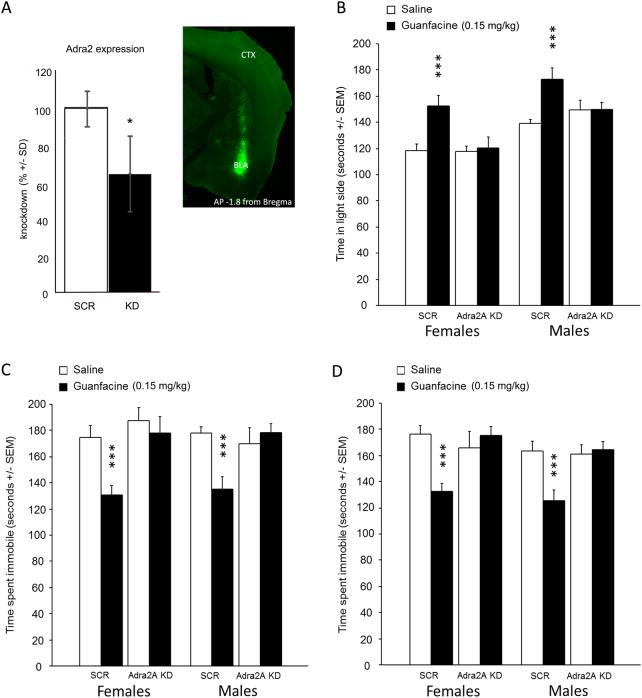
Fig. 1
Fig. 1
Real-time PCR of Adra2 mRNA following knockdown (measured in the hippocampus, see Methods for details (a). Confocal images show expression of GFP after infusion of shRNA-carrying AAV (anteroposterior from Bregma: −1.8 mm; BLA basolateral amygdala, CTX cortex). Effect of α2a adrenergic receptor knockdown in the amygdala combined with guanfacine injection in tests of anxiolytic (light–dark box) and antidepressant efficacy (forced swim and tail suspension). Mice were injected i.p. with either guanfacine (0.15 mg/kg) or saline (0.1 M, pH 7.3), 30 min prior to testing. Time spent in the light side during the light–dark box (b). Time spent immobile in the tail suspension test (c) and forced swim test (d). N = 5 per group for real-time PCR; N = 10–15 per group for behavioral assays. *p < 0.05 ***p < 0.001. Real-time PCR data are expressed as mean ± SD; behavioral data are expressed as mean ± SEM
Fig. 2
Fig. 2
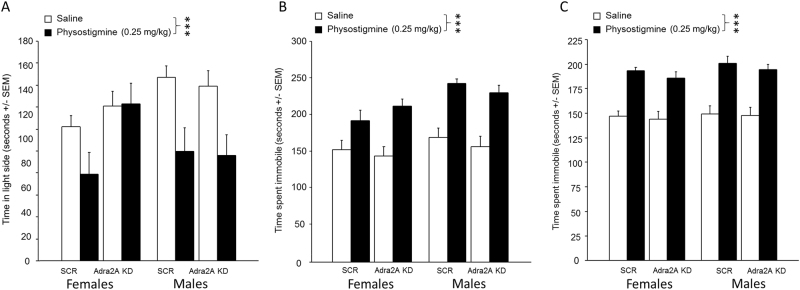
Effect of α2a adrenergic receptor knockdown in the amygdala following administration of the cholinesterase inhibitor physostigmine in tests of anxiolytic (light–dark box) and antidepressant efficacy (forced swim and tail suspension). Mice were injected i.p. with either with physostigmine (0.25 mg/kg) or saline, 60 min before testing. Time spent in the light side during the light–dark box (a). Time spent immobile in the tail suspension test (b) and forced swim test (c). N = 10–15 per group. ***p < 0.001. All data are expressed as mean ± SEM
Fig. 3
Fig. 3
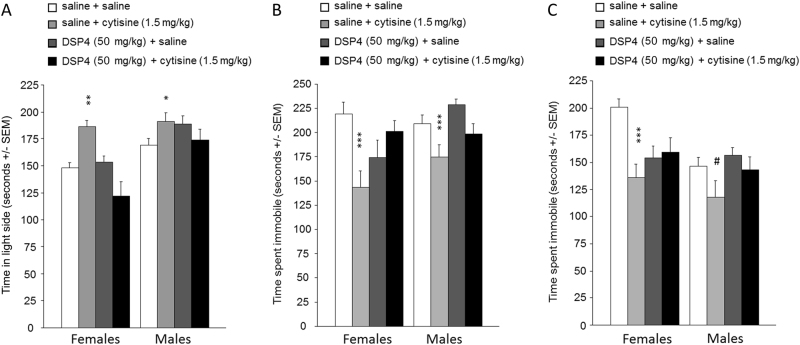
Effect of the nicotinic partial agonist cytisine (1.5 mg/kg, 30 min prior to testing) or saline (0.1 M, pH 7.3) in tests of anxiolytic (light–dark box) and antidepressant efficacy (forced swim and tail suspension) following norepinephrine depletion with the neurotoxin DSP-4. Time spent in the light side during the light–dark box (a). Time spent immobile in the tail suspension test (b) and forced swim test (c). N = 10–12 per group. #p < 0.1; *p < 0.05; **p < 0.01, ***p < 0.001. All data are expressed as mean ± SEM
Fig. 4
Fig. 4
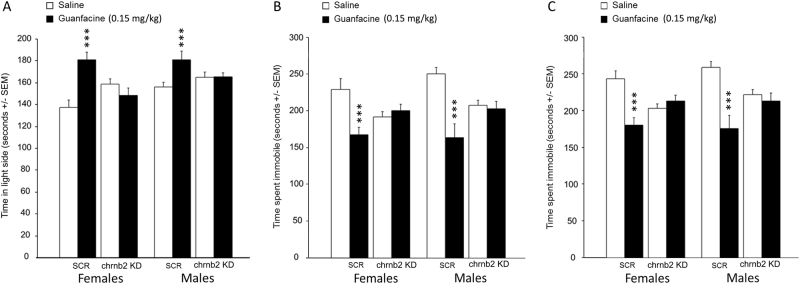
Effect β2 nicotinic acetylcholine receptor subunit knockdown in the amygdala combined with guanfacine injection in tests of anxiolytic (light–dark box) and antidepressant efficacy (forced swim and tail suspension). In all tests, mice were administered either the α2a adrenergic agonist guanfacine (0.15 mg/kg) or saline (0.1 M, pH 7.3), 30 min prior to testing. Time spent in the light side during the light–dark box (a). Time spent immobile in the tail suspension test (b) and forced swim test (c). N = 10–15 per group. ***p < 0.001. All data are expressed as mean ± SEM
Fig. 5
Fig. 5
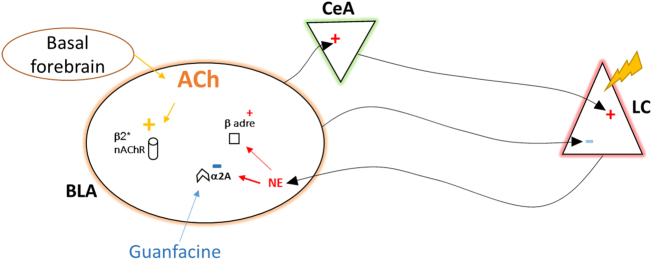
At baseline, the nucleus basalis provides a substantial acetylcholine (ACh) input to the amygdala, which activates high affinity nicotinic receptors (β2 nAChRs). Upon exposure to stressful conditions, the HPA axis is stimulated and induces activation of the LC. NE levels increase in the basolateral amygdala (BLA) and activate stimulatory beta adrenergic receptors (βAR). BLA, in turn, activates the central amygdala (CeA), which feeds back to activate the LC in a positive feedback stress loop. Guanfacine treatment activates Gi-coupled α2AR, decreasing neuronal activity in amygdala, leading to decreased anxiety- and depression-like behaviors. Similarly, decreasing activity of β2 nAChRs also decreases activity of BLA neurons, leading to decreased anxiety- and depression-like behaviors. When amygdala nAChR signaling is absent, guanfacine is no longer effective in these behavioral tasks, likely due to the diminished activity of the amygdala, suggesting a dominant role of ACh transmission in amygdala that is permissive for the neuromodulatory role for NE

References

    1. Glavin GB. Stress and brain noradrenaline: a review. Neurosci Biobehav Rev. 1985;9:233–43. doi: 10.1016/0149-7634(85)90048-X. - DOI - PubMed
    1. Isingrini E, Perret L, Rainer Q, Amilhon B, Guma E, Tanti A, et al. Resilience to chronic stress is mediated by noradrenergic regulation of dopamine neurons. Nat Neurosci. 2016;19:560–3. doi: 10.1038/nn.4245. - DOI - PubMed
    1. Morilak DA, Barrera G, Echevarria DJ, Garcia AS, Hernandez A, Ma S, et al. Role of brain norepinephrine in the behavioral response to stress. Prog Neuropsychopharmacol Biol Psychiatry. 2005;29:1214–24. doi: 10.1016/j.pnpbp.2005.08.007. - DOI - PubMed
    1. Caudill MM, Hunter AM, Cook IA, Leuchter AF. The antidepressant treatment response index as a predictor of reboxetine treatment outcome in major depressive disorder. Clin EEG Neurosci. 2015;46:277–84. doi: 10.1177/1550059414532443. - DOI - PubMed
    1. Strawn JR, Compton SN, Robertson B, Albano AM, Hamdani M, Rynn MA. Extended release guanfacine in pediatric anxiety disorders: a pilot, randomized, placebo-controlled trial. J Child Adolesc Psychopharmacol. 2017;27:29–37. doi: 10.1089/cap.2016.0132. - DOI - PMC - PubMed

Publication types

MeSH terms