


EEG-Based Brain-Computer Interfaces for Communication and Rehabilitation of People with Motor Impairment: A Novel Approach of the 21 st Century
- PMID: 29472849
- PMCID: PMC5810272
- DOI: 10.3389/fnhum.2018.00014
EEG-Based Brain-Computer Interfaces for Communication and Rehabilitation of People with Motor Impairment: A Novel Approach of the 21 st Century
Abstract
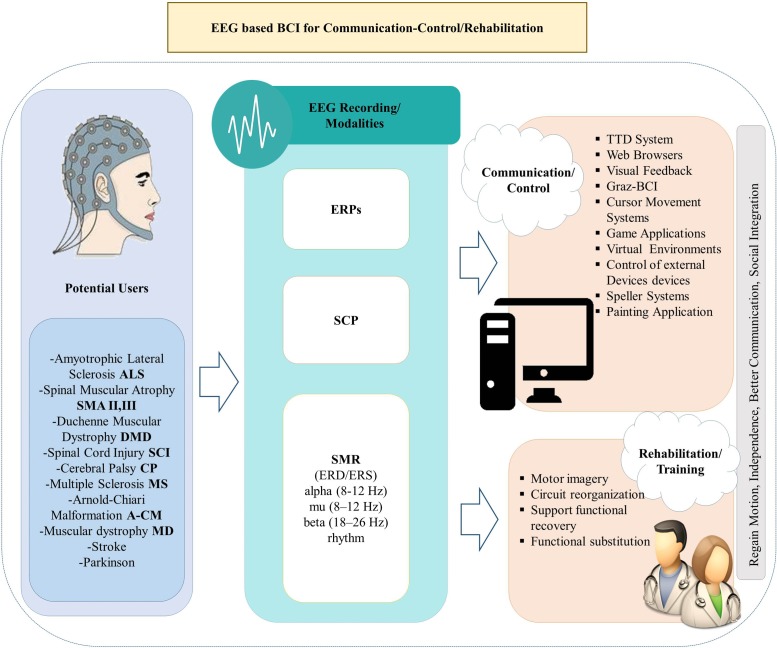
People with severe neurological impairments face many challenges in sensorimotor functions and communication with the environment; therefore they have increased demand for advanced, adaptive and personalized rehabilitation. During the last several decades, numerous studies have developed brain-computer interfaces (BCIs) with the goals ranging from providing means of communication to functional rehabilitation. Here we review the research on non-invasive, electroencephalography (EEG)-based BCI systems for communication and rehabilitation. We focus on the approaches intended to help severely paralyzed and locked-in patients regain communication using three different BCI modalities: slow cortical potentials, sensorimotor rhythms and P300 potentials, as operational mechanisms. We also review BCI systems for restoration of motor function in patients with spinal cord injury and chronic stroke. We discuss the advantages and limitations of these approaches and the challenges that need to be addressed in the future.
Keywords: P300; brain–computer interfaces (BCI); communication; electroencephalogram (EEG); neuromuscular disorders (NMD); rehabilitation; sensorimotor rhythms (SMR); slow cortical potentials (SCP).
References
-
- Abdulkader S. N., Atia A., Mostafa M.-S. M. (2015). Brain computer interfacing: applications and challenges. Egypt. Informatics J. 16 213–230. 10.1016/j.eij.2015.06.002 - DOI
-
- Ang K. K., Guan C., Phua K. S., Wang C., Zhao L., Teo W. P., et al. (2015). Facilitating effects of transcranial direct current stimulation on motor imagery brain–computer interface with robotic feedback for stroke rehabilitation. Arch. Phys. Med. Rehabil. 96 S79–S87. 10.1016/j.apmr.2014.08.008 - DOI - PubMed
Publication types
LinkOut - more resources
Full Text Sources
Other Literature Sources
Miscellaneous
