Review
. 2018 Jan 23:9:446.
doi: 10.3389/fnagi.2017.00446. eCollection 2017.

Role of Copper in the Onset of Alzheimer's Disease Compared to Other Metals

Affiliations
Review

Role of Copper in the Onset of Alzheimer's Disease Compared to Other Metals

Soghra Bagheri et al. Front Aging Neurosci. .

Abstract

Alzheimer's disease (AD) is a neurodegenerative disorder that is characterized by amyloid plaques in patients' brain tissue. The plaques are mainly made of β-amyloid peptides and trace elements including Zn2+, Cu2+, and Fe2+. Some studies have shown that AD can be considered a type of metal dyshomeostasis. Among metal ions involved in plaques, numerous studies have focused on copper ions, which seem to be one of the main cationic elements in plaque formation. The involvement of copper in AD is controversial, as some studies show a copper deficiency in AD, and consequently a need to enhance copper levels, while other data point to copper overload and therefore a need to reduce copper levels. In this paper, the role of copper ions in AD and some contradictory reports are reviewed and discussed.

Keywords: Alzheimer’s disease; amyloid plaques; calcium; cholesterol; copper; neurodegenerative disorder; zinc.


Figures
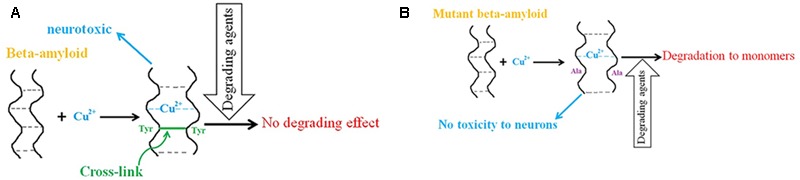
FIGURE 1
FIGURE 1
The role of copper in β-amyloid neurotoxicity in AD. (A) Copper binding to β-amyloid peptides leads to the formation of dityrosine-linked β-amyloid dimers, which resist degradation into monomers and have neurotoxic properties. (B) Mutant β-amyloids (Tyr to Ala) in the presence of copper ions have no toxicity effect on neurons and degrade to monomers by degrading agents.
FIGURE 2
FIGURE 2
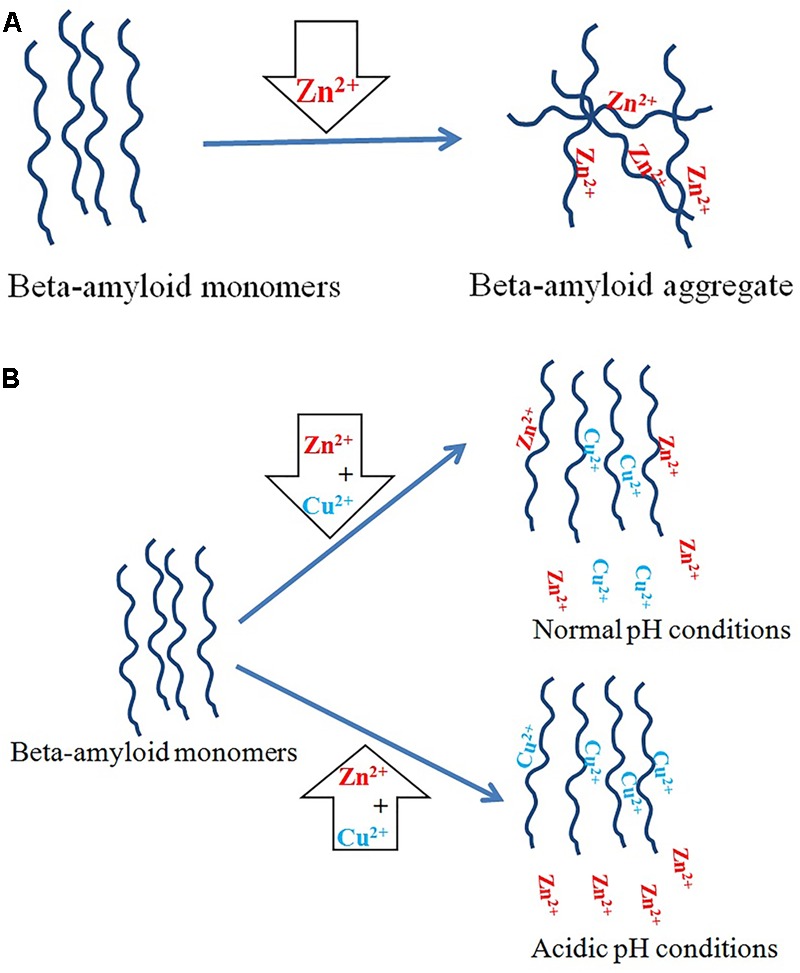
Copper and zinc ions in AD. (A) Zinc ions promote β-amyloid aggregation. (B) Copper ions have an inhibitory effect on aggregation induced by zinc ions. Under physiological conditions, β-amyloid binds the same ratio of copper and zinc ions, but in acidic pH copper ions replace zinc ions overall.
FIGURE 3
FIGURE 3
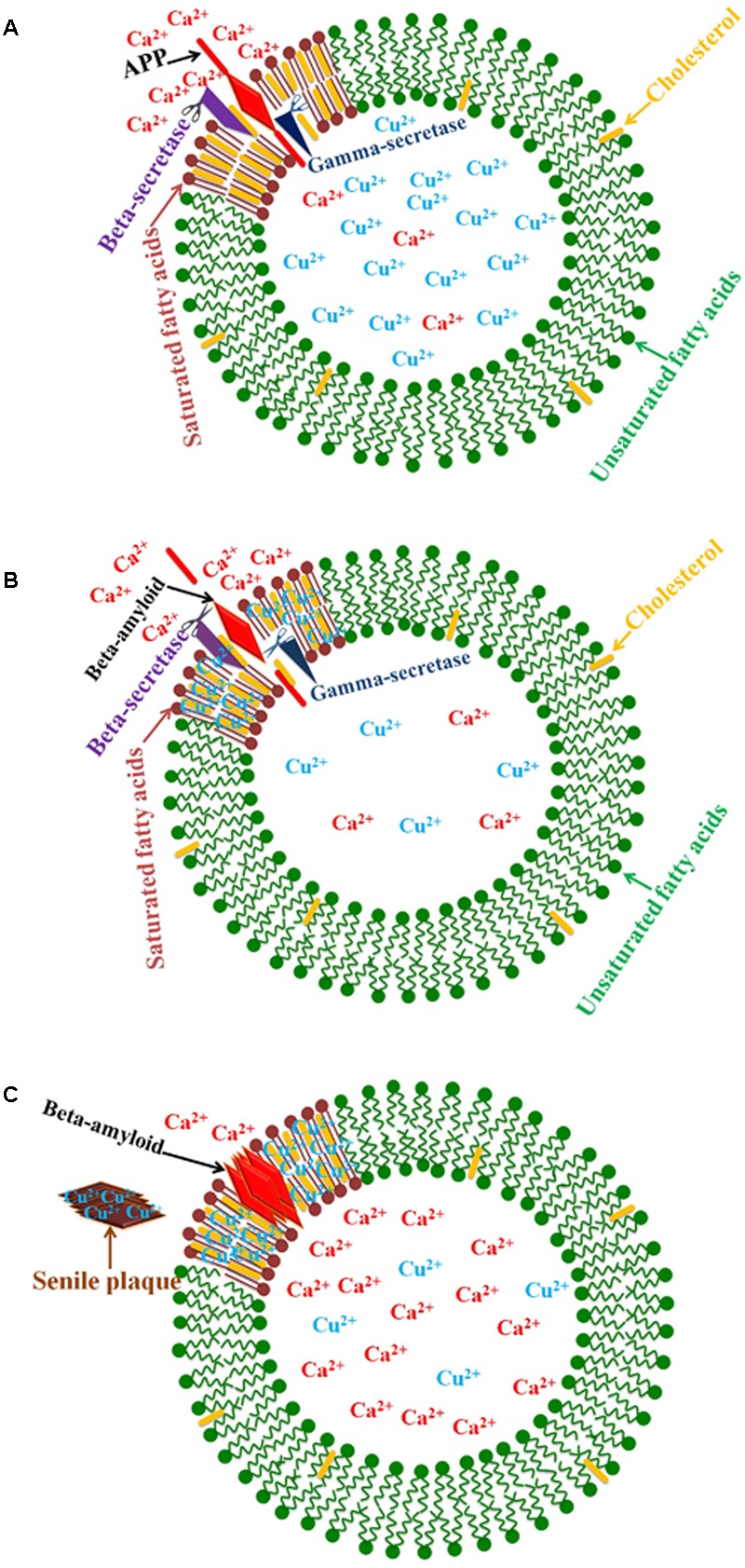
Schematic diagram of the relationship between copper and lipid rafts in AD. (A) The enzymes that cleave APP to β-amyloid peptides are found in lipid rafts. (B) Cellular copper deficiency results in copper ions accumulating in cholesterol-rich lipid rafts, and β-amyloid production increases because of greater enzyme activity due to a rising copper concentration. (C) β-amyloid peptides compose the oligomeric pores in membranes via the cholesterol-binding domain. These pores are calcium channels that disrupt calcium homeostasis in neural cells.

References

    1. Acevedo K. M., Hung Y. H., Dalziel A. H., Li Q. X., Laughton K., Wikhe K., et al. (2011). Copper promotes the trafficking of the amyloid precursor protein. J. Biol. Chem. 286 8252–8262. 10.1074/jbc.M110.128512 - DOI - PMC - PubMed
    1. Ajloo D., Saboury A. A., Haghi-Asli N., Ataei-Jafarai G., Moosavi-Movahedi A. A., Ahmadi M., et al. (2007). Kinetic, thermodynamic and statistical studies on the inhibition of adenosine deaminase by aspirin and diclofenac. J. Enzyme Inhib. Med. Chem. 22 395–406. 10.1080/14756360701229085 - DOI - PubMed
    1. Al-Hilaly Y. K., Williams T. L., Stewart-Parker M., Ford L., Skaria E., Cole M., et al. (2013). A central role for dityrosine crosslinking of Amyloid-β in Alzheimer’s disease. Acta Neuropathol. Commun. 1:83. 10.1186/2051-5960-1-83 - DOI - PMC - PubMed
    1. Angulo E., Casadó V., Mallol J., Canela E. I., Viñals F., Ferrer I., et al. (2003). A1 adenosine receptors accumulate in neurodegenerative structures in Alzheimer disease and mediate both amyloid precursor protein processing and tau phosphorylation and translocation. Brain Pathol. 13 440–451. 10.1111/j.1750-3639.2003.tb00475.x - DOI - PMC - PubMed
    1. Arbor S. C., Lafontaine M., Cumbay M. (2016). Amyloid-beta Alzheimer targets — protein processing, lipid rafts, and amyloid-beta pores. Yale J. Biol. Med. 89 5–21. - PMC - PubMed