


The Effects of Cariprazine and Aripiprazole on PCP-Induced Deficits on Attention Assessed in the 5-Choice Serial Reaction Time Task
- PMID: 29473089
- PMCID: PMC5920008
- DOI: 10.1007/s00213-018-4857-0
The Effects of Cariprazine and Aripiprazole on PCP-Induced Deficits on Attention Assessed in the 5-Choice Serial Reaction Time Task
Erratum in
-
Correction to: The Effects of Cariprazine and Aripiprazole on PCP-Induced Deficits on Attention Assessed in the 5-Choice Serial Reaction Time Task.Psychopharmacology (Berl). 2018 May;235(5):1621. doi: 10.1007/s00213-018-4884-x. Psychopharmacology (Berl). 2018. PMID: 29564481 Free PMC article.
Abstract
Rationale: Attentional processing deficits are a core feature of schizophrenia, likely contributing to the persistent functional and occupational disability observed in patients with schizophrenia. The pathophysiology of schizophrenia is hypothesized to involve dysregulation of NMDA receptor-mediated glutamate transmission, contributing to disruptions in normal dopamine transmission. Preclinical investigations often use NMDA receptor antagonists, such as phencyclidine (PCP), to induce cognitive disruptions relevant to schizophrenia. We sought to test the ability of partial dopamine D2/D3 agonists, cariprazine and aripiprazole, to attenuate PCP-induced deficits in attentional performance.
Objectives: The objective of this study is to determine whether systemic administration of cariprazine or aripiprazole attenuated 5-choice serial reaction time task (5-CSRTT) deficits induced by repeated exposure to PCP.
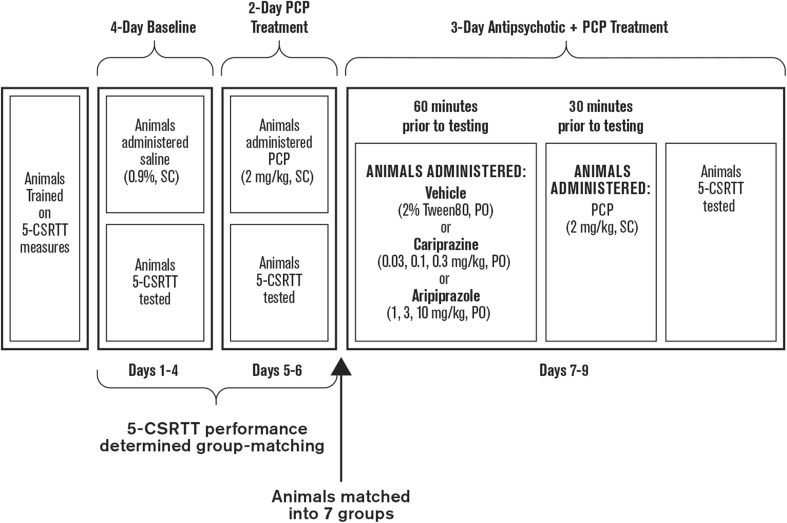
Methods: We utilized a repeated PCP-treatment regimen (2 mg/kg, subcutaneous [s.c.], once daily for 5 days) in rats to induce deficits in the 5-CSRTT. Rats were pre-treated with cariprazine (0.03, 0.1, or 0.3 mg/kg, oral [p.o.]) or aripiprazole (1, 3, or 10 mg/kg, p.o.) to determine whether they prevented PCP-induced deficits in the 5-CSRTT performance.
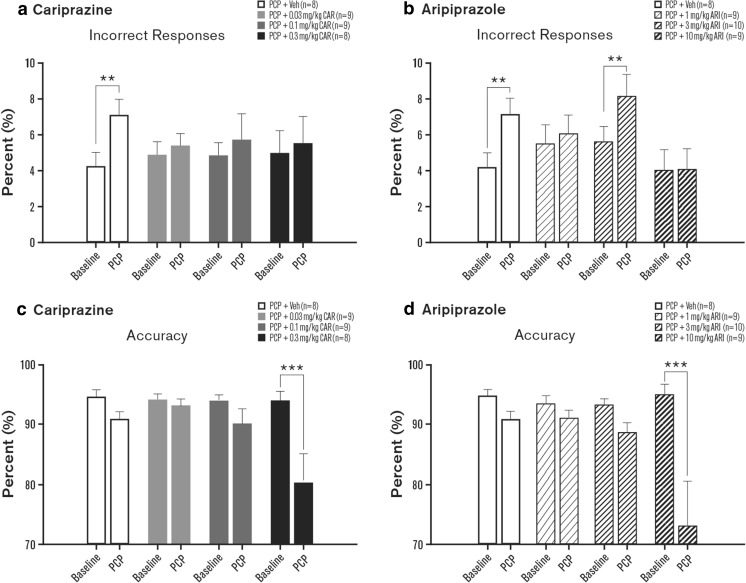
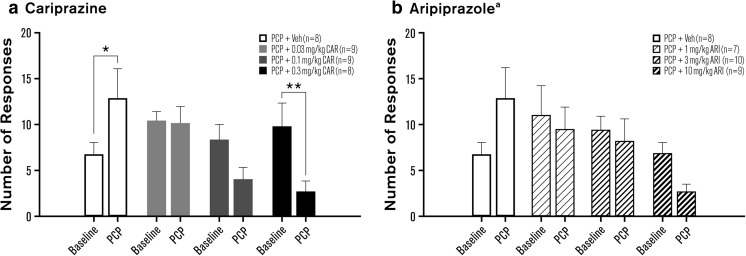
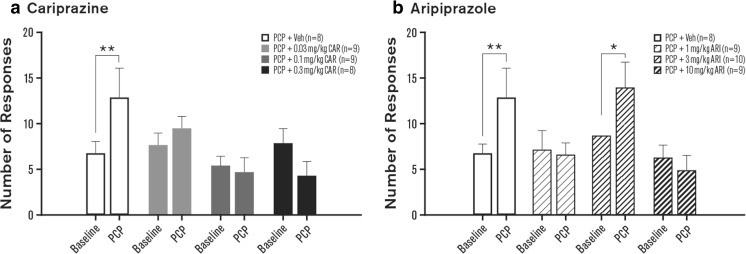
Results: PCP treatment increased inappropriate responding in the 5-CSRTT, elevating incorrect, premature, and timeout responses. Cariprazine treatment reduced PCP-induced increases in inappropriate responding. However, at higher doses, cariprazine produced non-specific response suppression, confounding interpretation of the attenuated PCP-induced deficits. Aripiprazole treatment also attenuated PCP-induced deficits; however, unlike cariprazine treatment, aripiprazole reduced correct responding and increased omissions.
Conclusions: Cariprazine and aripiprazole both demonstrated potential in attenuating PCP-induced deficits in the 5-CSRTT performance. While both compounds produced non-specific response suppression, these effects were absent when 0.03 mg/kg cariprazine was administered.
Keywords: 5-CSRTT; Aripiprazole; Cariprazine; Cognition; PCP; Schizophrenia.
Conflict of interest statement
This study was funded by Forest Laboratories, LLC, an Allergan affiliate, and Gedeon Richter Plc. Both companies participated in the study design, analysis, and interpretation of the data, and the decision to submit the paper for publication. The authors have full control of all data and agree to allow the journal to review the data if requested. N. Adham is an employee of Allergan. B. Kiss is an employee of Gedeon Richter. I. Gyertyán was an employee of Gedeon Richter Plc at the time of the study. During the last 3 years, A. Markou received research contract support from Astra-Zeneca, Bristol-Myers-Squibb, and Forest Laboratories, and honoraria from AbbVie, Germany. S. Barnes and J. Young report no conflict of interest.
Figures
References
-
- Amitai N, Markou A. Disruption of performance in the five-choice serial reaction time task induced by administration of N-methyl-D-aspartate receptor antagonists: relevance to cognitive dysfunction in schizophrenia. Biol Psychiatry. 2010;68:5–16. doi: 10.1016/j.biopsych.2010.03.004. - DOI - PMC - PubMed
Publication types
MeSH terms
Substances
LinkOut - more resources
Full Text Sources
Other Literature Sources
