


The current state and future perspectives of cannabinoids in cancer biology
- PMID: 29473338
- PMCID: PMC5852356
- DOI: 10.1002/cam4.1312
The current state and future perspectives of cannabinoids in cancer biology
Erratum in
-
The current state and future perspectives of cannabinoids in cancer biology.Cancer Med. 2018 Nov;7(11):5859. doi: 10.1002/cam4.1876. Cancer Med. 2018. PMID: 30460793 Free PMC article. No abstract available.
Abstract
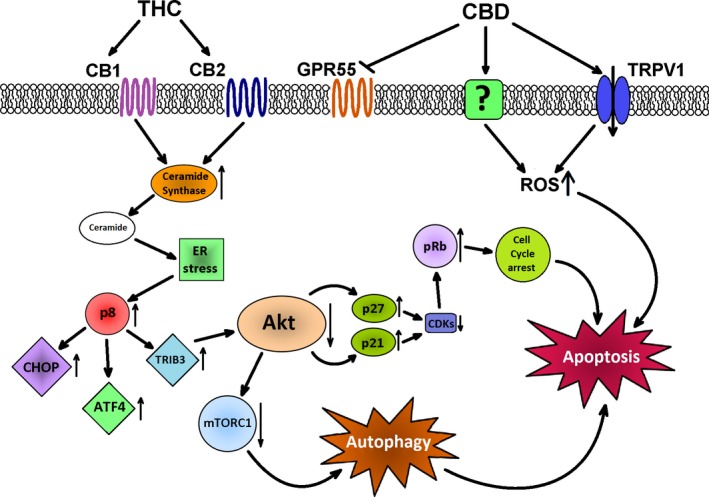
To date, cannabinoids have been allowed in the palliative medicine due to their analgesic and antiemetic effects, but increasing number of preclinical studies indicates their anticancer properties. Cannabinoids exhibit their action by a modulation of the signaling pathways crucial in the control of cell proliferation and survival. Many in vitro and in vivo experiments have shown that cannabinoids inhibit proliferation of cancer cells, stimulate autophagy and apoptosis, and have also a potential to inhibit angiogenesis and metastasis. In this review, we present an actual state of knowledge regarding molecular mechanisms of cannabinoids' anticancer action, but we discuss also aspects that are still not fully understood such as the role of the endocannabinoid system in a carcinogenesis, the impact of cannabinoids on the immune system in the context of cancer development, or the cases of a stimulation of cancer cells' proliferation by cannabinoids. The review includes also a summary of currently ongoing clinical trials evaluating the safety and efficacy of cannabinoids as anticancer agents.
Keywords: CBD; THC; Cancer; Cannabidiol; Cannabinoids; Cannabis; Tetrahydrocannabinol.
© 2018 The Authors. Cancer Medicine published by John Wiley & Sons Ltd.
Figures
References
-
- Birdsall, S. M. , Birdsall T. C., and Tims L. A.. 2016. The use of medical marijuana in cancer. Curr Oncol Rep. 18:40 https://doi.org/10.1007/s11912-016-0530-0. - DOI - PubMed
-
- State Medical Marijuana Laws [Internet]. [cited 2016 Jun 9]. Available from: http://www.ncsl.org/research/health/state-medical-marijuana-laws.aspx
-
- Kramer, J. L. 2015. Medical marijuana for cancer. CA Cancer J. Clin. 65:109–122. - PubMed
-
- Matsuda, L. A. , Lolait S. J., Brownstein M. J., Young A. C., and Bonner T. I.. 1990. Structure of a cannabinoid receptor and functional expression of the cloned cDNA. Nature 346:561–564. - PubMed
Publication types
MeSH terms
Substances
LinkOut - more resources
Full Text Sources
Other Literature Sources
