


Review
doi: 10.1016/j.ceb.2018.02.002.
Epub 2018 Feb 21.
Unloosing the Gordian knot of peroxisome formation
Affiliations
- PMID: 29475136
- PMCID: PMC6525147
- DOI: 10.1016/j.ceb.2018.02.002
Item in Clipboard
Review
Unloosing the Gordian knot of peroxisome formation
Curr Opin Cell Biol.
2018 Feb.
Abstract
Peroxisome biogenesis is governed by molecular machineries, which are either unique to peroxisomes or are partially shared with mitochondria. As peroxisomes have important protective functions in the cell, modulation of their number is important for human health and disease. Significant progress has been made towards our understanding of the mechanisms of peroxisome formation, revealing a remarkable plasticity of the peroxisome biogenesis pathway. Here we discuss most recent findings with particular focus on peroxisome formation in mammalian cells.
Copyright © 2018 The Authors. Published by Elsevier Ltd.. All rights reserved.
Figures
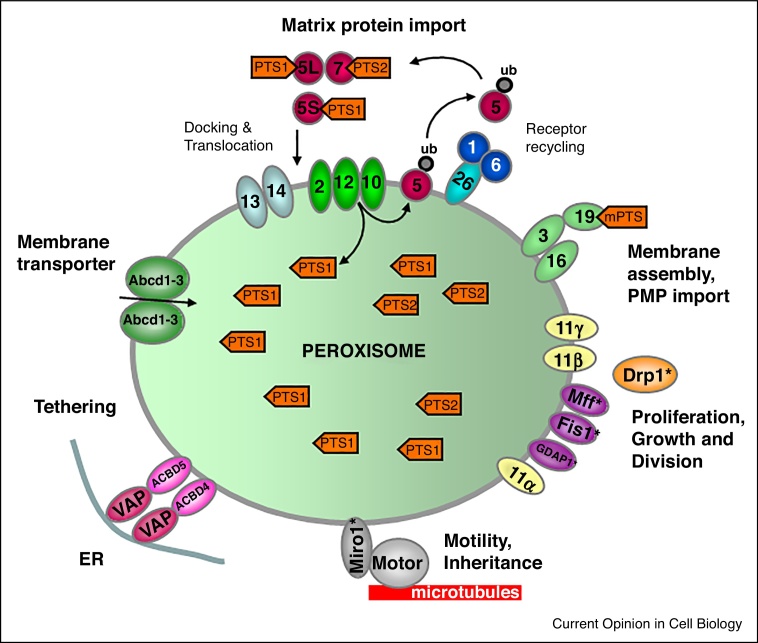
Schematic overview of the molecular machineries involved in the biogenesis of mammalian peroxisomes. Matrix protein import: After synthesis on free ribosomes, cargo proteins containing the p eroxisomal t argeting s ignals PTS1 or PTS2 bind to the corresponding cytosolic receptors Pex5 or Pex7 and form receptor-cargo complexes. The Pex7–cargo complex requires Pex5L, the long isoform of Pex5, for import. Import is achieved by a complex set of integral or peripheral PMPs that form the matrix protein import machinery, which mediates docking of the cargo-bound import receptor at the peroxisomal membrane, cargo translocation into the matrix of the organelle by a dynamic translocon, and export of the receptor back to the cytosol. Recycling of the receptor involves its ubiquitination (ub) and extraction from the membrane by an AAA-ATPase complex (Pex1, Pex6). Membrane assembly and insertion of PMPs (containing an mPTS) depends on Pex19, Pex3 and Pex16. Pex19 functions as a cycling receptor/chaperone, which binds the PMPs in the cytosol and interacts with Pex3 at the peroxisomal membrane. Proliferation, growth and division: Pex11α, Pex11β and Pex11γ are involved in the regulation of peroxisome size and number. Pex11β remodels the peroxisomal membrane, and interacts with the membrane adaptors Mff and Fis1, which recruit the dynamin-like fission GTPase Drp1 to peroxisomes, which is activated by Pex11β. Motility and Inheritance: Miro1 serves as membrane adaptor for the microtubule-dependent motor proteins kinesin and dynein [19•, 38••, 64••]. Tethering: ACBD5 and ACBD4 interact with ER-resident VAPA/B to mediate peroxisome-ER contacts. Membrane transporter: only the ABC transporter proteins involved in fatty acid uptake are shown. Proteins with a dual localisation to both peroxisomes and mitochondria are marked with an asterisk.
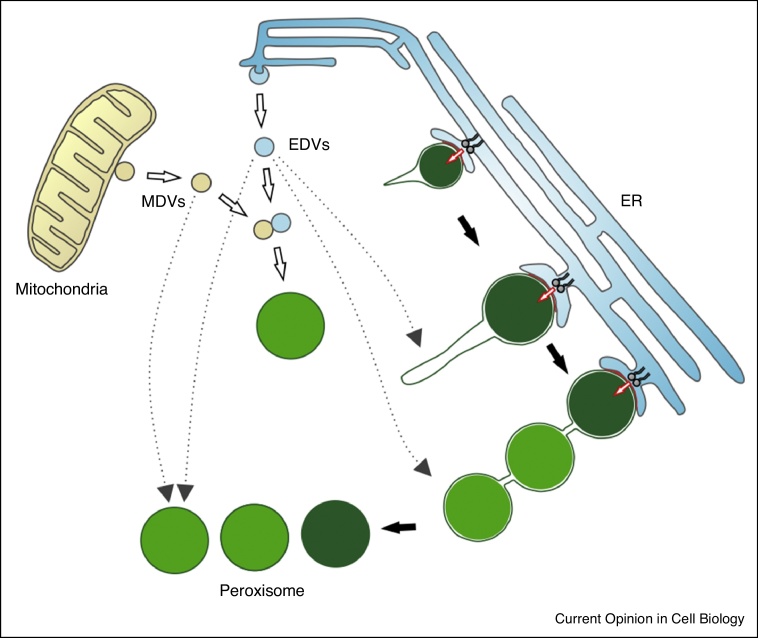
Schematic representation of mechanisms for peroxisome formation in mammalian cells. Peroxisome formation by growth and division follows a multistep maturation process involving peroxisomal membrane remodelling and elongation, membrane constriction and final scission. Membrane expansion requires peroxisome-ER contact (red line) and lipid transfer (red arrow), generating a membrane compartment which imports newly synthesised PMPs and matrix proteins. De novo peroxisome formation: In the absence of pre-existing peroxisomes, preperoxisomal vesicles can be generated at the ER (EDV) and mitochondria (MDV), which may fuse and mature into new import-competent peroxisomes. These newly formed peroxisomes will further multiply by growth and division. In the presence of peroxisomes, preperoxisomal vesicles may fuse with growing or existing peroxisomes to supply certain proteins and lipids. EDV, ER-derived vesicles; MDV, mitochondria-derived vesicles; newly formed peroxisomes are coloured in light green.
References
-
- Waterham H.R., Ferdinandusse S., Wanders R.J.A. Human disorders of peroxisome metabolism and biogenesis. Biochim Biophys Acta — Mol Cell Res. 2016;1863:922–933. - PubMed
-
- Delmaghani S., Defourny J., Aghaie A., Beurg M., Dulon D., Thelen N., Perfettini I., Zelles T., Aller M., Meyer A. Hypervulnerability to sound exposure through impaired adaptive proliferation of peroxisomes. Cell. 2015;163:894–906. - PubMed
Publication types
MeSH terms
Grants and funding
LinkOut - more resources
Full Text Sources
Other Literature Sources
Research Materials
