


The Prognostic Relevance of Sentinel Lymph Node Metastases Assessed by PHGR1 mRNA Quantification in Stage I to III Colon Cancer
- PMID: 29475140
- PMCID: PMC5884186
- DOI: 10.1016/j.tranon.2018.01.015
The Prognostic Relevance of Sentinel Lymph Node Metastases Assessed by PHGR1 mRNA Quantification in Stage I to III Colon Cancer
Abstract
Background: Regional lymph node (LN) metastasis is a strong and well-established prognostic factor in colon cancer, and recent data suggest a prognostic value of detecting micrometastases and isolated tumor cells in regional LNs. The aim of the study was to investigate the clinical relevance of detecting sentinel lymph node (SLN) metastases in colon cancer patients by measuring the novel metastasis marker PHGR1 mRNA.
Methods: Using quantitative reverse-transcription polymerase chain reaction, we measured PHGR1 mRNA levels in SLNs and primary tumors from 206 patients surgically treated for stage I to III colon cancer and 52 normal LNs from patients undergoing surgery for benign colon diseases. The prognostic impact of these findings was evaluated by Kaplan-Meier analysis and Cox proportional-hazards regression.
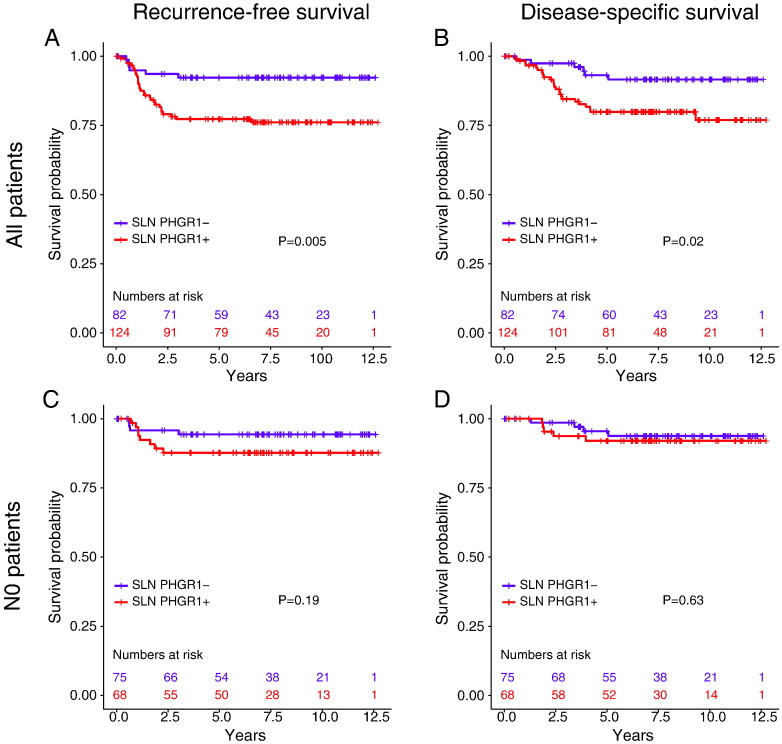
Results: Compared to normal LNs, elevated PHGR1 mRNA levels were detected in SLNs from 56 (89%) of the 63 patients with pN+ disease. Furthermore, 68 (48%) of the 143 node-negative (pN0) patients had elevated PHGR1 mRNA levels in SLNs, suggesting occult metastases. With a median follow-up of 7.2 years, a significantly shorter recurrence-free (P=.005) and disease-specific (P=.02) survival was observed in patients with elevated PHGR1 mRNA levels in SLNs. Multivariable modeling showed that the SLN PHGR1 mRNA level was an independent prognostic factor. However, when the survival analyses were restricted to pN0 patients, no significant prognostic information was found.
Conclusion: Measuring PHGR1 mRNA in SLNs provided independent prognostic information on operable colon cancer patients but not in the pN0 subgroup.
Copyright © 2018 Oncoinvent AS. Published by Elsevier Inc. All rights reserved.
Figures



References
-
- Dienstmann R, Salazar R, Tabernero J. Personalizing colon cancer adjuvant therapy: selecting optimal treatments for individual patients. J Clin Oncol. 2015;33:1787–1796. - PubMed
-
- Lea D, Håland S, Hagland HR, Søreide K. Accuracy of TNM staging in colorectal cancer: a review of current culprits, the modern role of morphology and stepping-stones for improvements in the molecular era. Scand J Gastroenterol. 2014;49:1153–1163. - PubMed
-
- Veen T, Nedrebø BS, Stormark K, Søreide JA, Kørner H, Søreide K. Qualitative and quantitative issues of lymph nodes as prognostic factor in colon cancer. Dig Surg. 2013;30:1–11. - PubMed
-
- Rahbari NN, Bork U, Motschall E, Thorlund K, Büchler MW, Koch M, Weitz J. Molecular detection of tumor cells in regional lymph nodes is associated with disease recurrence and poor survival in node-negative colorectal cancer: a systematic review and meta-analysis. J Clin Oncol. 2012;30:60–70. - PubMed
LinkOut - more resources
Full Text Sources
Other Literature Sources
