


NEOnatal Central-venous Line Observational study on Thrombosis (NEOCLOT): evaluation of a national guideline on management of neonatal catheter-related thrombosis
- PMID: 29475450
- PMCID: PMC5824541
- DOI: 10.1186/s12887-018-1000-7
NEOnatal Central-venous Line Observational study on Thrombosis (NEOCLOT): evaluation of a national guideline on management of neonatal catheter-related thrombosis
Abstract
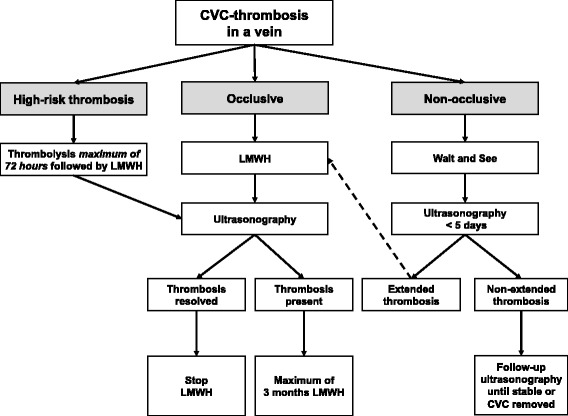
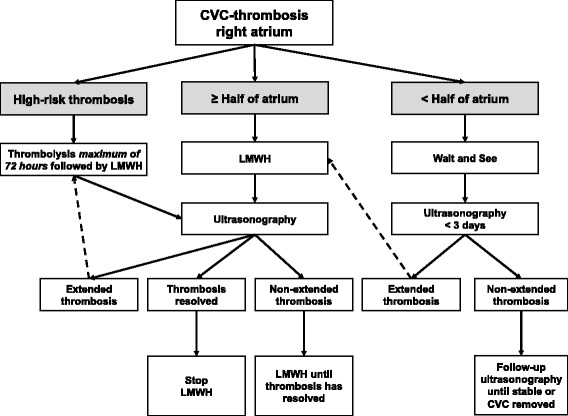
Background: In critically ill (preterm) neonates, central venous catheters (CVCs) are increasingly used for administration of medication or parenteral nutrition. A serious complication, however, is the development of catheter-related thrombosis (CVC-thrombosis), which may resolve by itself or cause severe complications. Due to lack of evidence, management of neonatal CVC-thrombosis varies among neonatal intensive care units (NICUs). In the Netherlands an expert-based national management guideline has been developed which is implemented in all 10 NICUs in 2014.
Methods: The NEOCLOT study is a multicentre prospective observational cohort study, including 150 preterm and term infants (0-6 months) admitted to one of the 10 NICUs, developing CVC-thrombosis. Patient characteristics, thrombosis characteristics, risk factors, treatment strategies and outcome measures will be collected in a web-based database. Management of CVC-thrombosis will be performed as recommended in the protocol. Violations of the protocol will be noted. Primary outcome measures are a composite efficacy outcome consisting of death due to CVC-thrombosis and recurrent thrombosis, and a safety outcome consisting of the incidence of major bleedings during therapy. Secondary outcomes include individual components of primary efficacy outcome, clinically relevant non-major and minor bleedings and the frequency of risk factors, protocol variations, residual thrombosis and post thrombotic syndrome.
Discussion: The NEOCLOT study will evaluate the efficacy and safety of the new, national, neonatal CVC-thrombosis guideline. Furthermore, risk factors as well as long-term consequences of CVC-thrombosis will be analysed.
Trial registration: Trial registration: Nederlands Trial Register NTR4336 . Registered 24 December 2013.
Keywords: Antithrombotic therapy; Catheter; Neonate; Observational; Thrombosis.
Conflict of interest statement
Ethics approval and consent to participate
The Medical Ethics Review Committee confirmed that official approval of this study was not required as the Medical Research Involving Human Subjects Act did not apply to the NEOCLOT study. (#14.17.0121) Consent to participate was not required.
Consent for publication
Not applicable.
Competing interests
This trial is partly funded by an unrestricted grant of Daiichi Sankyo. Daiichi Sankyo has no role in the design of the study and the collection, analysis and interpretation of data, and in writing the manuscript.
Publisher’s Note
Springer Nature remains neutral with regard to jurisdictional claims in published maps and institutional affiliations.
Figures
References
-
- Nowak-Gottl U, Kosch A, Schlegel N. Thromboembolism in newborns, infants and children. Thromb Haemost. 2001;86:464–474. - PubMed
-
- Monagle P, Chan AK, Goldenberg NA, Ichord RN, Journeycake JM, Nowak-Gottl U, et al. Antithrombotic therapy in neonates and children: antithrombotic therapy and prevention of thrombosis, 9th ed: American College of Chest Physicians Evidence-Based Clinical Practice Guidelines. Chest. 2012;141:e737S–e801S. doi: 10.1378/chest.11-2308. - DOI - PMC - PubMed
-
- Butler-O'Hara M, Buzzard CJ, Reubens L, McDermott MP, DiGrazio W, D'Angio CT. A randomized trial comparing long-term and short-term use of umbilical venous catheters in premature infants with birth weights of less than 1251 grams. Pediatr. 2006;118:e25–e35. doi: 10.1542/peds.2005-1880. - DOI - PubMed
Publication types
MeSH terms
Associated data
Grants and funding
LinkOut - more resources
Full Text Sources
Other Literature Sources
Medical
