


The Patient Perspective on the Impact of Tenosynovial Giant Cell Tumors on Daily Living: Crowdsourcing Study on Physical Function and Quality of Life
- PMID: 29475829
- PMCID: PMC5845102
- DOI: 10.2196/ijmr.9325
The Patient Perspective on the Impact of Tenosynovial Giant Cell Tumors on Daily Living: Crowdsourcing Study on Physical Function and Quality of Life
Abstract
Background: Tenosynovial giant cell tumor (TGCT) is a rare, benign lesion affecting the synovial lining of joints, bursae, and tendon sheaths. It is generally characterized as a locally aggressive and often recurring tumor. A distinction is made between localized- and diffuse-type. The impact of TGCT on daily living is currently ill-described.
Objective: The aim of this crowdsourcing study was to evaluate the impact of TGCT on physical function, daily activities, societal participation (work, sports, and hobbies), and overall quality of life from a patient perspective. The secondary aim was to define risk factors for deteriorated outcome in TGCT.
Methods: Members of the largest known TGCT Facebook community, PVNS is Pants!!, were invited to an e-survey, partially consisting of validated questionnaires, for 6 months. To confirm disease presence and TGCT-type, patients were requested to share histological or radiological proof of TGCT. Unpaired t tests and chi-square tests were used to compare groups with and without proof and to define risk factors for deteriorated outcome.
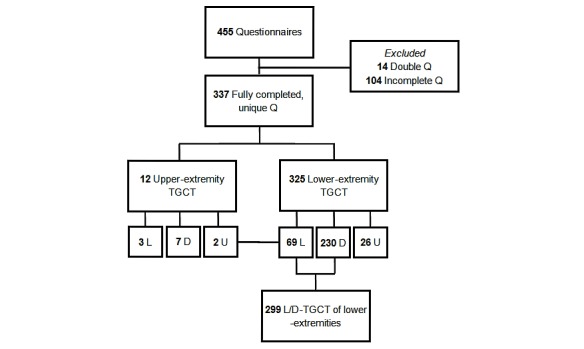
Results: Three hundred thirty-seven questionnaires, originating from 30 countries, were completed. Median age at diagnosis was 33 (interquartile range [IQR]=25-42) years, majority was female (79.8% [269/337]), diffuse TGCT (70.3% [237/337]), and affected lower extremities (knee 70.9% [239/337] and hip 9.5% [32/337]). In 299 lower-extremity TGCT patients (32.4% [97/299]) with disease confirmation, recurrence rate was 36% and 69.5% in localized and diffuse type, respectively. For both types, pain and swelling decreased after treatment; in contrast, stiffness and range of motion worsened. Patients were limited in their employment (localized 13% [8/61]; diffuse 11.0% [21/191]) and sport-activities (localized 58% [40/69]; diffuse 63.9% [147/230]). Compared with general US population, all patients showed lower Patient-Reported Outcomes Measurements Information System-Physical Function (PROMIS-PF), Short Form-12 (SF-12), and EuroQoL 5 Dimensions 5 Levels (EQ5D-5L) scores, considered clinically relevant, according to estimated minimal important difference (MID). Diffuse versus localized type scored almost 0.5 standard deviation lower for PROMIS-PF (P<.001) and demonstrated a utility score of 5% lower for EQ-5D-5L (P=.03). In localized TGCT, recurrent disease and ≥2 surgeries negatively influenced scores of Visual Analog Scale (VAS)-pain/stiffness, SF-12, and EQ-5D-5L (P<.05). In diffuse type, recurrence resulted in lower score for VAS, PROMIS-PF, SF-12, and EQ-5D-5L (P<.05). In both types, patients with treatment ≤1year had significantly lower SF-12.
Conclusions: TGCT has a major impact on daily living in a relatively young and working population. Patients with diffuse type, recurrent disease, and ≥2 surgeries represent lowest functional and quality of life outcomes. Physicians should be aware that TGCT patients frequently continue to experience declined health-related quality of life and physical function and often remain limited in daily life, even after treatment(s).
Keywords: crowdsourcing; giant cell tumor of tendon sheath; health-related quality of life; patient-reported outcome measures; pigmented villonodular; quality of life; rare diseases; social media; social participation; surveys and questionnaires; synovitis.
©Monique Josephine Mastboom, Rosa Planje, Michiel Adreanus van de Sande. Originally published in the Interactive Journal of Medical Research (http://www.i-jmr.org/), 23.02.2018.
Conflict of interest statement
Conflicts of Interest: None declared.
Figures
References
-
- de St. Aubain S, van de Rijn M. Tenosynovial giant cell tumour, localized type. In: Fletcher CD, Bridge JA, Hogendoorn PC, Mertens F, editors. WHO Classification of Tumours of Soft Tissue and Bone. 4 edition. Lyon, France: IARC Press; 2013.
-
- de St. Aubain S, van de Rijn M. Tenosynovial giant cell tumour, diffuse type. In: Fletcher CD, Bridge JA, Hogendoorn PC, Mertens F, editors. WHO Classification of Tumours of Soft Tissue and Bone. Lyon, France: lARC Press; 2013. Apr 30,
-
- Mastboom MJ, Verspoor FG, Verschoor AJ, Uittenbogaard D, Nemeth B, Mastboom WJ, Bovée JV, Dijkstra PD, Schreuder HW, Gelderblom H, Van de Sande MA, TGCT study group Higher incidence rates than previously known in tenosynovial giant cell tumors. Acta Orthop. 2017 Aug 08;88(6):688–94. doi: 10.1080/17453674.2017.1361126. - DOI - PMC - PubMed
-
- Gelhorn HL, Tong S, McQuarrie K, Vernon C, Hanlon J, Maclaine G, Lenderking W, Ye X, Speck RM, Lackman RD, Bukata SV, Healey JH, Keedy VL, Anthony SP, Wagner AJ, Von Hoff DD, Singh AS, Becerra CR, Hsu HH, Lin PS, Tap WD. Patient-reported Symptoms of tenosynovial giant cell tumors. Clin Ther. 2016 Dec;38(4):778–93. doi: 10.1016/j.clinthera.2016.03.008. https://linkinghub.elsevier.com/retrieve/pii/S0149-2918(16)30145-X - DOI - PMC - PubMed
LinkOut - more resources
Full Text Sources
Other Literature Sources
