Characterization of Coding/Noncoding Variants for SHROOM3 in Patients with CKD
- PMID: 29476007
- PMCID: PMC5967772
- DOI: 10.1681/ASN.2017080856
Characterization of Coding/Noncoding Variants for SHROOM3 in Patients with CKD
Abstract
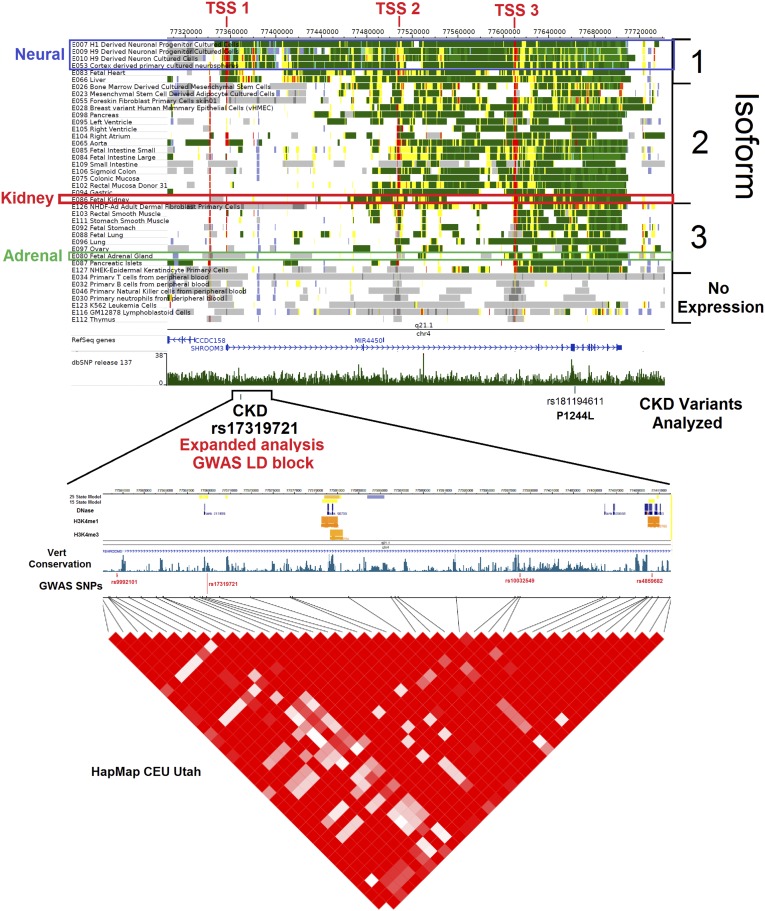
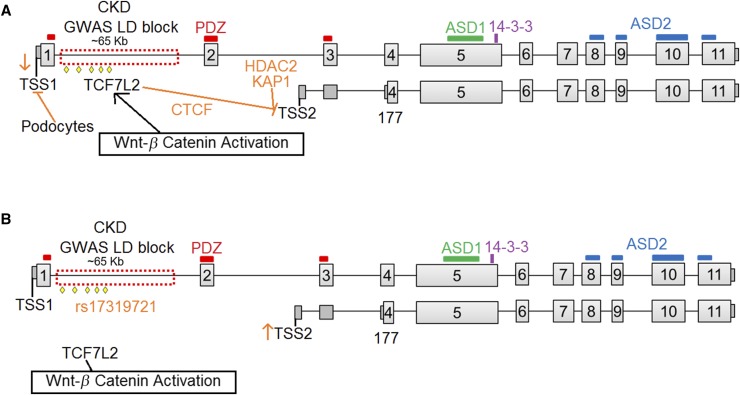
Background Interpreting genetic variants is one of the greatest challenges impeding analysis of rapidly increasing volumes of genomic data from patients. For example, SHROOM3 is an associated risk gene for CKD, yet causative mechanism(s) of SHROOM3 allele(s) are unknown.Methods We used our analytic pipeline that integrates genetic, computational, biochemical, CRISPR/Cas9 editing, molecular, and physiologic data to characterize coding and noncoding variants to study the human SHROOM3 risk locus for CKD.Results We identified a novel SHROOM3 transcriptional start site, which results in a shorter isoform lacking the PDZ domain and is regulated by a common noncoding sequence variant associated with CKD (rs17319721, allele frequency: 0.35). This variant disrupted allele binding to the transcription factor TCF7L2 in podocyte cell nuclear extracts and altered transcription levels of SHROOM3 in cultured cells, potentially through the loss of repressive looping between rs17319721 and the novel start site. Although common variant mechanisms are of high utility, sequencing is beginning to identify rare variants involved in disease; therefore, we used our biophysical tools to analyze an average of 112,849 individual human genome sequences for rare SHROOM3 missense variants, revealing 35 high-effect variants. The high-effect alleles include a coding variant (P1244L) previously associated with CKD (P=0.01, odds ratio=7.95; 95% CI, 1.53 to 41.46) that we find to be present in East Asian individuals at an allele frequency of 0.0027. We determined that P1244L attenuates the interaction of SHROOM3 with 14-3-3, suggesting alterations to the Hippo pathway, a known mediator of CKD.Conclusions These data demonstrate multiple new SHROOM3-dependent genetic/molecular mechanisms that likely affect CKD.
Keywords: CRISPR/Cas9; GWAS; Genomic Variants; Rare Variants; SHROOM3; TCF7L2.
Copyright © 2018 by the American Society of Nephrology.
Figures


Comment in
-
Using Large Datasets to Understand CKD.J Am Soc Nephrol. 2018 May;29(5):1351-1353. doi: 10.1681/ASN.2018030288. Epub 2018 Apr 11. J Am Soc Nephrol. 2018. PMID: 29643114 Free PMC article. No abstract available.
References
-
- Jacob HJ: Next-generation sequencing for clinical diagnostics. N Engl J Med 369: 1557–1558, 2013 - PubMed
-
- Meyer TE, Verwoert GC, Hwang S-J, Glazer NL, Smith AV, van Rooij FJA, et al.; Genetic Factors for Osteoporosis Consortium; Meta Analysis of Glucose and Insulin Related Traits Consortium : Genome-wide association studies of serum magnesium, potassium, and sodium concentrations identify six Loci influencing serum magnesium levels. PLoS Genet 6: e1001045, 2010 - PMC - PubMed
Publication types
MeSH terms
Substances
Grants and funding
LinkOut - more resources
Full Text Sources
Other Literature Sources
Medical
Molecular Biology Databases