


The nature of postural tremor in Parkinson disease
- PMID: 29476038
- PMCID: PMC5880634
- DOI: 10.1212/WNL.0000000000005215
The nature of postural tremor in Parkinson disease
Abstract
Objective: To disentangle the different forms of postural tremors in Parkinson disease (PD).
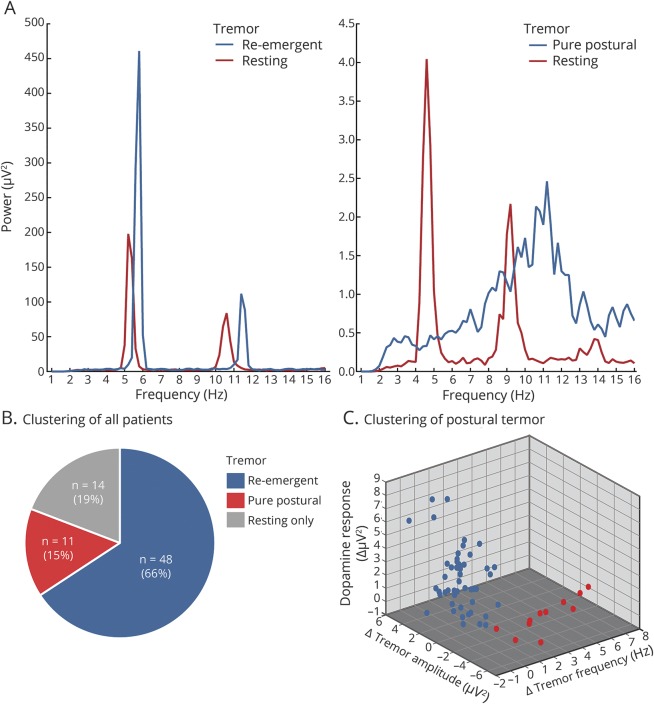
Methods: In this combined observational and intervention study, we measured resting and postural tremor characteristics in 73 patients with tremulous PD by using EMG of forearm muscles. Patients were measured both "off" medication (overnight withdrawal) and after dispersible levodopa-benserazide 200/50 mg. We performed an automated 2-step cluster analysis on 3 postural tremor characteristics: the frequency difference with resting tremor, the degree of tremor suppression after posturing, and the dopamine response.
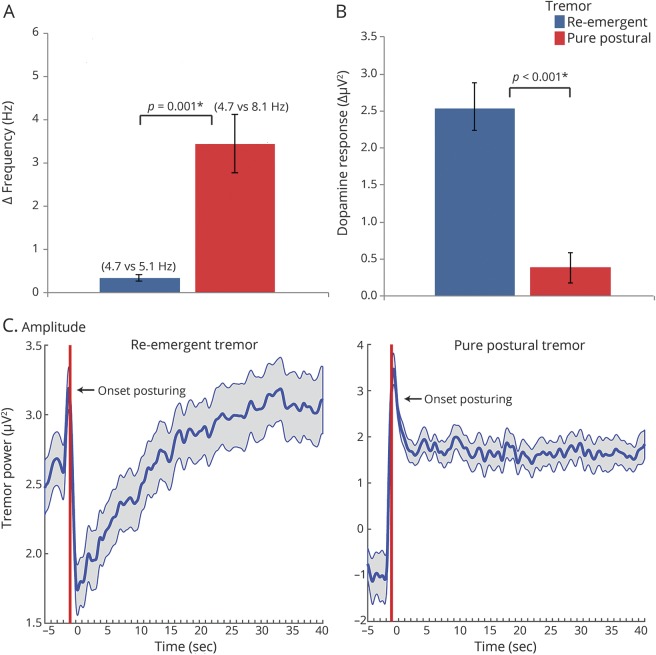
Results: The cluster analysis revealed 2 distinct postural tremor phenotypes: 81% had re-emergent tremor (amplitude suppression, frequency difference with resting tremor 0.4 Hz, clear dopamine response) and 19% had pure postural tremor (no amplitude suppression, frequency difference with resting tremor 3.5 Hz, no dopamine response). This finding was manually validated (accuracy of 93%). Pure postural tremor was not associated with clinical signs of essential tremor or dystonia, and it was not influenced by weighing.
Conclusion: There are 2 distinct postural tremor phenotypes in PD, which have a different pathophysiology and require different treatment. Re-emergent tremor is a continuation of resting tremor during stable posturing, and it has a dopaminergic basis. Pure postural tremor is a less common type of tremor that is inherent to PD, but has a largely nondopaminergic basis.
© 2018 American Academy of Neurology.
Figures
Comment in
-
No handshake agreement on postural tremor subtypes in Parkinson disease?Neurology. 2018 Mar 27;90(13):581-582. doi: 10.1212/WNL.0000000000005199. Epub 2018 Feb 23. Neurology. 2018. PMID: 29476034 No abstract available.
-
Reader response: The nature of postural tremor in Parkinson disease.Neurology. 2018 Oct 9;91(15):723. doi: 10.1212/WNL.0000000000006312. Neurology. 2018. PMID: 30297509 No abstract available.
-
Author response: The nature of postural tremor in Parkinson disease.Neurology. 2018 Oct 9;91(15):724. doi: 10.1212/WNL.0000000000006314. Neurology. 2018. PMID: 30297510 No abstract available.
References
-
- Gigante AF, Bruno G, Iliceto G, et al. Action tremor in Parkinson's disease: frequency and relationship to motor and non-motor signs. Eur J Neurol 2014;22:223–228. - PubMed
-
- Koller WC, Vetere-Overfield B, Barter R. Tremors in early Parkinson's disease. Clin Neuropharmacol 1989;12:293–297. - PubMed
-
- Louis ED, Levy G, Côte LJ, Mejia H, Fahn S, Marder K. Clinical correlates of action tremor in Parkinson disease. Arch Neurol 2001;58:1630–1634. - PubMed
Publication types
MeSH terms
Substances
LinkOut - more resources
Full Text Sources
Other Literature Sources
Medical
