. 2018 Feb 23;9(1):810.
doi: 10.1038/s41467-018-02826-8.

A recurrent kinase domain mutation in PRKCA defines chordoid glioma of the third ventricle

Affiliations

A recurrent kinase domain mutation in PRKCA defines chordoid glioma of the third ventricle

Benjamin Goode et al. Nat Commun. .

Abstract

Chordoid glioma is a rare brain tumor thought to arise from specialized glial cells of the lamina terminalis along the anterior wall of the third ventricle. Despite being histologically low-grade, chordoid gliomas are often associated with poor outcome, as their stereotypic location in the third ventricle makes resection challenging and efficacious adjuvant therapies have not been developed. Here we performed genomic profiling on 13 chordoid gliomas and identified a recurrent D463H missense mutation in PRKCA in all tumors, which localizes in the kinase domain of the encoded protein kinase C alpha (PKCα). Expression of mutant PRKCA in immortalized human astrocytes led to increased phospho-ERK and anchorage-independent growth that could be blocked by MEK inhibition. These studies define PRKCA as a recurrently mutated oncogene in human cancer and identify a potential therapeutic vulnerability in this uncommon brain tumor.


Conflict of interest statement

The authors declare no competing financial interests.

Figures
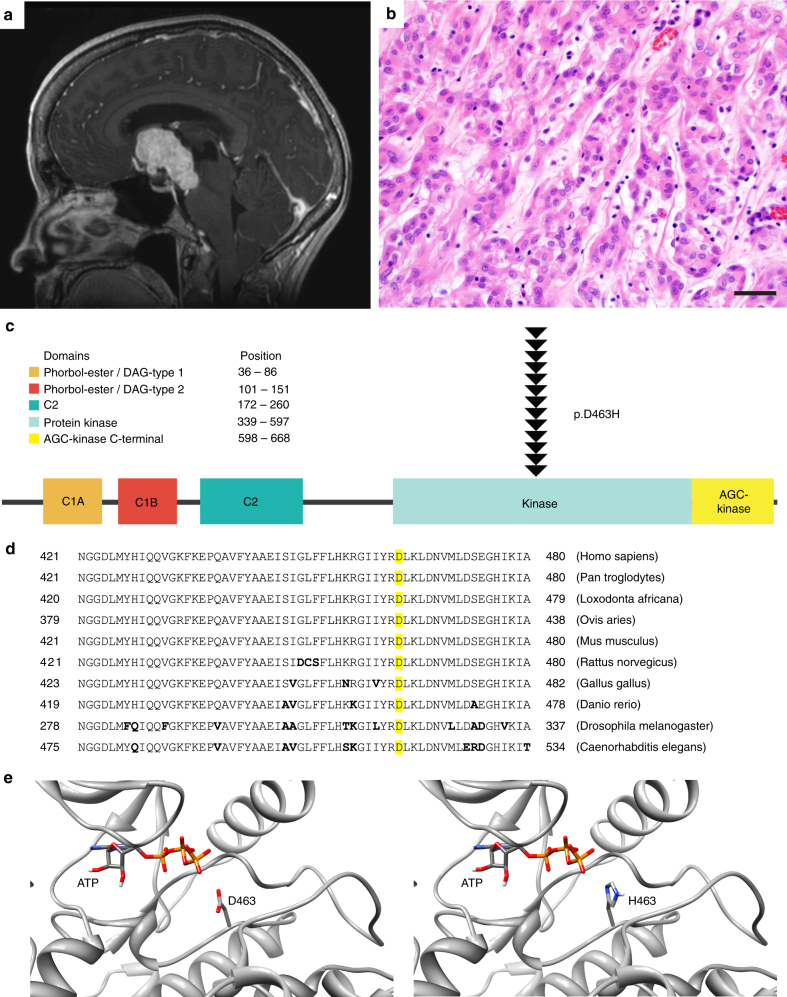
Fig. 1
Fig. 1
Chordoid glioma of the third ventricle is defined by PRKCA D463H mutation that localizes in the active site of the kinase domain in the encoded protein kinase C alpha (PKCα). a T1-weighted post-contrast magnetic resonance image of a chordoid glioma. b Hematoxylin and eosin stained section of a chordoid glioma. Scale bar, 40 μm. c Diagram of human PKCα with the location of the D463H mutation identified in each of the 13 chordoid gliomas shown. d Amino acid sequence for PKCα in the region of D463 (highlighted in yellow) demonstrating a high degree of conservation from Homo sapiens to C. elegans. e Structural model of the active site of the kinase domain for PKCα showing how the side chain of amino acid Asp463 sits within the ATP binding pocket, where it functions as a proton acceptor during the ATP hydrolysis reaction. Substitution of Asp with His at this codon (D463H) is structurally predicted to result in a side chain with a proton acceptor at nearly the same location, which may potentially alter kinase function through steric differences or ability of the side chains to be protonated or deprotonated based on differential proton affinities
Fig. 2
Fig. 2
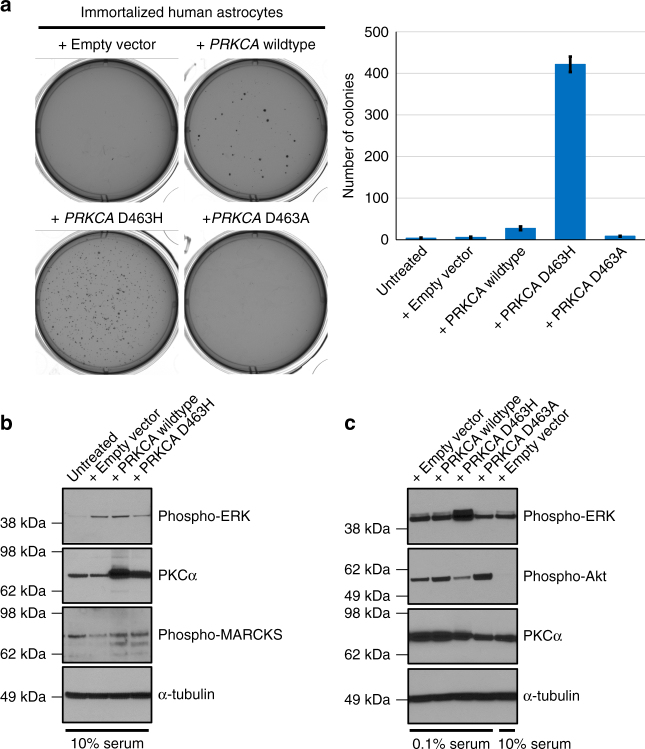
Mutant PRKCA induces ERK phosphorylation and is sufficient to drive anchorage-independent growth of immortalized human astrocytes. a Colony formation in soft agar of immortalized human astrocytes after infection with lentivirus expressing empty vector, wildtype PRKCA, D463H tumor mutant PRKCA, or D463A non-tumor mutant PRKCA. Images of representative wells (left) and quantitation of colony number per well (right) are shown. Error bars represent standard deviation from the mean of six replicates derived from two independent experiments performed in triplicate. b Western blots on total cell lysate from 293 T cells growing in 10% fetal bovine serum after transient transfection with empty vector, PRKCA wild-type, or PRKCA D463H mutant. c Western blots on immortalized human astrocytes after lentiviral transduction and then serum starvation for 24 h before collection of total cell lysate
Fig. 3
Fig. 3
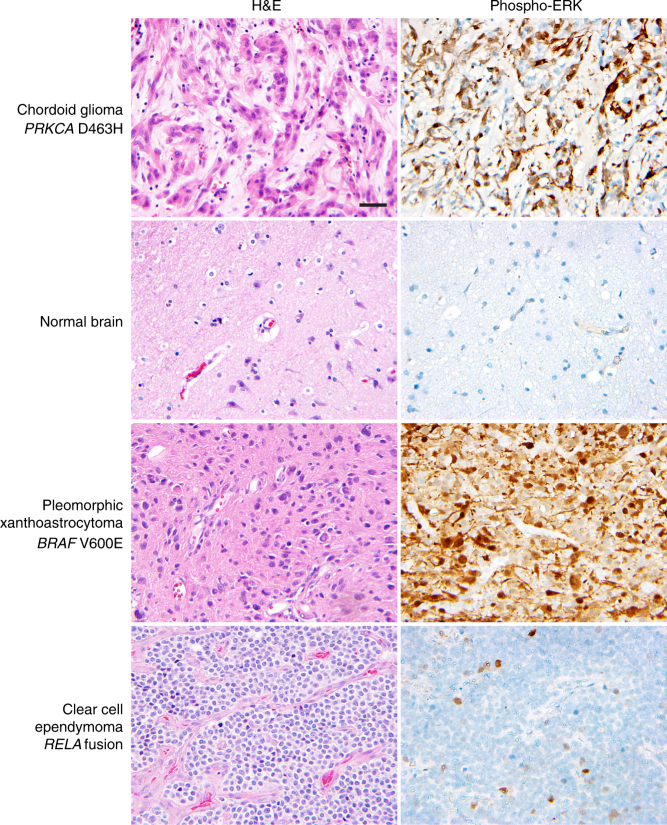
Chordoid gliomas demonstrate high levels of phospho-ERK, equivalent to levels seen in other glioma types harboring oncogenic alleles of Ras-Raf-MAP kinase pathway components. Shown are representative images of hematoxylin and eosin (H&E) staining and phospho-ERK immunohistochemistry on a chordoid glioma with PRKCA D463H mutation (CG-UVA-1), normal brain, pleomorphic xanthoastrocytoma with BRAF V600E mutation, and clear cell ependymoma with C11orf95-RELA gene fusion. Scale bar, 40 μm
Fig. 4
Fig. 4
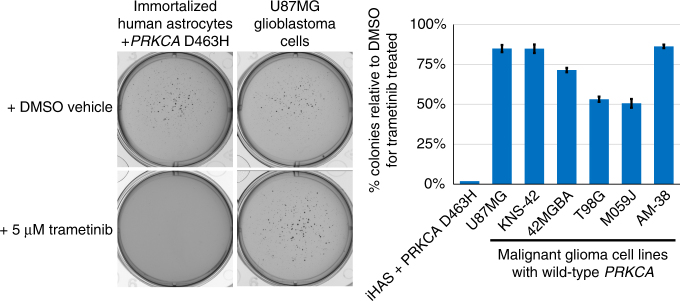
MEK inhibition is sufficient to block the oncogenic effects of mutant PRKCA. Colony formation in soft agar was assessed for immortalized human astrocytes transduced with D463H mutant PRKCA alongside multiple malignant glioma cell lines, all of which harbor wildtype PRKCA alleles. DMSO vehicle or 5 μM trametinib was added to the top agar layer during casting. Images of representative wells (left) and quantitation of the percent reduction in colony number of trametinib treated wells relative to DMSO-treated wells (right) are shown. Error bars represent standard deviation from the mean of six replicates derived from two independent experiments performed in triplicate

References

    1. Brat DJ, et al. Third ventricular chordoid glioma: a distinct clinicopathologic entity. J. Neuropathol. Exp. Neurol. 1998;57:283–290. doi: 10.1097/00005072-199803000-00009. - DOI - PubMed
    1. Reifenberger G, et al. Chordoid glioma of the third ventricle: immunohistochemical and molecular genetic characterization of a novel tumor entity. Brain Pathol. 1999;9:617–626. doi: 10.1111/j.1750-3639.1999.tb00543.x. - DOI - PMC - PubMed
    1. Pomper MG, Passe TJ, Burger PC, Scheithauer BW, Brat DJ. Chordoid glioma: a neoplasm unique to the hypothalamus and anterior third ventricle. Am. J. Neuroradiol. 2001;22:464–469. - PMC - PubMed
    1. Kurian KM, et al. Third ventricular chordoid glioma: clinicopathological study of two cases with evidence for a poor clinical outcome despite low grade histological features. Neuropathol. Appl. Neurobiol. 2005;31:354–361. doi: 10.1111/j.1365-2990.2005.00551.x. - DOI - PubMed
    1. Ampie L, et al. Prognostic factors for recurrence and complications in the surgical management of primary chordoid gliomas: a systematic review of literature. Clin. Neurol. Neurosurg. 2015;138:129–136. doi: 10.1016/j.clineuro.2015.08.011. - DOI - PMC - PubMed

Publication types

Substances