. 2018 Jun;12(7):1743-1757.
doi: 10.1038/s41396-018-0053-9. Epub 2018 Feb 23.

Mycoplasma-related endobacteria within Mortierellomycotina fungi: diversity, distribution and functional insights into their lifestyle

Affiliations

Mycoplasma-related endobacteria within Mortierellomycotina fungi: diversity, distribution and functional insights into their lifestyle

Alessandro Desirò et al. ISME J. 2018 Jun.

Abstract

Bacterial interactions with animals and plants have been examined for over a century; by contrast, the study of bacterial-fungal interactions has received less attention. Bacteria interact with fungi in diverse ways, and endobacteria that reside inside fungal cells represent the most intimate interaction. The most significant bacterial endosymbionts that have been studied are associated with Mucoromycota and include two main groups: Burkholderia-related and Mycoplasma-related endobacteria (MRE). Examples of Burkholderia-related endobacteria have been reported in the three Mucoromycota subphyla. By contrast, MRE have only been identified in Glomeromycotina and Mucoromycotina. This study aims to understand whether MRE dwell in Mortierellomycotina and, if so, to determine their impact on the fungal host. We carried out a large-scale screening of 394 Mortierellomycotina strains and employed a combination of microscopy, molecular phylogeny, next-generation sequencing and qPCR. We detected MRE in 12 strains. These endosymbionts represent novel bacterial phylotypes and show evidence of recombination. Their presence in Mortierellomycotina demonstrates that MRE occur within fungi across Mucoromycota and they may have lived in their common ancestor. We cured the fungus of its endosymbionts with antibiotics and observed improved biomass production in isogenic lines lacking MRE, demonstrating that these endobacteria impose some fitness costs to their fungal host. Here we provided the first functional insights into the lifestyle of MRE. Our findings indicate that MRE may be antagonistic to their fungal hosts, and adapted to a non-lethal parasitic lifestyle in the mycelium of Mucoromycota. However, context-dependent adaptive benefits to their host at minimal cost cannot not be excluded. Finally, we conclude that Mortierellomycotina represent attractive model organisms for exploring interactions between MRE and fungi.


Conflict of interest statement

The authors declare that they have no conflict of interest.

Figures

Fig. 1
Fig. 1
Phylogenetic placement of the 12 strains of Mortierellomycotina found to harbor MRE within the eight Mortierellomycotina phylogenetic groups (sensu [4]) based on 28S rRNA gene sequences. The 12 strains are spread across five Mortierellomycotina phylogenetic groups (groups 1, 2, 5, 6, 7) (sensu [4]) and within the additional phylogenetic group 8/Modicella group. The tree shows the topology obtained with the Bayesian method; branches with Bayesian posterior probabilities ≥0.95 are thickened and ML bootstrap support values ≥70 are shown. Sequences generated in this study are in bold and highlighted in gray
Fig. 2
Fig. 2
Phylogenetic placement of MRE identified in Mortierellomycotina based on 16S rRNA gene sequences. MRE from Mortierellomycotina cluster into three novel early-diverging clades within the monophyletic clade that encompasses Ca. Moeniiplasma glomeromycotorum and MRE from Endogonaceae. A single MRE 16S rDNA phylotype was obtained from each fungal strain. The tree shows the topology obtained with the Bayesian method; branches with Bayesian posterior probabilities ≥0.95 are thickened and ML bootstrap support values ≥70 are shown. Sequences generated in this study are in bold and highlighted in gray
Fig. 3
Fig. 3
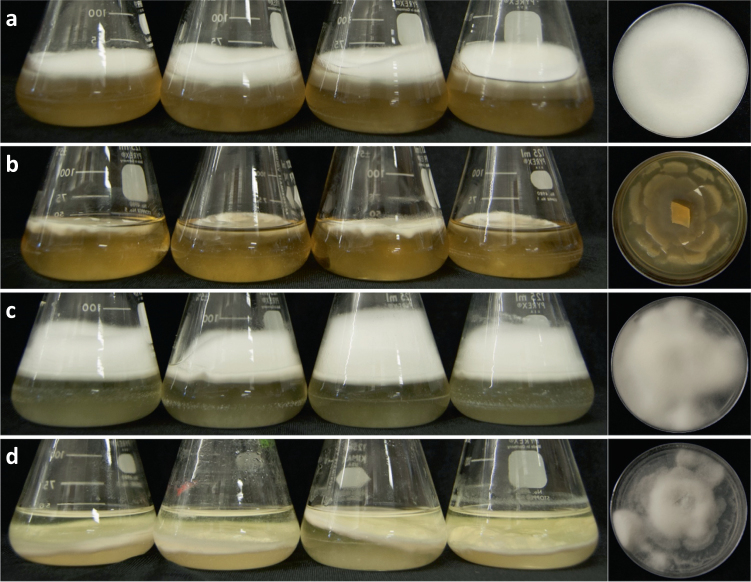
Mortierella elongata NVP80 cured a, c and wild-type b, d lines grown in ME+YE broth and agar plates a, b and PD broth and PD+YE agar plates c, d. The cured line shows greater biomass production and more aerial hyphae than the wild-type line
Fig. 4
Fig. 4
Mean dry weight (mg) values of M. elongata NVP80 cured (CU) and wild-type (WT) lines grown at different temperature conditions. Bars represent the mean (4 replicates) ± standard deviation. Lowercase letters represent Tukey honestly significant differences after ANOVA at P ≤ 0.05
Fig. 5
Fig. 5
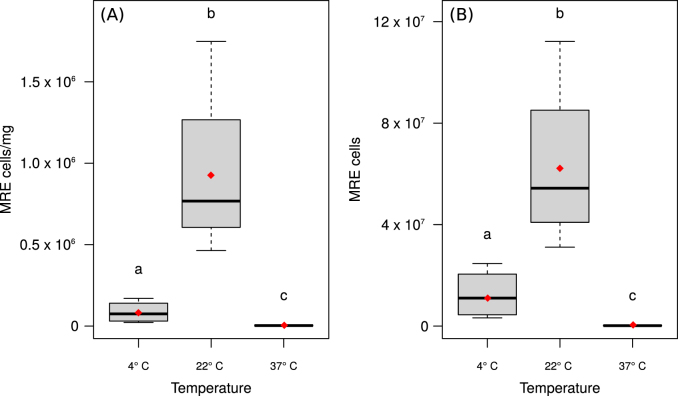
Distribution of the relative (cells per mg) a and absolute b number of MRE cells within the mycelium of M. elongata NVP80 grown at different temperatures. Boxplots summarize minimum, first quartile, median, third quartile, and maximum values of the data distribution. Mean values (red diamond) are also shown. Lowercase letters represent Mann–Whitney significant differences after Kruskal–Wallis test at P ≤ 0.05
Fig. 6
Fig. 6
Mean dry weight (mg) values of M. elongata NVP80 cured (CU) and wild-type (WT) lines grown in different rich a and poor b media types. Bars represent the mean (4 replicates) ± standard deviation. Lowercase letters represent Mann–Whitney significant differences after Kruskal–Wallis test at P ≤ 0.05
Fig. 7
Fig. 7
Distribution of the relative (cells per mg) a and absolute b number of MRE cells within the mycelium of M. elongata NVP80 grown in different media types. Boxplots summarize minimum, first quartile, median, third quartile, and maximum values of the data distribution. Mean values (red diamond) are also shown. Lowercase letters represent Mann–Whitney significant differences after Kruskal–Wallis test at P ≤ 0.05
Fig. 8
Fig. 8
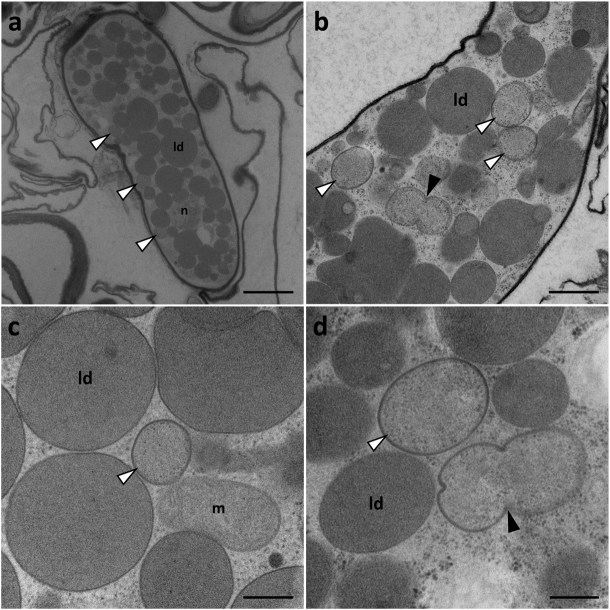
Transmission electron micrographs of MRE in the mycelium of M. humilis AD092. ad Coccoid MRE cells (white arrowhead) are directly embedded in the fungal cytoplasm, where bacteria undergoing cell division were frequently observed (black arrowhead). MRE are in close proximity of lipid droplets (ld) that are abundant in hyphae of M. humilis. c, d Similar to Ca. Moeniiplasma glomeromycotorum, a thin homogeneous electron-dense layer is visible outside the bacterial cell membrane. Mitochondrion (m); nucleus (n); Scale bars, a 2 µm; b 0.59 µm; c 0.26 µm; d 0.25 µm

References

    1. Spatafora JW, Chang Y, Benny GL, Lazarus K, Smith ME, Berbee ML, et al. A phylum-level phylogenetic classification of zygomycete fungi based on genomescale data. Mycologia. 2016;108:1028–46. doi: 10.3852/16-042. - DOI - PMC - PubMed
    1. Benny GL, Smith ME, Kirk PM, Tretter ED, White MM. Challenges and future perspectives in the systematics of Kickxellomycotina, Mortierellomycotina, Mucoromycotina, and Zoopagomycotina. In: Li D-W, editor. Biology of microfungi. Switzerland: Springer International Publishing; 2016. p. 65–126.
    1. Nagy LG, Petkovits T, Kovács GM, Voigt K, Vágvölgyi C, Papp T. Where is the unseen fungal diversity hidden? A study of Mortierella reveals a large contribution of reference collections to the identification of fungal environmental sequences. New Phytol. 2011;191:789–94. doi: 10.1111/j.1469-8137.2011.03707.x. - DOI - PubMed
    1. Wagner L, Stielow B, Hoffmann K, Petkovits T, Papp T, Vágvölgyi C, et al. A comprehensive molecular phylogeny of the Mortierellales (Mortierellomycotina) based on nuclear ribosomal DNA. Persoonia. 2013;30:77–93. doi: 10.3767/003158513X666268. - DOI - PMC - PubMed
    1. Tedersoo L, Bahram M, Põlme S, Kõljalg U, Yorou NS, Wijesundera R, et al. Global diversity and geography of soil fungi. Science. 2014;346:1256688. doi: 10.1126/science.1256688. - DOI - PubMed

Publication types