. 2018 Jun;12(7):1729-1742.
doi: 10.1038/s41396-018-0077-1. Epub 2018 Feb 23.

Peatland Acidobacteria with a dissimilatory sulfur metabolism

Affiliations

Peatland Acidobacteria with a dissimilatory sulfur metabolism

Bela Hausmann et al. ISME J. 2018 Jun.

Abstract

Sulfur-cycling microorganisms impact organic matter decomposition in wetlands and consequently greenhouse gas emissions from these globally relevant environments. However, their identities and physiological properties are largely unknown. By applying a functional metagenomics approach to an acidic peatland, we recovered draft genomes of seven novel Acidobacteria species with the potential for dissimilatory sulfite (dsrAB, dsrC, dsrD, dsrN, dsrT, dsrMKJOP) or sulfate respiration (sat, aprBA, qmoABC plus dsr genes). Surprisingly, the genomes also encoded DsrL, which so far was only found in sulfur-oxidizing microorganisms. Metatranscriptome analysis demonstrated expression of acidobacterial sulfur-metabolism genes in native peat soil and their upregulation in diverse anoxic microcosms. This indicated an active sulfate respiration pathway, which, however, might also operate in reverse for dissimilatory sulfur oxidation or disproportionation as proposed for the sulfur-oxidizing Desulfurivibrio alkaliphilus. Acidobacteria that only harbored genes for sulfite reduction additionally encoded enzymes that liberate sulfite from organosulfonates, which suggested organic sulfur compounds as complementary energy sources. Further metabolic potentials included polysaccharide hydrolysis and sugar utilization, aerobic respiration, several fermentative capabilities, and hydrogen oxidation. Our findings extend both, the known physiological and genetic properties of Acidobacteria and the known taxonomic diversity of microorganisms with a DsrAB-based sulfur metabolism, and highlight new fundamental niches for facultative anaerobic Acidobacteria in wetlands based on exploitation of inorganic and organic sulfur molecules for energy conservation.


Conflict of interest statement

The authors declare that they have no conflict of interest.

Figures
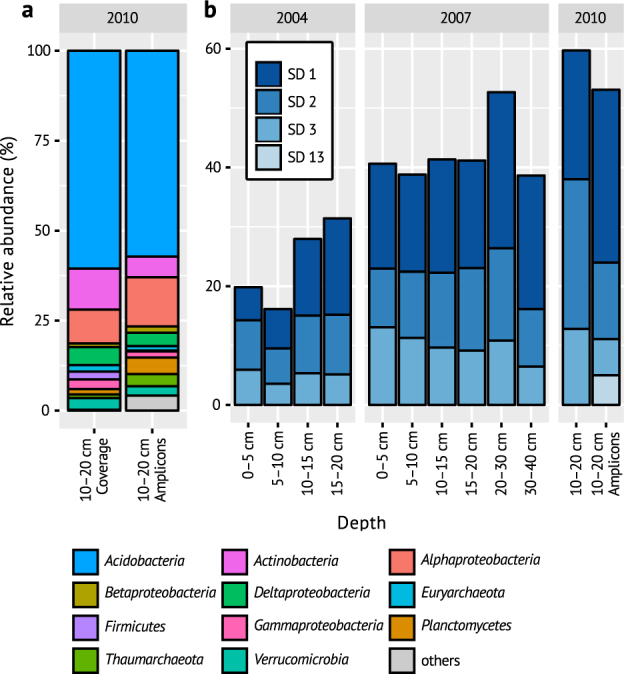
Fig. 1
Fig. 1
Microbial community composition in Schlöppnerbrunnen II peatland in samples from different years and soil depths. a Abundance of phyla and proteobacterial classes in the native soil (relative to all classified reads/amplicons). Taxa less abundant than 1% are grouped in grey. Coverage abundance is based on metagenomic reads mapped to classified scaffolds. Amplicon abundance is based on rrn operon-copy number-corrected abundance of 16S rRNA gene operational taxonomic units [9]. b Relative abundance of acidobacterial subdivisions (SD) in the native soil samples as determined by 16S rRNA gene qPCR assays. In addition, all subdivisions more abundant than 1% in a 16S rRNA gene amplicon dataset are shown [9]
Fig. 2
Fig. 2
Organization of dissimilatory sulfur metabolism genes on acidobacterial MAGs SbA1–7. Red: sat; orange: aprBA, qmoABC; green: dsrABCMKJOPM2K2; blue: dsrD; turquoise: dsrL; violet: dsrNVWa; pink: suyAB, comC, slcC; 1–4 (grey): syntenic genes encoding for conserved proteins of unknown function; white: genes of unknown function or not involved in sulfur metabolism. In SbA2 all genes are on one scaffold (scaffold 0lkb). Gene fragments at contig borders are indicated by an asterisk. aprB in SbA6, indicated by two asterisks, is truncated, which indicates a pseudogene or is due to an assembly error. Scaffolds are separated by two slashes
Fig. 3
Fig. 3
Metabolic model as inferred from analysis of acidobacterial MAGs SbA1–7. Sulfur metabolism is highlighted in yellow. Enzymes and transporters are shown in blue font. Glycoside hydrolases are shown in pink font (Supplementary Table S2). Extracellular compounds are in parentheses. A slash (/) indicates isozymes, i.e., enzymes that perform the same function, but are distinctly different or have more than one established name. AcdA+B, MaeB+Pta, MeaB+Mce, Tal+Pgi: bifunctional fusion genes/proteins. Otherwise the plus sign (+) indicates protein complexes. TCA: tricarboxylic acid cycle, FDH: formate dehydrogenase, Hase: hydrogenase, NDH: NADH dehydrogenase, HCO: haem-copper oxidase, TO: terminal oxidase, KDG: 2-dehydro-3-deoxy-D-gluconate, KDGP: 2-dehydro-3-deoxy-D-gluconate 6-phosphate. Expression of at least one copy of every enzyme and transporter was observed in the incubation samples
Fig. 4
Fig. 4
Glycoside hydrolase genes are enriched in acidobacterial genomes/MAGs compared to genomes from other taxa that encode DsrA/DsrB. DsrAB-containing MAGs SbA1–7 are shown as solid symbols and numbered accordingly. X-axis shows the total number of predicted CDS per genome/MAG
Fig. 5
Fig. 5
Putative lifestyles of DsrAB-encoding Acidobacteria

References

    1. Wasmund K, Mußmann M, Loy A. The life sulfuric: microbial ecology of sulfur cycling in marine sediments. Environ Microbiol Rep. 2017;9:323–44. - PMC - PubMed
    1. Meyer B, Imhoff JF, Kuever J. Molecular analysis of the distribution and phylogeny of the soxB gene among sulfur-oxidizing bacteria: evolution of the Sox sulfur oxidation enzyme system. Environ Microbiol. 2007;9:2957–77. - PubMed
    1. Müller AL, Kjeldsen KU, Rattei T, Pester M, Loy A. Phylogenetic and environmental diversity of DsrAB-type dissimilatory (bi)sulfite reductases. ISME J. 2015;9:1152–65. - PMC - PubMed
    1. Watanabe T, Kojima H, Fukui M. Identity of major sulfur-cycle prokaryotes in freshwater lake ecosystems revealed by a comprehensive phylogenetic study of the dissimilatory adenylylsulfate reductase. Sci Rep. 2016;6:36262. - PMC - PubMed
    1. Pester M, Knorr KH, Friedrich MW, Wagner M, Loy A. Sulfate-reducing microorganisms in wetlands – fameless actors in carbon cycling and climate change. Front Microbiol. 2012;3:72. - PMC - PubMed

Publication types
